
News
Aflao hospital under investigation after woman was left to die as nurses refused MoMo payment

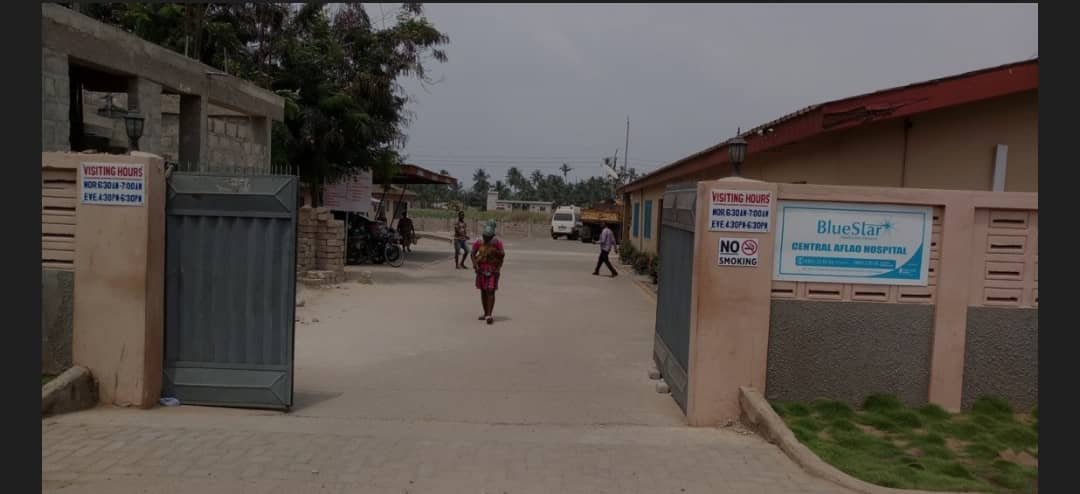
The Medical and Dental Council have begun investigations into an incident at the Central Aflao Hospital in the Ketu South Municipality of the Volta Region where two nurses of the facility were alleged to have refused to treat a patient in a critical condition, unless cash was deposited, leading to her death.
The two nurses have since been released for investigations after the family of the deceased, Linda Adua, 39, petitioned the president, the Minister of Health, the Ghana Health Service and the Medical and Dental Council.
The Volta Regional Health Director, Dr. Senanu Djokoto confirmed the incident to Citi News and noted that internal investigations have begun and the report will be made available in a few days.
Background
According to the family of the deceased, several pleas of the sick woman and her 19-year-old son could not convince the nurses to accept mobile money payment for her treatment, leaving the patient unattended until she passed away.
The Medical and Dental Council and the Ghana Health Service (GHS) have swiftly responded to the petition and dispatched a team of investigators to the hospital to probe the matter.
Dr Gabrielle Kojo, the Medical Director of the Aflao Central Hospital, also known as Nkansah Hospital, confirmed to the Daily Graphic that a team from the GHS was in the hospital to investigate the matter.
“The police have summoned us to release the nurses involved for interrogation on the matter, which we have done,” he said.
Dr Makafui Dagbasu, the Medical Director of the Ketu South Municipal Hospital, the main referral centre of the municipality, also confirmed that the hospital was currently being investigated over the subject.
Abigail Adua, an elder sister of the deceased, told the Daily Graphic that at a point when Linda appeared to have died, the hospital directed the son to take her to a government facility where she was pronounced dead on arrival.
Linda, who is yet to be buried, lived with her only son in Aflao, where she operated a restaurant.
“Much as we appreciate the work and dedication to duty of health professionals, we think that there are some bad lots among them in the hospitals and clinics, whose actions and inaction are denting the image of the medical and nursing professions and need to be brought to order to sanitise the system,” Ms Adua said.
She said Linda’s son, Jerry Nii Tetteh, had just gained admission to pursue a degree programme at the Kwame Nkrumah University of Science and Technology (KNUST), and was now left alone and traumatised as his reliable source of support and friend was gone.
Abigail said on April 11 this year, Linda asked her son to accompany her to the hospital because she was not feeling too well.
“They reached the hospital around 4:05 a.m., and were met by two nurses on duty, who requested that they made a deposit of GH¢400 before she would be attended to,” Abigail narrated.
She said Linda offered to pay through mobile money transfer, but the nurses said electronic transfers were against the hospital’s policy, insisting that Tetteh should go out of the hospital to look for a mobile money merchant to withdraw cash for the payment.
“My sister pleaded with the nurses to take the MoMo and attend to her because it was too early in the morning to find a merchant to withdraw the money, but they refused,” she said.
Plea
She said Linda’s son later “had to walk from the hospital to Avoeme Junction before getting a motorbike to take him to the Aflao Border, about two kilometres from the hospital, in search of a mobile money merchant.
“All this while, Linda remained seated in a wheelchair in the outpatient department (OPD) unattended to by the nurses. No details of the complaints were recorded, and her vitals were also not taken except her name which was recorded in the patient register at the OPD,” she added.
The son found no merchant to facilitate the cash withdrawal, she said.
Linda, meanwhile, complained of difficulty in breathing and pleaded with the nurses to put her on oxygen.
“One of the nurses retorted that she was disturbing them as she scanned her phone,” she said.
She said Linda, who had been wheeled to a ward, asked the son to assist her to the washroom, but she fell on the way.
“It was at that point that another patient in the ward, who witnessed the whole incident, rushed out to inform the nurses about what had happened.
“The nurse, apparently sensing danger, told Linda’s son to get a taxi and take her to the Ketu South Municipal Hospital as her situation was beyond their capacity,” she said.
Confused and helpless
Abigail said the son rushed to get the taxi as his mother remained motionless, and by the time he got back to the hospital with the taxi, the mother had been put on a stretcher, and wheeled from the ward to the entrance of the hospital.
She said the nurses asked the young man to sit in the taxi as they pushed the motionless body of his mother into the taxi, with her head resting on his laps and instructed him to take her to the Ketu South Municipal Hospital without a referral note or an accompanying officer.
“Just upon arrival at the Ketu South Municipal Hospital, Linda was pronounced dead by the medical staff who said they were sure she had died several minutes before being brought to their facility at about 7:40 a.m,” she said.
Abigail said when the news of the incident reached the family, they reached out to the management of the Central Aflao Hospital to understand what Linda’s son had narrated to them.
Source: Citi Newsroom with background from the Daily Graphic


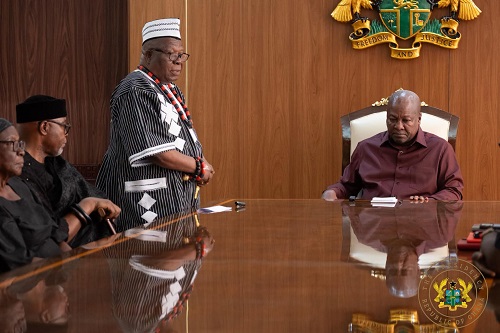
The family of Ambassador James Victor Gbeho, a distinguished statesman and diplomat, has paid a courtesy call on President John Dramani Mahama. They officially informed him of his passing.
The delegation, representing the Gbeho family, noted that it was culturally and diplomatically important to formally notify the President of the loss before making a public announcement of his death.
Ambassador Gbeho was a towering figure in Ghanaian and international politics. He served in many diplomatic missions, including New York. He was Ghana’s Minister for Foreign Affairs, a Member of Parliament for the Anlo constituency, and President (formerly Executive Secretary) of the ECOWAS Commission.
He was widely respected for his role in regional integration and his contributions to global diplomacy at the United Nations.
President Mahama expressed his condolences and shared reflections on Ambassador Gbeho’s contributions to the country, West Africa and the world.
Funeral details will be announced later.

The Minister for the Interior, Muntaka Mohammed-Mubarak, has revoked all firearm permits in Ghana with immediate effect and announced a new registration process for all gun owners.
The minister made the announcement on Tuesday, June 23, at the information service department saying all individuals who currently hold licences to own firearms or sidearms must undergo a fresh registration process.
“From this afternoon, all permits that have been granted to any individual that you are holding a sidearm or firearm is hereby revoked,” Mr Muntaka said.
He explained that the government had identified gaps in the country’s firearm registration system and needed to introduce stricter measures to improve public safety.
“We are opening the window where everyone will have to come forward again to register or re-register the gun because we’ve changed the procedure,” he stated.
According to him, the government decided not to wait until the end of the year to make the changes because lives could still be saved within the next six months.
The Interior Minister said one of the new requirements would be mandatory mental health screening for applicants seeking firearm licences.
“We’ve seen that people with mental health have already gone through and have the sidearm. Now we are introducing mental health. Before we give you the sidearm, we have to be sure that you have the mental stability to hold the firearms,” he said.
Mr Muntaka also announced that applicants would be required to undergo drug tests before being granted licences.
“We’ve also realised that people who are on drugs are also holding their arms and they are legitimate because it’s been registered. Now you have to go through drug tests to be sure that you are not on drugs before you can hold sidearms,” he added.
The minister said the new measures form part of efforts by the government to tighten firearm control and prevent legally registered weapons from falling into the wrong hands.
He urged all firearm owners to cooperate with the new registration process once details of the exercise are announced.
By: Jacob Aggrey

 News1 week ago
NFS, AACMA raise GH¢300K for new fire tender
- News5 days ago
FSD Africa, others launch Green Project Preparation Facility to unlock investment in climate infrastructure in Ghana
- News1 week ago
CSA urges Universities to strengthen cybersecurity following university of Nottingham cyber-attack


