Editorial
WASSCE results heart-warming!

In view of the importance of education within the context of the huge sums of money government has spent on the Free Senior High School (SHS), it is heartwarming to note that the West African Senior School Certificate Examination (WASSCE) performance has been the best since 2015, according to West African Examination Council report.
It is also gratifying that the students have not disappointed their parents and the people of Ghana, repaying the trust for the heavy investment made in their education.
It is clear that the candidates have put up a gleaming performance, especially, when the current management of education did not place any “cut-off point” on grades Basic Education Certificate Examination (BECE) candidates must obtain to pursue SHS education.
In previous years, aggregate 30 was fixed as the cut-off point. This shows that when given the chance and provided with the requisite support, as many students as possible can perform well in exams.
The performance has been improved greatly because of the numerous interventions rolled out by government. To begin with, the Free Senior High School (SHS) policy, removed obstacles such as school fees and this gave them the peace of mind to concentrate on their studies.
Again, the supply of free core text books to every student as well as free uniforms to both day and boarding students also contributed positively to their good performance.
Ghanaians are aware of the special training organised for Science and Mathematics tutors together with the provision of the Chief Examiner’s Report to schools to serve as a guide for the students.
All these helped to bring improvement in the performance of the students.
The Spectator is happy about this development and urges the government to continue with this policy of comprehensive support for education – not only for the core subjects, but for the non-core subjects so that there will be continuous improvement in the years ahead.
The percentage of candidates who obtained A1 to C6 in the core subjects constituted more than 50 per cent. In English language, the percentage score was 57.34 per cent in 2020, while Integrated Science in the same year, is 52.53 per cent.
Similarly, percentage score in Mathematics is 65.71 per cent, while it is 64.31 per cent in Social Studies. This shows that the average performance of the candidates for this year is the best compared with results within the past six years.
We will continue to urge our students not to rest on their oars but study harder so as to perform better in the years ahead.
The Spectator also congratulates all teaching and non-teaching staff as well as Headmasters and management of our schools on their hard work and appeal to them to continue the good work so that as a country, Ghana can place itself higher on the educational ladder.
Similarly, The Spectator lauds government on the good work done in supporting education in the manner it has done.
We doff our hats off for all those who have helped to promote this positive agenda.



Dear Editor,
The performance of the Black Stars of Ghana has plunged the entire nation into a joyful mood.
Very few people gave the team any chance at the World Cup but with the little they have shown, Ghanaians have shown massive support.
All the two matches they have played with England and Panama have been characterized by unending joy after the games.
Apart from the team’s performance, the theme song by Ghana’s ace musician, Kofi Kinata have taken the celebration to a new dimension.
The song resonates through every corner both match and non-match days. And when they are played through the large speakers, it gets both young and old dancing their hearts out.
This is a mood I wish Ghanaians would sustain for a long time to keep the unity and friendship among us. Within this period, politics have been relegated to the background and football dominating the discussion. This is what football can do, let’s keep it growing. For the Black Stars, we say ‘Ayekoo.’
Mawuli Quaye,
Accra
Dear Editor,
I have, over time, observed the growing practice of drying washed clothes on the pavements of some principal streets in Accra, as well as on the grassy medians of major roads.
This practice is often carried out by individuals who have made these public spaces their place of abode.
As a country that seeks to maintain a clean, orderly, and beautiful environment, I believe it is time for the government, through the relevant local authorities, to address this issue.
The use of pavements and road medians for drying clothes undermines efforts to promote cleanliness and urban beautification.
Furthermore, this situation could negatively affect Ghana’s tourism industry. Tourists who visit our country do not only come to see historical landmarks and tourist attractions; they also pay attention to the cleanliness, organization, and general appearance of our streets and public spaces.
The sight of clothes hanging on pavements and road medians creates an impression that is inconsistent with the image of a modern and welcoming city.
Equally disturbing is the practice of bathing children on road medians and street pavements. Apart from raising concerns about public hygiene and safety, such activities diminish the dignity and proper use of these public spaces.
As a concerned citizen, I believe that if we are truly committed to keeping our cities clean, attractive, and conducive to tourism and investment, then we must take decisive action.
Local authorities should enforce existing bylaws and regulations governing the use of public spaces and implement measures to prevent such practices.
By doing so, we can preserve the beauty of our cities and project a positive image of Ghana to both residents and visitors alike.
Kojo K,
Madina

 News1 week ago
FSD Africa, others launch Green Project Preparation Facility to unlock investment in climate infrastructure in Ghana
- News1 week ago
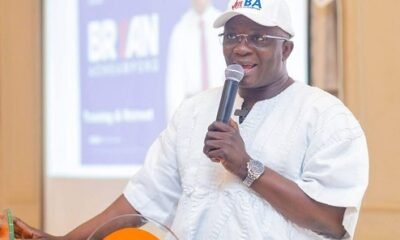
Bryan Acheampong calls for unity, urges Kennedy Agyapong to support Dr. Bawumia
- News1 week ago
Merck Foundation holds 13th Africa Asia Luminary with 12 First Ladies to advance healthcare capacity across Africa and Asia