Gender
Trained but jobless …the human cost of Ghana’s skills mismatch


ALONG the busy corridors of the George Walker Bush highway, in Accra, 26-year old Nana Akua Afriyie arranges her beautiful sewn African print dresses on mannequins in front of her shop, hoping to attract buyers.
She trained in fashion design at a Technical and Vocational Education and Training (TVET) school in the Ashanti Region and graduated with high expectations. But three years on, she admits the journey has been tough.
“Everywhere I go, they tell me the same thing -they already have enough fashion designers,” Akua said with a wry smile.
“I wish I had studied something like agro-processing or Information Communication Technology (ICT), because that is where the jobs seem to be.”
Her story is not unique. Across Ghana, TVET graduates are struggling to find work, even as employers complain about difficulties in hiring people with the right skills.
This paradox lies at the heart of a new study commissioned by United Nations Children’s Fund (UNICEF) Ghana in partnership with the Government of Ghana, which has revealed deep structural gaps in the TVET system.
Oversupply and
shortages
The study, conducted across 57 pre-tertiary public and private TVET institutions, found a sharp mismatch between the skills offered in schools and the skills demanded on the labour market.
Only one out of the 57 schools offers training in agriculture which is a dominant driver of Ghana economy. This is despite employers reporting a rising need for skilled workers in agro-processing and agricultural technology.
The situation in ICT is only slightly better. Although the digital economy is growing rapidly, just four TVET institutions provide ICT-related training.
By contrast, trades like fashion design and garment-making are oversupplied. Almost every TVET institution offers them, leading to a glut of graduates competing in a saturated field.
Kwame Bediako, who runs a medium-sized agro-processing company in Ejisu, says the imbalance is hurting businesses. “We need young people who understand modern farming, post-harvest handling, and agro-processing.
But the schools are not training them. Instead, every year, we see hundreds of fashion and hairdressing graduates with no jobs waiting for them,” he told this paper.
Employment gap
Beyond the mismatch of trades, the study also uncovered a “perception gap” between employers and graduates.
Employers surveyed consistently reported that TVET graduates lacked adequate practical exposure and soft skills such as teamwork, communication, and problem-solving. Yet when students were interviewed, many expressed confidence in their preparedness for the job market.
“It’s like we are speaking two different languages,” said a construction contractor in Kumasi who took part in the survey.
“We advertise for masons or welders, and applicants come with certificates but cannot deliver basic tasks on-site. Meanwhile, they believe they are fully qualified. It is frustrating for everyone.”
This gap highlights a deeper issue: the way TVET outcomes are measured.
While many institutions prioritise exams and certification, employers value real-world performance, adaptability, and reliability – qualities directly tied to the targets of Sustainable Development Goal (SDG) eight which seeks to achieve decent work and economic growth.
Infrastructure
under strain
The introduction of free TVET education in Ghana has been hailed as a bold step to expand access and empower more young people with employable skills. But the surge in enrollment has placed immense pressure on schools.
Workshops, classrooms, and training equipment are overstretched, making it difficult for instructors to deliver effective Competency-Based Training (CBT) – a method designed to give students practical, hands-on skills.
At one TVET school visited during the study, a single welding machine was being shared by more than 30 students, drastically limiting practice time.
“We are trying, but the resources are just not enough,” admitted an instructor who asked not to be named.
Interestingly, the study noted that private TVET institutions recorded higher CBT accreditation levels than their public counterparts, but both sectors face similar challenges of inadequate infrastructure and outdated equipment – a challenge that reflects the urgency of SDG nine: Industry, Innovation, and Infrastructure.
Ghana’s demographic
dividend at risk
With a youthful population, Ghana is one of several African countries projected to benefit from a demographic dividend – the economic growth that can result when a large share of the population is of working age.
But UNICEF warns that this opportunity may slip away if young people are not adequately prepared for the job market. High unemployment, job insecurity, and limited opportunities are already major concerns.
“TVET is a powerful pathway to equip young people with relevant skills,” the report stated. “But unless curricula, training, and infrastructure are aligned with industry needs, Ghana risks losing the benefits of its demographic advantage – and missing its commitments under SDG four: Quality Education.”
Workplace experience:
A partial fix
One of the ways schools have tried to bridge the skills gap is through Workplace Experience Learning (WEL) – placing students in companies for internships or apprenticeships.
While many employers support this, some expressed concerns about the risks involved. “It is costly to supervise students who come for training, and sometimes they slow down productivity,” said an ICT firm manager in Kumasi. “But we do it because we know the system needs it.”
Recommendations
and the way forward
The study made several recommendations to address the skills mismatch. Its suggested curriculum alignment. It called on schools to update curricula to reflect the skills industries need, especially in agriculture, ICT, and construction.
Also UNICEF urged schools to inculcate soft skills in TVET training, infrastructure investment and build stronger partnerships.
UNICEF called for a collective effort involving government, private sector, development partners, and communities to ensure that TVET fulfils its role as a driver of sustainable economic growth.
For Akua, the fashion graduate, the lack of opportunities has been discouraging. Yet she remains hopeful. “If I had the chance to retrain in ICT or food processing, I would do it. I don’t want to just sit at home,” she said.
Her words echo the aspirations of thousands of Ghanaian youth – ambitious, energetic, and eager to contribute, but often trapped by systemic shortcomings in education and training.
By Esinam Jemima Kuatsinu
Join our WhatsApp Channel now!
https://whatsapp.com/channel/0029VbBElzjInlqHhl1aTU27

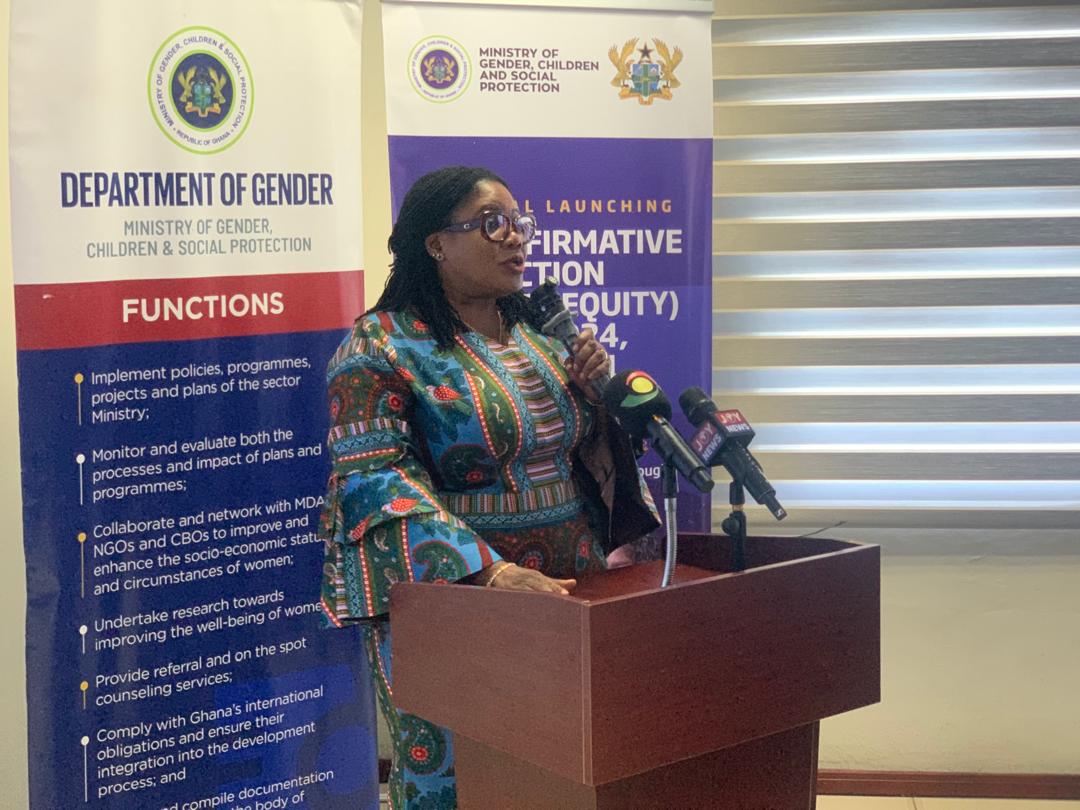
Gender equality should not be left to women alone, but requires the active participation of men and other stakeholders, the Minister for Gender, Children and Social Protection, Dr Agnes Naa Momo Lartey, has said.
She said gender equality was a national development issue and not a matter concerning only women, stressing that both men and women had important roles to play in creating an inclusive society.
Dr Lartey said this last Thursday in Accra at a capacity workshop on the implementation of the Affirmative Action (Gender Equity) Act, 2024.
The workshop was aimed at helping journalists understand the provisions of the Act, strengthen their capacity to communicate gender equity issues and promote accurate, balance reporting on the implementation of the Act.
Ghana could not achieve meaningful development if one section of society was excluded from participating fully in leadership, decision-making and other areas of national development.
“It is not about a group of people. It is not about one of the sexes. It is about the nation. It is about the country,” she said.
She called for stronger commitment to translating the Affirmative Action (Gender Equity) Act, 2024 (Act 1121), into practical action to improve women’s participation in leadership and decision-making.
She said the passage of the law should not be considered the end of the process, but rather the beginning of deliberate efforts to ensure that its objectives were achieved.
Dr Lartey said increasing the number of women in leadership was important, but their participation must also have a meaningful impact on national development.
“We want it to count,” she stressed, calling for practical initiatives that would move the affirmative action agenda from policy to implementation.
The Executive Director of Women, Media and Change (WOMEC), Dr Charity Binka, also urged the media to play a critical role in ensuring the effective implementation of the Act.
She said Ghana had taken an important step by passing the law after 13 years of efforts, but the real test was its implementation.
According to Dr Binka, the Act requires 30 per cent representation of women in leadership and decision-making by 2026, rising to 50 per cent by 2030.
She urged the media to inform the public about the law, monitor institutions’ compliance and challenge stereotypes that undermine women’s leadership.
Dr Binka urged journalists to ensure institutions were complying with requirements, including Gender Equity Policies, Compliance Certificates and annual reports.
She said affirmative action was not about replacing merit with gender, but addressing structural barriers that had historically limited qualified women’s opportunities to participate and lead.
She called for stronger collaboration among government, civil society, traditional and religious leaders, the private sector, the media and other stakeholders to turn the law into measurable results for women and girls.
By Esinam Jemima Kuatsinu
The United Nations has warned, that Gender equality is “woefully off track.”
At the current rate of progress, gender equality would take 171 years to achieve, the UN’s Gender Snapshot report said.
The number of countries with a woman as head of state or government has increased from 2020 to 2026. “Yet six in seven countries are still led by men.
Women’s representation in national cabinets declined to 22.4 per cent in 2026, after peaking at 23.3 per cent in 2024,” the report said. “The decline is a warning sign that gains cannot be taken for granted, and that progress towards equal political power remains fragile.”
Funding for gender equality has fallen to its lowest level since 2021, the report found. At the same time, 42 per cent of UN agencies reported that their efforts to promote gender equality had been weakened, as a result of budget cuts.
Millions of women also continued to endure some extremely severe forms of violence and discrimination across the globe, the UN said. Nearly one in five girls is married before the age of 18, and nearly one in three women globally have survived partner or sexual violence in their lifetime.
In the past year, 316 million women experienced physical or sexual violence by an intimate partner, the report said.
UN Under-Secretary-General for Economic and Social Affairs, Li Junhua, said the statistics were not inevitable. “It is the result of choices, made visible through data. Investing in gender equality, institutions, and the statistical systems that hold them to account is not a cost. It is the fastest route back to the 2030 Agenda’s promise of equal power for all.”-GNA
SKIP THE QUEUE, TAP THE NEWS
You can now read the Ghanaian Times and The Spectator newspapers from the comfort of your device via TimesNewsPlus.
Join our WhatsApp Channel: https://whatsapp.com/channel/0029VbBElzjInlqHhl1aTU27