Features
A dilemma called Ghana (Part 4)


- /home/u249204778/domains/spectator.com.gh/public_html/wp-content/plugins/mvp-social-buttons/mvp-social-buttons.php on line 27
https://spectator.com.gh/wp-content/uploads/2023/06/Crest-Pix-1.png&description=A dilemma called Ghana (Part 4)', 'pinterestShare', 'width=750,height=350'); return false;" title="Pin This Post">
- Share
- Tweet /home/u249204778/domains/spectator.com.gh/public_html/wp-content/plugins/mvp-social-buttons/mvp-social-buttons.php on line 72
https://spectator.com.gh/wp-content/uploads/2023/06/Crest-Pix-1.png&description=A dilemma called Ghana (Part 4)', 'pinterestShare', 'width=750,height=350'); return false;" title="Pin This Post">
Ghana’s coat of arms
In this penultimate edition of my five-part series on the above topic, I seek to discuss the road to what has become wrongly termed the Fourth Republic. I make this assertion because Ghana has never been re-colonised since our independence on March 6, 1957, and our republican status in 1960.
I will look at certain landmarks since the 31st December Revolution that brought Jerry Rawlings back into the saddle, this time with a Provisional National Defence Council (PNDC) that ruled for eleven years.
I was on a short holiday in Ghana when 31st December happened and I went through the hassle of chasing an exit permit to be able to fly out of the country. That period saw the harshest hamarttan season I have ever witnessed.
Once again, many Ghanaians supported the return of Rawlings since the PNP administration was bickering within itself instead of focussing on governance. Workers Defence Committees (WDC) and People’s Defence Committees (PDC) were set up to uphold and ensure probity and accountability with revolutionary fervour.
These committees were later to merge as Committees for the Defence of the Revolution (CDR). The CDR were empowered to adjudicate and resolve certain petty litigations. Public Tribunals were set up to fast track legal matters since the courts were considered too slow with justice delivery.
But the Revolution was roundly condemned in the Western media. Nigerian media were vociferous in their condemnation of the situation in Ghana. Their stance was to shift later in 1982, when Rawlings attended an ECOWAS meeting in Lagos. As part of his closing remarks, Rawlings said something to the effect that their deliberations would be meaningless if the conference was just a forum for drinking wine and photo ops and no action was taken.
By that delivery, Rawlings became the darling of the Nigerian media. And that respect has been there to date. No wonder Nigerians kept saying that if we did not want Rawlings, we should send him to them.
However, that country was to deport over a million and a half Ghanaians in 1983. I was reporting on the harrowing experience the deportees were facing in various suburbs of Lagos for the media organisation I was an intern with in that country. Many lost their belongings or gave them away at ridiculously low prices. Some others ran back to Ghana with vehicles belonging to their bosses.
Our compatriots came home to a country that was suffering a devastating drought and bush fires with virtually no food to feed the masses. But the PNDC marshalled a team to get the returnees settled. The National Mobilisation Programme was set up, and that became a rallying point for disaster management.
The Programme was to settle the returnees within 90 days. It later set up Mobisquads that engaged in replanting cocoa plantations burnt by wildfires on a voluntary basis. They were in every corner of the country, helping farmers, and food production was on the mend.
The PNDC encouraged women’s participation in the decision making process. The 31st December Women’s Movement idea, which was originally mooted by the likes of Mrs. Nicol, Cecilia Johnson, Sherry Ayittey, and others, became concretised and put women empowerment on a high pedestal under the presidency of Nana Konadu Agyemang-Rawlings, wife of Jerry Rawlings.
Rawlings’ charisma and bonding with the people were the rallying points for the national drive to change the direction of governance where the people owned their decisions. But dissent was growing both at home and abroad. As the pressure gathered momentum, the PNDC set up a National Commission for Democracy to collect and collate views on the way forward for the country.
The verdict was that Ghana needed a return to constitutional democracy. As a result, a consultative assembly was elected to draft a constitution that was put to the people in a referendum for approval. The 1992 Constitution was, therefore, overwhelmingly endorsed by Ghanaians.
The fact that constitutional democracy was being restored did not mean the PNDC was a failure. Road infrastructure, schools, health facilities, and some industries were improved to appreciable levels, thanks to Rawlings’ personal hands-on approach to leadership. Professionalism was injected into the Armed Forces, which to a large extent won them the respect they had lost under the SMC regimes.
Many political parties sprang up for Election 1992. The actors of the PNDC formed the National Democratic Congress (NDC), Nkrumah’s CPP was splintered into many parties and the Progress Party became the New Patriotic Party (NPP). Rawlings won the presidential election as the NDC candidate against the NPP’s Prof. Albert Adu Boahen. Not satisfied with the result, the NPP boycotted the parliamentary vote.
The NDC again won the general elections in 1996 with the NPP entering Parliament this time. Constitutional democracy was working for Ghana. With this came many structural reforms in education, the judiciary, commerce, and health delivery.
The revolutionary verve was receding as government policies were scrutinised and dissected by the opposition and the media. Though Rawlings’s charisma was intact, democratic protocols impeded his free-spirited leadership style. Ordinary people’s access to him was restricted. Though he found a way to break protocol occasionally, it was very few and far between.
Election 2000 saw the NPP win under the leadership of Mr. John Agyekum Kufuor. The campaign was toxic, with the NPP accusing the NDC of corruption and lacking the economic savvy to continue in power. The NDC, on the other hand, pointed to the political antecedents of the tribalistic divisiveness of the NPP.
The NPP declared Ghana a highly indebted poor country (HIPC), a situation that made lending countries forgive the country’s debts. It allowed for more inflows of cash and grants. The cedi was re-denominated with three zeroes yanked off. A thousand cedis then became One Ghana Cedi. It is instructive that even today, some Ghanaians refer to the cedi in the old terms. A hundred cedis is still One Million, isn’t it?
Professor John Evans Atta Mills, the NDC candidate and who was Rawlings’ Vice President, took the electoral loss in stride and bided his time. He lost again to Kufuor in 2004. With campaign messages of corruption and nepotism against the Kufuor administration, the NDC took the electoral fight to the NPP.=
The HIPC idea had lost steam, and the government took the country out of the programme and began a new journey into the international borrowing market. Prof. John Evans Atta Mills, with John Dramani Mahama as running mate, won Election 2008 against the NPP’s Nana Addo Dankwa Akufo-Addo.
I recall a private chat he had with me after I interviewed him at the NDC congress at the University of Ghana in 2006. Prof. Mills told me why he wanted to be president. He said, “My brother, as humans, we must abhor greed and selfishness in public office. Birds sing without seeking an audience. Flowers give out fragrances, asking for nothing in return. Trees take carbon dioxide and give us oxygen, but only humans have the propensity to cheat nature and their fellow humans. This must stop.”
Prof. Mills epitomised what the import of his chat with me portrayed throughout his time as President. A deeply religious man, he did not shy away from holding occasional prayer sessions at the presidency, to the chagrin of the opposition. He was visibly furious with state institutions whose staff condoned acts of corruption.
In spite of his health concerns, Atta Mills was on top of national issues until his sudden death on July 24, 2012, at age 68. I was in New York when my daughter called to inform me. At JFK that evening, other passengers on our flight to Accra got to know as I was discussing the sad situation with a classmate of the late President.
John Dramani Mahama was to be sworn in as President that evening in accordance with constitutional provisions.
By Dr Akofa K. Segbefia
Writer’s email address:
akofa45@yahoo.com


There is a scripture that is found in Matthew 6:22 which says that the lamp of the body is the eye and therefore the eye must see well to enable the body to get to its destination.
What most people do not know is that behind the scenes, there is a strong interaction between the eyes and the brain before a picture becomes clear. The state of mind therefore is crucial to the eye seeing clearly to enable the body to process accurately the information the eyes are feeding it for proper identification of what the eyes see.
This is similar to how a person behaves i.e. what informs the decisions that forms in the mind that results in the actions that a person performs. The actions of a person does not therefore just happen but is as a result of things that went on in the mind, which in most cases resulted from information passed on to it by the eyes either consciously or unconsciously.
There are so many issues that affect our society which makes one wonder, whether the people who displayed such acts were created by someone or something other than God.
How can a person see a beach created by God with beautiful beaches and fresh air blowing all around, decides to defecate at such places, and therefore desecrate the environment? lt is simply mind boggling?
When other people in other countries who dwell on the coast are using their beaches for tourist attraction purposes as a means of livelihood and also to promote environmental health, some people living around our beaches, have turned them into rubbish dumping sites and toilets.
It is a very sad situation and the earlier we did something about it the better. It is a national emergency that must engage the attention, first of the government and then the citizenry, where religious bodies and NGOs must play a critical role.
The things we focus on in this country, needs to be addressed. Our minds which processes the info the eyes send to the brain, must be disciplined. There are certain behaviours that a disciplined mind can ignore even when the eye has provided info to the brain. One of the things a disciplined mind does, is the avoidance of a second look, which is critical for every person who wants to avoid adultery or fornication.
Once a person is not blind, he will see things. The boobs, the ‘shankus’, the coca cola shapes, the light complexioned, the dark complexioned etc. the eyes will definitely see and report same to the brain. What the brain or the mind decides to do or instructs the eye to do is the issue.
It can decide to instruct the eye to take a second look and let the mind drool over it or say ignore it and that will be the end.
If the mind becomes trained to focus on environmental issues like clean environment, the eyes will automatically be reporting on insanitary conditions to the brain as and when it sees them. The mind will pay attention to such data and begin to process them and to identify solutions to deal with the reported insanitary conditions.
There is the need to encourage citizens to train the mind to focus on the right thing so that in tandem with the eyes, focus will be maintained. When the mind is so trained, it communicates with the eye to also focus on hood things that helps in both are spiritual life and our secular lives, for indeed the eyes are the lamp of the body. God bless.
THE relationship between New Times Corporation (NTC) and African Concrete Productions (ACP) is based entirely on matters of the stomach. Each depends on the other in a dietary symbiosis, reinforced by the close proximity of each other
At lunchtime, you’d see a particular set of Times workers marching regimentally to ACP to face the wall. You’d think they are soldiers. It has long been declared that the company manufactures the best kokonte in the Greater Accra Region. ACP is, therefore, a culinary haven for those NTC kokonte fans, both male and female.
As the NTC kokonte warriors cross the border to ACP, you’d see some ACP banku fanatics dancing joyously to NTC. They are lucky folks because they do not have to obtain visa to enter into ‘Times’ to attack the balls of banku with precision and accuracy. They also claim that the lightsoup at ‘Times’ is arguably the best in West Africa.
So the relationship between the two entities was quite cordial and based practically on stomach palaver, until ACP workers staged an industrial revolution, whereupon the managing director, accountant and estate manager were allegedly stripped naked and locked up in a room. An insurgency had began in earnest.
An ACP worker came to ‘Times’, this time not to eat banku and okro. He had come to inform newsmen that juicy stuff awaited them at ACP. It could make a front page lead story.
A camerawoman and a female reporter were accordingly dispatched to go and bring back news, juicy news as juicy as kokonte and groundnut soup.
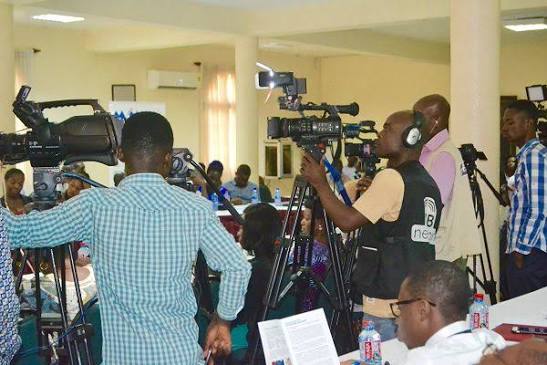
I was driving to work when I espied the familiar camerawoman clicking away outside the ACP premises. I didn’t see any ‘Times’ reporter but angry workers who were on the verge of getting violent. I slowed down and the driver behind blew his horn at me like a lunatic. I drove on.
Later, I heard the reporter and camerawoman were harassed and brutalised. The report came,. “The camerawoman, Mrs Salome Adonu-Agbottah and reporter Mrs Doreen Allotey, in an attempt to retrieve the camera which the workers had seized from them were severely beaten. They were manhandled and almost pushed into a big gutter opposite the company’s premises.
BRUISES
“….The camerawoman had bruises on her body, her hand bag was destroyed and the money in it stolen. Mrs Allotey’s watch was also snatched and her feet stamped on.”
Luckily, it was not her nose that was trampled upon. She has a beautiful nose.
The bad news was received with extreme sorrow. If the victims had been men, it would not have seemed too bad. But to brutalise women is just unacceptable. The New Times Corporation has not stopped mourning the incident which has been condemned in many circles.
Some people keep asking me why Times sent females to cover a potentially violent demonstration. I tell them they might as well ask why CNN’s amazon, Christina Amanpour, is assigned to cover the carnage in Bosnia-Herzegovina and Rwanda. She is always on the frontline in jeans and jacket.
Journalism is a potentially hazardous profession, and once you accept to study and practise the trade, you might as well bone up to face any assignment as long as your superiors feel you are capable of handling it or you have demonstrated the capacity to handle it. Both males and females can be assigned anywhere, anytime just like policemen and women are assigned.
The only difference between cops and pressmen is that the latter are armed only with a pen and the former with a gun. The question is should newsmen also arm themselves so that in any event of an assault they would not be found wanting in self-defence? They can’t adequately defend themselves with a pen and a jotter. A pen cannot even disfigure an opponent’s upper lip.
Photo-journalists have particularly suffered violence. Spectator ace-cameraman Vincent Dzatse was severely assaulted by AMA men when he attempted to take pictures of their indiscretions.
Sports cameraman, P. K. Arthur has been beaten more than once at the sports stadium when riots errupted and he wanted to capture it on his lenses.
Some sports journalists have been banned from entering the Accra Sports Stadium by supporters because in their comments, they didn’t write “sense”. Some supporters once nearly lynched Christian Abbew, Spectator Sports Editor, near a courtroom. He was stoned like the biblical Stephen. He had gone to defend a contempt charge.
I think it is time journalists met and discussed how best to defend themselves in any event of an attack by individuals or mobs. In the pursuance of their duty, they must be free from harassment and assault.
Some journalists go to work and return home with a black-eye or a double fore-head. It is just not right. Something has to be done about it. I think journalists should be armed. But first we must be trained in the use of firearms so that our warning shot do not hit below the belt. What about training in Kung Fu?
This article was first published on Saturday, October 17, 1998.