Features
Africans are their own enemies (Part 2)

- /home/u249204778/domains/spectator.com.gh/public_html/wp-content/plugins/mvp-social-buttons/mvp-social-buttons.php on line 27
Warning: Trying to access array offset on false in /home/u249204778/domains/spectator.com.gh/public_html/wp-content/plugins/mvp-social-buttons/mvp-social-buttons.php on line 27
&description=Africans are their own enemies (Part 2)', 'pinterestShare', 'width=750,height=350'); return false;" title="Pin This Post">
- Share
- Tweet /home/u249204778/domains/spectator.com.gh/public_html/wp-content/plugins/mvp-social-buttons/mvp-social-buttons.php on line 72
Warning: Trying to access array offset on false in /home/u249204778/domains/spectator.com.gh/public_html/wp-content/plugins/mvp-social-buttons/mvp-social-buttons.php on line 72
&description=Africans are their own enemies (Part 2)', 'pinterestShare', 'width=750,height=350'); return false;" title="Pin This Post">
“A man’s enemies are those of his own household,” so the Bible says inMicah 7:6. Last week, we validated this with the treachery of top Ghanaian military and police officers in conniving with the CIA to depose Ghana’s first president, Osagyefo Dr. Kwame Nkrumah.
This week, the case of the Congolese nationalist, Patrice Lumumba whose compatriots cruelly backstabbed him buttresses the point.
They unashamedly connived with their oppressors to chase Lumumba out of office and assassinate him barely three months after gaining independence for them, depriving Africa of a gem of a leader.
He was a journalist and a poet but above all he was a freedom fighter like Nkrumah, in fact one of Nkrumah’s protégés.
He emerged when his country, then known as Belgian Congo, had suffered decades of oppressive colonial rule foisted on them by King Leopold II of Belgium in 1885 at the onset of the scramble for Africa.
The king did not only commandeer the Congo as his private property, but also enslaved and brutalised the natives, killing millions.
Those who failed to meet their quota of rubber harvest had their hands amputated.
Unwilling to submit to the regime of injustice, oppression and exploitation, Lumumba formed a political pressure group in 1958 at the age of 33 to agitate for change.
Even though he was from a minority tribe and very young, his charisma and courage attracted many heavyweights from the bigger ethnic groups to his cause.
They launched the Congolese National Movement, (Mouvement National Congolais), MNC, the first really all-Congolese political party.
In contrast, his two principal rivals, Joseph Kasavubu and MoiseTshombe, hailed from large, powerful, ethnic groups with political parties that were regional in character.
But they controlled large swathes of land populous enough to threaten Lumumba and his party despite its national character.
The same year he formed his party, Lumumba whose fame was growing with lightning speed, was invited by Dr. Nkrumah to the All-African People’s Conference in Accra held a year after securing independence for Ghana against all odds.
After independence, Dr. Nkrumah declared that Ghana’s freedom was meaningless unless it was linked up with the total liberation of Africa.
The conference, was therefore, convened to galvanise the rest of Africa to liberate themselves from the shackles of colonialism.
Two years after the summit, following mounting pressure on Belgium, France and the United Kingdom, they consented, albeit grudgingly, to demands by the colonies for multi-party elections.
As many as 26 African countries including the Congo and most francophone colonies, gained independence.
The MNC won a sizeable majority mandating it to form a government, with Lumumba becoming the first Prime Minister at 35 years.
Kasavubu was elected ceremonial president implying that the radical, leftist Lumumba, was more powerful to the dislike of the Belgians and their Western allies, especially the US.
Like his mentor, his speeches were alarmingly fiery, sharply stinging, fearlessly uncompromising, brutally sincere, and unnervingly electrifying.
The best is the one he gave on June 30, 1960, the day the Congo was granted its independence.
That day, King Boudewijn, the last Belgian king over the Congo, added insult to injury when he said the Congolese had been granted independence because his country’s project to civilise them had been accomplished. What?
As if the Belgians had done the Congo any favour by returning their stolen freedom to them, Kasavubu docilely thanked them for independence.
But Lumumba could not stomach the nonsense and vehemently protested, exposing the savagery of the Belgians vis-à-vis their claims of civilisation.
He stressed that independence had resulted from a relentless fight and not from the magnanimity of the Belgians. Among other things, he said:
“Although, this independence of the Congo is being proclaimed today by agreement with Belgium, … no Congolese will ever forget that independence was won in struggle, a persevering and inspired struggle, carried on from day to day, a struggle, in which we were undaunted by privation or suffering and stinted neither strength nor blood.
“It was filled with tears, fire, and blood. We are deeply proud of our struggle because it was just and noble and indispensable in putting an end to the humiliating bondage forced upon us.
“That was our lot for the eighty years of colonial rule and our wounds are too fresh and much too painful to be forgotten.
“We have experienced forced labour in exchange for pay that did not allow us to satisfy our hunger, to clothe ourselves, to have decent lodgings or to bring up our children as dearly loved ones.
“Morning, noon, and night we were subjected to jeers, insults, and blows because we were Negroes. … Our lot was worse than death itself.
“Who will ever forget the shootings which killed so many of our brothers, or the cells into which were mercilessly thrown those who no longer wished to submit to the … oppression used by the colonialists as a tool of their domination?
“All that, my brothers, brought us untold suffering. But we, who were elected by the votes of your representatives … to guide our native land, we, who have suffered in body and soul from colonial oppression, we tell you that henceforth, all that is finished with.
“We shall show the world what the black man can do when working in liberty, and we shall make the Congo the pride of Africa.
“I ask you all to sink your tribal quarrels: they weaken us and may cause us to be despised abroad.
“I ask you all not to shrink from any sacrifice for the sake of ensuring the success of our grand undertaking.
Like Nkrumah, he concluded that his country’s independence was a decisive step towards the liberation of the whole of Africa.
To the West, that speech meant a declaration of war. His candour was too piercing and humiliating for Belgium and its allies, especially the US.
To their chagrin, a firebrand like Nkrumah, or even more radical freedom fighter had emerged, threatening their interests.
He must be eliminated, dead or alive. How? Look for the enemies within and use them.
They enlisted Kasavubu and Tshombe, as well as Joseph Desire Mobutu, a 31-year-old army officer whom Lumumba had made his personal assistant.
Lumumba’s call for unity to develop the Congo fell on deaf ears. For almost immediately after independence, some units of the army mutinied against their Belgian officers, demanding improved service conditions and an indigenous hierarchy.
Tshombe used the ensuing confusion as pretext to lead the mineral-rich Katanga province to secede. Another province, Kasai, also broke away, leaving the Congo fragmented and fragile.
Belgium sent in troops, ostensibly, to protect its nationals, but in reality, to reinforce the secessionist regimes of Katanga and Kasai where they landed.
In line with their “divide and rule” tactic, the West backed Kasavubu and Tshombe’s push for regional autonomy against Lumumba’s moves to unify the country.
The embattled Prime Minister, called for help from the US unaware that the Americans were after him. Even his appeal to the UN proved futile,
While Lumumba was trying his best to save the situation, Kasavubu declared him dismissed from office. He retaliated, saying he had removed Kasavubu.
With the UN forces and the Belgians backing the rebels, Lumumba appealed to the Soviet Union for support to help his troops to quell the revolt, a move that alarmed Belgium, and its allies.
In the confusion, Mobutu staged a coup, not to reinstate the Prime Minister but to assassinate him with the connivance of the US and Belgium.
While under house arrest by rebel soldiers of Katanga and Belgian forces, Lumumba escaped, intending to flee to an area controlled by his forces.
But the Belgians and troops loyal to Mobutu, with the help of the CIA, hunted for him and murdered him and two of his aides in cold blood for no crime.
Mobutu ordered a mafia-style execution, looking on callously as they were shot, and their bodies hacked to pieces before being dissolved in acid.
That was on January 17, 1960, barely seven months after Lumumba gained independence for his country.
A Belgian officer who supervised the killings, took one of Lumumba’s teeth as a trophy to his country.
In June this year, after more than six decades, Belgium returned the tooth for burial after apologising for the atrocity meted out to Lumumba.
Mobutu became one of the worst despots in world history. He ruled for 32 years, killed a countless number of his compatriots like King Leopold did, and impoverished millions while he stashed away the country’s wealth in numerous personal foreign accounts.
As long as he remained a puppet of the West and did their bidding, they looked on unconcerned while the Congolese people languished in abject misery.
His country has never since found its feet.
By Tony Prempeh
Contact:
teepeejubilee@yahoo.com

Features
Confronting newborn abandonment in Ghana: When a cry for help is heard in a dustbin – Part 2

The root causes: It is never just one reason
My years of counselling at CPAC show me abandonment is rarely an act of malice. It is the tragic endpoint of seven overwhelming distresses:
1. Severe maternal mental illness —The hidden emergency
a) Clinical Postpartum Depression (PPD): This is far beyond “baby blues.” It is a severe mood disorder that can appear weeks to months after birth. Due to a massive drop in hormones, extreme sleep deprivation, and emotional exhaustion, the mother feels deep sadness, worthlessness, and complete emotional numbness towards her baby. Picture: A new mother sits by her bed all day, staring blankly. Her baby cries for hours, but she cannot lift her hands to carry the baby. She whispers, “This baby would be better off without me.” She does not hate the baby; she feels she has completely failed as a mother.
b) Peripartum Psychosis (Postpartum Psychosis): This is a psychiatric emergency. Rare but extremely dangerous, appearing suddenly within the first 2-3 weeks after delivery. The mother completely loses touch with reality. She hears commanding voices telling her to abandon the baby, or believes the baby is possessed by an evil spirit or is a “spirit child” who will bring a curse. Picture: A mother genuinely believes she heard a voice saying, “Leave this child at the crossroads at midnight or your family will die.” She abandons the baby not out of hatred, but because her broken mind believes she is obeying a higher spiritual order to save her family.
c) Pre-existing untreated Schizophrenia: This is a chronic, severe mental disorder that existed before the pregnancy. The stress of pregnancy and labour shatters her fragile coping. She suffers from paranoid delusions — believing people want to poison her and the baby — flat affect (zero facial expression), and grossly disorganised thinking, making it impossible to plan how to feed or clean a baby. Picture: A young woman whose family called her illness “spiritual attack” instead of taking her for medication wanders away after delivery, completely forgetting she even gave birth, leaving the infant behind.
2. Extreme socio-economic deprivation: For many girls in some parts of Ghana such as Kasoa, Madina, or Bekwai, poverty is not a statistic; it is a daily panic. No money for antenatal care, no money for hospital delivery, no money for baby diapers or formula. When a mother cannot feed herself, the thought of feeding another mouth feels impossible. Some mothers say, “I left her where someone richer would find her, because I could not watch her starve to death in my hands.” It is a distorted act of survival.
3. Intense societal stigma and shame: In Ghana, pregnancy outside marriage, teenage pregnancy, or pregnancy from rape can bring extreme family rejection. The girl is called “spoilt,” beaten, banned from church, or sacked from school. The fear of bringing shame to the family name is heavier than the fear of police. So she hides the pregnancy for 9 months, delivers alone, and abandons in secret to protect her family’s “honour.”
4. Paternal abandonment — The Man Who Ran Away: Behind almost every abandoned baby is a man who vanished. He says, “It is not mine,” or “Abort it,” and switches off his phone. The mother is left utterly isolated — no emotional, financial, or social support. She is criminalised alone, but the abandonment started with him. Psychological research shows paternal denial is one of the strongest predictors of maternal panic and newborn abandonment.
5. Substance abuse disorders: Alcohol, tramadol, and other drug addiction impair the brain’s executive functioning — the ability to plan, judge consequences, and process emotions. A mother struggling with addiction may give birth in a highly intoxicated or withdrawal state, unable to comprehend the needs of the newborn, leading to neglect and eventual abandonment.
6. The spirit child cultural phenomenon and superstition: In some remote pockets of Northern Ghana and even in few parts of Central and Ashanti regions, public health research shows babies born with congenital deformities, severe disabilities, or whose mothers die in childbirth are branded as “spirit children” or cursed. In extreme instances, families, under cultural pressure, mandate that such babies be exposed or abandoned at shrines or bushes. This is not mental illness, but a harmful cultural belief system that still kills.
The invisible wounds
On the baby: Risk of death from hypothermia, sepsis, and infection. Survivors suffer Anaclitic Depression and Failure to Thrive due to lack of touch. As adults, they battle Reactive Attachment Disorder, chronic mistrust, and identity crisis — “Why did my mother leave me in a dustbin?”
On the mother: Lifelong hidden grief, intense guilt, chronic PTSD, depression, and elevated suicide risk. A prison cell does not heal this.
On the nation: Overburdened orphanages like Osu Children’s Home, draining health budgets, and overworked Social Welfare officers.
SKIP THE QUEUE, TAP THE NEWS

You can now read the Ghanaian Times and The Spectator newspapers from the comfort of your device via TimesNewsPlus.
Join our WhatsApp Channel: https://whatsapp.com/channel/0029VbBElzjInlqHhl1aTU27
“There is no one righteous, not even one; there is no one who understands; no one seeks God. But now a righteousness from God, apart from law, has been made known, to which the Law and the Prophets testify. This righteousness from God comes through faith in Jesus Christ, to all who believe. For there is no difference; – Rom. 3:10, 21-22. (NIV)
Introduction
Dictionaries define righteousness as “behavior that is morally justifiable or right.” Such behavior is characterized by accepted standards of morality, justice, virtue, or uprightness. The Bible’s standard of human righteousness is God’s own perfection in every attribute, every attitude, every behavior, and every word. Thus, God’s laws, as given in the Bible, both describe His own character and constitute the plumb line by which He measures human righteousness.
The bad news is that true and perfect righteousness is not possible for man to attain on his own; the standard is simply too high. The good news is that true righteousness is possible for mankind, but only through the cleansing of sin by Jesus Christ and the indwelling of the Holy Spirit. We have no ability to achieve righteousness in and of ourselves. But Christians possess the righteousness of Christ, because “ For He made Him who knew no sin to be sin for us, that we might become the righteousness of God in Him.” – 2 Corinthians 5:21. This is an amazing truth. On the cross, Jesus exchanged our sin for His perfect righteousness so that we can one day stand before God and He will see not our sin, but the holy righteousness of the Lord Jesus.
Establishing our hearts in righteousness
“Keep your heart with all diligence, for out of it spring the issues of life” – Proverbs 4:23
According to the above verse in Proverbs, our heart is the source of our life. Our life flows from our heart. The Holy Spirit resides in the spirit of the born again Christian. So there is a strong influence of the Holy Spirit in the heart of the new-born Christian. But our heart is also comprised of our soul. As Christians we can choose to focus our soul on the Lord, or on evil things. If we focus on corrupt, immoral, and evil things our heart will be affected detrimentally. It will cause our heart to be crooked or wicked, instead of straight or righteous. So the Scripture says to keep, or guard, our heart. It is wise to protect our heart as what we allow to dominate our heart will inevitably become the fruit, or influence the outcome, of our lives.
One way to approach life is to continually ask the question, “How will this decision or action affect my heart?” Everything we do, every thought we entertain, everything we watch, read, or listen to, shapes our heart. Therefore, the future prosperity of our life will flow from how well we care for our heart.
Think of everything you do, every moment of time, as a seed. We have been given responsibility for choosing which seeds to plant in our heart. What will you grow in the garden of your heart? What seeds will you choose? Our heart is our garden, and our life is the fruit of our garden. So next time you are tempted to dwell on a bad thought, think, “Do I want this seed to grow and manifest in my life?” Next time you are tempted to indulge in a sinful action ask yourself, “Do I want the extension, or fruit, of this sinful action to be what I am known for?”
God gives us the freedom to plant whatever we like in our garden. God loves us regardless of the good or bad choices we may make in our lives. You may be reaping the fruit of some poor choices right now. And God is still saying, “I love you.” But He has wise advice for us; He desires we have a good life. He says, “Guard you heart with all diligence.” This Hebrew word translated ‘diligence’ conveys the meanings of: prison and guard (ibid). A superintendant of a prison is very particular as to what goes in and out of his prison. A prison has very tight security. Just as a superintendant watches over his prison, so we should also supervise our heart (our lives). We should exercise meticulous security with regards to what enters into our heart. Actually, even what comes out of it, as the Scripture says, “ Wherefore, my beloved brethren, let every man be swift to hear, slow to speak, slow to wrath” – James 1:19, as “For out of the abundance of the heart the mouth speaks.” –Matthew 12:34b.
If what goes into, and what comes out of, our heart determines the success of our lives, what is the first important principle to establish in our heart? “In righteousness you shall be established;” – Isaiah 54:14
Righteousness is the key foundational truth we need to first establish in our heart. Jesus said, “But seek first the kingdom of God and His righteousness, and all these things shall be added to you.” –Matthew 6:33. Notice Jesus said, “His righteousness”, not our own righteousness. We have to seek and understand God’s righteousness. Isaiah 54:14 says, “Their righteousness is of me, saith the Lord.” God’s righteousness comes from God, not from within us. Humans cannot make themselves God’s righteousness, as all humans have sinned and are therefore inferior to God. God’s righteousness is a gift from God: “ For He made Him who knew no sin to be sin for us, that we might become the righteousness of God in Him.” – 2 Corinthians 5:21
Righteousness, or right standing with God, has been attained for us through the exchange Jesus made on our behalf. Jesus took our sin and gave us His righteousness. God’s righteousness is imparted to us when we are made a new creature in Christ – 2 Corinthians 5:17. This righteousness is a gift from God and undeserved by us: “For if by the one man’s offense death reigned through the one, much more those who receive abundance of grace and of the gift of righteousness will reign in life through the One, Jesus Christ.”- Romans 5:17
Through our faith in Jesus’ blood, shed to remit our sins – Romans 3:25, God imparts righteousness to us by His grace. We actually become a new righteous creation, fully identifying in Jesus’ death, burial, resurrection and ascension. This is the foundational miracle we need to understand and have established in our heart. All the other miraculous promises of God come the same way, by God’s grace through faith. Righteousness must be established in our heart for us to truly have faith to receive our rich inheritance in Christ. Jesus has been made unto us righteousness (1 Corinthians 1:30). We are now “For all the promises of God in Him are Yes, and in Him Amen, to the glory of God through us”. – 2 Corinthians 1:20
Establishing our minds in righteousness
God expects that, when we accept Jesus Christ as our Lord and Savior, we will be radically changed. In Romans 12:2 He tells us, And do not be conformed to this world, but be transformed by the renewing of your mind,
This transformation is to be a metamorphosis, of a magnitude at least comparable to that by which a caterpillar becomes a butterfly. He expects us to become totally different.
Scripture uses many different images to express the change that should occur: We become “a new creation; old things have passed away; behold, all things have become new.“ – 2 Cor 5:17. It is almost as if we become a new species. Scripture speaks of the “first Adam” who was earthly and fell into sin, and the “second Adam” (Jesus Christ) who was sinless and holy – Rom. 5:12-19; 1 Cor 15:44-49.
We are “made new in the attitude of our minds” – Eph. 4:23.
We “put off our old self” and “put on the new self” – Eph. 4:22,24; Col 3:9-10.
We “live by the Spirit” and not by the flesh – Gal. 5:16; Rom 8:13.
We become “instruments of righteousness” rather than “instruments of wickedness” – Rom. 6:13.
Each of these metaphors, in a different way, emphasizes the magnitude of the change that is expected. Each is dramatic and astonishing in itself; their cumulative effect is even more powerful. We are talking about a tremendous transformation. It should be visible to others, but its internal effect should be far greater than what others can perceive.
The goal of this transformation
What is the goal of this metamorphosis? Scripture states it in a number of different ways, which overlap and can be seen as different ways of expressing the same basic concept. Scripture often does this, because our minds are inadequate to comprehend, and our language inadequate to express, the full scope of God’s revelation to us.
To be continued!
Stay blessed!
For further inquiries please contact us on Tel Nos. 0243588467 or 0268130615
Email: saltnlightministries@gmail.com
Website: saltandlightministriesgh.org
SKIP THE QUEUE, TAP THE NEWS
You can now read the Ghanaian Times and The Spectator newspapers from the comfort of your device via TimesNewsPlus.
Join our WhatsApp Channel: https://whatsapp.com/channel/0029VbBElzjInlqHhl1aTU27

 Entertainment1 week ago
Rhythms On Da Runway returns November 28 with 16th edition themed ‘Unbound’
- Entertainment1 week ago
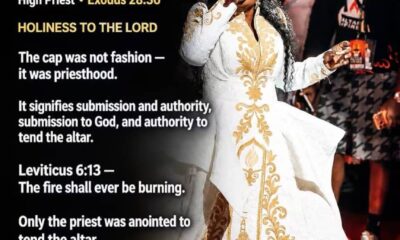
Ohemaa Mercy’s Tehillah Experience outfit was priestly regalia, not costume – Management clarifies
 News1 week ago
Janet Asana Nabla criticises Mahama over China curriculum controversy involving Haruna Iddrisu