Hot!
70 years of photography …Keta through the lenses of self-taught master cameraman, FK Tagbor


Frank Kodzovi Tagbor, is a self-taught photographer who started photography as a hobby whilst still in elementary (now basic) school.
When he finished Standard 7 (today’s BECE) in 1952, after a couple of years at Anlo State School having spent most of his schooling years at Dzelukope RC School, he started professional photography from the Tagbor family home at Ashigame, Dzelukope.
His was what would be called today a ‘table-top’ enterprise as his studio was a table with the legs covered with cloth serving as his ‘dark room’ where he developed and printed the photos.

At 92, FK Tagbor, looking back with nostalgia, says today’s photography is no ‘work’, as it does not involve much creativity, with all the latest technological developments and modern gadgets in use.
Background
FK Tagbor, was born on January 13, 1930, at Ashigame, Dzelukope to Mr. Augustine Kodzo Tagbor and Madam Theresia Dueyeye Klokpa. His paternal grandmother was Madam Philipine Agbodzakey and the maternal grandmother, Madam Sarah Nagoti Mensah.
He started school at Dzelukope RC school but along the line started playing truant and dropped out of school to join a fishing company because he did not only love fishing but could also make good money through fishing as a young man.
But as fate would have it, he had to return to school after an incident at sea that nearly cost him his life. Out of embarrassment because his mates and juniors had become his seniors he decided to continue school at Keta RC instead of Dzelukope RC also because Dzelukope RC didn’t have a Middle School at the time.
So he had to take an entrance exam for Keta RC as most schools in the vicinity had only Primary sections and pupils from those schools had to compete for the few vacancies available at Keta RC. He passed the entrance exams alright but was not admitted to Keta RC.
Photography
Disappointed but not discouraged, he opted for Anlo State School and it was there that he completed his Middle School in 1952. He passed the then Standard 7 or Middle School Leaving Certificate.
Whilst at State School as a pupil, he bought a pinhole camera and started taking pictures of friends free of charge. He had the pictures developed at one, Mr. Adjorlolo’s studio at Keta.
His photography work was further enhanced by holiday jobs he undertook at the Keta Diocese’s printing press, St. Michael Press, within the St. Peter Claver Parish at Dzelukope. The press used to print both textbooks and religious material for the schools and churches under the Diocese.
After completion, he was fully employed at the St. Michael’s Printing Press. He first started as a handyman, doing cleaning, painting among other odd jobs. He was taught painting by a Reverend Father and moved on to become a binder as the press printed most of the schoolbooks, hymnals like Dzifomor, religious books (Dzifosafi) for the Keta Diocese.
It was a good job as wages were paid bi-weekly and even apprentices got monthly stipends (FK appreciated this gesture so much that when he also got apprentices, he was paying them stipends monthly too.)
Whilst at the Press he got access to some catalogues and saw some cameras on offer so he ordered a Billy One camera (a folding one) which in those days one could order from overseas and pay on delivery through the post (COD, Cash On Delivery—3 months for delivery) and so he took delivery of the camera after paying to the Post Office.
Commercial business
His real commercial photography took off from that point. This he did side by side with his work at the Press while the house at Ashigame, was his studio. One of his uncles, the late Emmanuel Tagbor took him to Accra and to a studio, JFC, where he would later take the pictures for development and printing, and have them posted back to him.
He was doing all these after work and at the weekends when he did not go to work at the press. Eventually, St. Michael Press had to shut down due to its dwindling fortunes, and government taking over the printing and distribution of textbooks.
Unemployed and with no more regular income from St. Michael’s Press, FK had to fall on his photography, as full-time job and income earner but no longer as part-time job.
FK started developing the films and printing them himself from his ‘studio’ at home. Under a table was his darkroom but he could only print small sizes at best, postcard sizes, himself.
In all these, he didn’t learn photography from anybody but relied on the manuals that accompanied the cameras and other equipment he bought.
Fame
Apart from individual contracts, from elementary and secondary schools like Spaco, ZICO, Anseco, Ketascho, Busco, St. Anthony’s Hospital, Dzodze, his fame and good work went ahead of him.
He moved his studio from the family home at Ashigame to the late John King’s house by the main road opposite PWD. This was his very first formal studio.
In a smart marketing move, he contacted, German manufacturers and suppliers of photographic material, ‘Agfa’, through their agent in Accra to use their brand name for his studio. “Agfa Photos”, which became the household name of his studio.
Some of the individual wedding engagements he could remember were, Mr & Mrs. Tehoda, Mr and Mrs. Tsikplornu, Mr & Mrs. Sebuava etc Family, church and political events became part of the main album/catalogue of Agfa Photos.
The master, self-taught photographer now had to look for apprentices. The first person he got was a lady, the late Stella Hugh-Tamakloe who went on to join the, Information Services Department and had a scholarship for further studies in photography abroad.
Overall, close to 30 apprentices learned at the feet of the legendary FK of Agfa Photos fame. However, Apart from his son, Christian, who has taken over the business, the only apprentice still in business is Mr. Moses Adzaho under the tradename, “Uncle Smiles Fotos”.
Indeed, Keta Municipal, and the whole of Southern Volta’s “sights” for close to 70 years are likely to have been captured through the fingers, eyes and lenses of FK Tagbor.
By Spectator Reporter


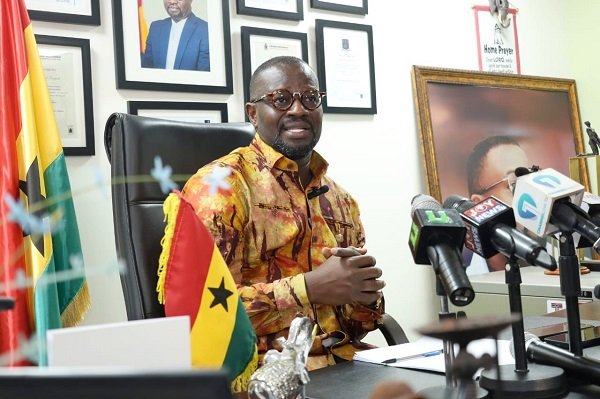
The Member of Parliament for Nsawam Adoagyiri, Frank Annoh Dompreh, has expressed concern over delays in the release of the District Assemblies Common Fund, warning that the situation is stalling development across the country.
On his facebook page, he described as a matter of urgent national importance, the Minority Chief Whip pointed to what he sees as a growing crisis of unpaid contractors, abandoned projects, and halted infrastructure works in many districts.
He noted that several communities are grappling with half completed schools, unfinished health facilities, abandoned markets, deteriorating roads, and stalled sanitation projects.
According to him, many contractors who have executed projects for district assemblies have not been paid, forcing some construction firms to demobilise from sites while workers lose their jobs.
He stressed that the District Assemblies Common Fund is not a discretionary allocation but a constitutional requirement under Article 252 of the 1992 Constitution, intended to support development at the local level.
In his view, years of delayed releases and accumulated arrears have weakened district development financing and disrupted projects meant to improve living conditions in communities.
He further argued that some payments made in recent years were largely the settlement of old debts rather than funding for new or ongoing projects, a situation he believes has affected contractor confidence and local economic activity.
He described the issue as more than a budgetary challenge, characterising it as a development emergency and a governance concern.
He therefore urged the appropriate authorities to pay outstanding DACF arrears, settle contractors who have completed their work, and ensure that transfers to districts are automatic and predictable.
He maintained that decentralisation can only succeed when district assemblies receive adequate and timely funding to carry out development projects.
He emphasised that stalled projects directly affect ordinary citizens, since they rely on such infrastructure for education, healthcare, transportation, sanitation, and economic activities.
He called for renewed attention to grassroots development, insisting that national progress should not be concentrated only in major cities but extended to all communities.
By: Jacob Aggrey

Richard Appiah, the footballer who killed two children and stored part of their bodies in a fridge at Abesim in the Bono Region in 2021 has been handed a lifetime sentence.
This was after a five member panel of judges at the Accra High Court returned a verdict of guilty against the convict.
Appiah, 32, also a draughtsman would spend the rest of his life in prison after he was convicted of murder.
More more more
BY MALIK SULLEMANA