Features
Who speaks for the millions of vulnerable Ghanaians?

The founding fathers of this beautiful country called Ghana, who fought for our independence from the British colonial administration in 1957, will by now be turning in their graves and asking about what is happening to a nation which they fought with their sweat and toils to free the people from their oppressors.
Osagyefo Dr. Kwame Nkrumah of blessed memory, first President of Ghana and others who spearheaded this country and positioned it on the international arena, would be disappointed about the economic mess that this country has been plunged into by our current leaders.
Operations of Parliament
Law making is considered to be the most important function of Parliament. Under Article 93 (2) of the 1992 Constitution, the legislative power of Ghana has been vested in Parliament and exercised in accordance with the 1992 Constitution.
Nobody other than Parliament has the power to pass any measure with the force of law except by or under the authority conferred by an Act of Parliament. The legislative function of Parliament consists of passing bills and scrutinizing statutory instruments and deciding whether to annul them or allow them to take effect by the effluxion of time. Besides, Chapter 13 of the 1992 Constitution variously vests the control of public funds (power of public purse) in Parliament.
Mouthpiece of the Electorate
In effect, Parliament is therefore an important institution in the democratic practice of our country and, therefore held in high esteem by the people. Whatever emanates from Parliament is considered as an important weapon to the administration of this country.
It is therefore, a sacred institution which must be protected and safeguarded by the players of this noble institution who are the parliamentarians. They are the people representatives and, therefore represent the interests and welfare of the people in the august house.
Strictly speaking, the parliamentarians, noted as MPs, represent the views and mouthpiece of the people in their constituencies to approve and oversee the revenues and expenditures proposed by government aside any other functions.
Walkouts in Parliament
The over 30 million Ghanaian population cannot be in Parliament at the same time and that is the reason why the 1992 Constitution has prescribed a limited number of 275 parliamentarians to the house to represent their constituencies and to participate in all matters and issues relating to the welfare of their constituencies as well as matters that affect their constituents.
It therefore, presupposes that since the MPs were elected by the people to represent their interests, it will be absolutely wrong and suicidal for them to behave in such a selfish manner when it comes to parliamentary proceedings such as debates and approval of bills among other functions in the house.
Staging walkouts in the midst of parliamentary sittings, are sometimes normal practices in parliament all over the world. It indicates a way of registering a protest and that is accepted in most parliaments across the globe. However, when this is overdone in such a way to affect the lives of the people who put them there, it becomes a huge problem to contain.
Ghanaians Patience Growing Pale
This country is evolving and therefore, the majority of the people are now discerning. The poor management of the economy by people appointed by the government to see to the growth of the economy which has brought about severe hardships among the people, has indeed, served as an eye-opener to the millions of Ghanaians since they cannot make ends meet.
They have therefore, resolved that they would never sit unconcerned and allow the economy to be downgraded in the midst of the vast economic resources at our disposal. They are therefore, drumming home to their representatives in Parliament to do the needful by holding government, especially its appointees, accountable to the economic mismanagement of the country. They are demanding that the non-performing ministers whose inefficiencies have led to the downturn of the economy must be shown the exit without further delay.
General Frustration Among The People
The general frustration among the citizenry has emboldened, toughened the people and energized them to voice out their sentiments freely without fear or favour on social media platforms. They do not care about emerging consequences whatsoever.
Even the little JHS students are abreast of the current economic downturn and are complaining. The hopes of Ghanaians are shattered and the question they keep asking is, who speaks for the millions of the vulnerable in the society?” Some of our parliamentarians are turning the august house into a charade, making it to appear different from what it is supposed to be and that is most unfortunate.
Recent Drama in Parliament
The recent walkout staged by the Majority MPs when it came to the vote of censure against the Finance Minister, Ken Ofori-Atta, spoke volumes of how some of our parliamentarians are not showing any seriousness in the business of the house.
Many Ghanaians including MPs from the Majority side had hitherto, condemned the abysmal performance of the Finance Minister and had called on the President to relieve him of his post. The Majority Caucus led by its leader, Osei-Kyei Mensah Bonsu, had met the President on this particular issue who pleaded with them to allow the Finance Minister to conclude the on-going negotiations with the International Monetary Fund (IMF) after which a firm decision would be taken on the matter.
The Speaker of Parliament constituted a committee to go into the allegations levelled against the Minister, after which a report was presented to the full house which was debated upon by both the Majority and Minority caucuses.
The Finance Minister was allowed to defend himself through his lawyers at both the committee meeting and also the floor of the house. It therefore, sounded strange when the minority walked out during a secret voting on the case.
Ghanaians Feeling Short-Changed
This is where most Ghanaians are feeling that, they are being short-changed by our parliamentarians by not calling a spade a spade. On the surface, you see the MPs disagreeing when it comes to debates on issues, but when there is the need to take decision on behalf of their constituents, you find them wanting.
The Finance Minister should by now know that he has lost confidence in the majority of the people including those from his own party. The problems of this country have indeed overwhelmed him and his economic management team and, therefore he should pack his bag and baggage and leave honourably.
Exactly as the Editor of ABC News Gordon Asare-Bediako pointed out recently on social media, “this matter should not have come to this level because for 98 Members of Parliament to write and publicly declare that they don’t want you any longer as Finance Minister, he should advise himself”. According to this writer, Mr. Ofori-Atta had allowed himself to be subjected to public ridicule.
President Must Do The Needful
Once there is a clarion call by the majority of Ghanaians to the President to reshuffle his ministers, it behoves on him to listen to the voices of the people and take action as early as possible. His adamant posturing, is not in the best interest of his party, the New Patriotic Party (NPP) in the way forward to the next election.
Once Parliament has concluded its assignment on the budget, the President should take an advantage to prune down the size of government, reshuffle some of his ministers and retire his Finance Minister honourably.
The President should take an advantage of the resignation of his Trade and Industry Minister, Allan Kojo Kyerematen and the Agriculture Minister, Dr. Owusu Afriyie Akoto, who have all resigned from his government to contest for the flagbearership position of the NPP in the next general election in 2024 to reshuffle his ministers in order to introduce vibrancy in his administration.
It was Ghanaians who gave the President the mandate to govern this country and, therefore they have every right to make suggestions as to how this country should be governed. It should not be a one-man show.
Contact email/WhatsApp of author
ataani2000@yahoo.com
0277753946/0248933366
By Charles Neequaye


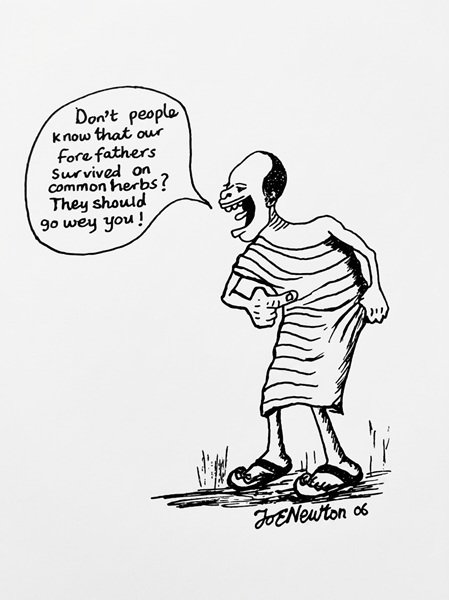
THE typical itinerant salesman in Sikaman is a herbalist. He is normally a slim macho with the capacity to perambulate the expanse of area covering the triangle of Accra-Tema-Ashiaman. In short, he can walk a total of 60 miles a day, marketing a product that cures every disease, including poverty. 
The door-to-door herbal pharmacist advertises his product by word of mouth. He has nothing to do with the Food and Drugs Board (FDB). After all, his concoctions do not feature on FM stations.
Those herbalists who cannot walk to propagate the herbal gospel, liaise with drivers of mass transportation and their mates. They are, therefore, given the chance to sell their products on Benz buses that ply the routes.
Normally, the herbalist starts his sales message with a prayer and Bible study. He asks the passengers to bow down their heads in supplication to God the father, the son, the Holy Spirit.
When a herbalist asks the passengers to close their eyes and bow their heads, Moslems on board naturally feel offended. They feel that the herbalist has no right to assume that every passenger is a Christian. They think such an assumption is an affront to Islam.
So a Moslem on board will raise the hand for a point of order. He’ll remind the herbalist that it would be in his own interest to mind his language.
“Be careful the way you address people in a public place. Not every person here is a Christian,” he’d state assertively.
Of course, the herbalist will promptly ignore him, but would all the same “watch” his tongue. Who knows whether or not the Moslem brother is inspired by Quoranic zeal to defend the tenets of Islam to the hilt?
When he starts saying, “Wallahi!” and “Inshallah!” it could be the beginning of proclaiming Islam as supreme, a point which must be driven home with talibanic precision.
So the herbalist must tread carefully lest he steps on fire.
The herbalist could even add a measure of mirth to it all, by announcing that Christians on board today have very interesting company on the journey, but that should not detract from the business of the day.
The Moslem brother will weigh the words carefully and offer a wry smile.
He must be careful the occasion does not degenerate into the use of semantics and proverbial oration to deride his conviction that public utterances must be mindful of religious sensibilities. He has made his point very clear and expects that it is taken in good faith in the interest of a peaceful journey.
The herbalist will now open the New Testament and preach salvation, stating clearly that salvation can come only through Jesus Christ and NOBODY else.
The Moslem brother will now start twitching his moustache. The visible and almost revolutionary reflexes of his upper lip can be an indication that sentiments have begun superseding reason, and the outcome could well be tragic now shift uneasily in his seat.
The time has come for him to also express his right to the religion of his fore-bears. He’ll put his hand into his pocket and rise to his feet. The time has indeed come!
This article was first published on Saturday, September 9, 2006
When the cause of a particular problem like sickness, disease, sudden illness, a social issue etc. are not known, it stands to reason that resolving it becomes a huge challenge.
Citizens would understand the government when public announcements are made to the effect that government is trying to find a solution to the issue, even though it is taking a while for it to be resolved because citizens are rational beings.
On the other hand, if the solution to a particular issue is known to everybody but the government for whatever reason, is dragging its feet in resolving it, citizens become frustrated and begin to lose trust in their leaders.
One such issue is the heavy traffic along a section of the Kasoa – Odokor road. A short stretch of bad road between the traffic light at the Weija Government Hospital and the entrance to the entrance of the overhead that leads to the N1, is the cause of the problem but nothing is being done about it, day after day, week after week, month after month. Thus is clearly unacceptable.
Another issue that requires urgent attention is the lack of pavements along a lot of streets in parts of the various Municipal Assemblies. Exercise is a prerequisite for long life and healthy living and for those of us who it has become a way of life, this issue of people putting up structures right to the edge of the drains beside the roads, are making life difficult for us.
We are compelled to walk along the roads, putting our lives at serious risk. Pedestrians should never be compelled to compete with vehicles on our streets and roads. Roads and streets are made for vehicles and pavements are made for pedestrians. That is the norm. Any attempt to normalise a situation where pedestrians are mingling with vehicles is insanity.
It is the road regulations that makes it so and therefore district or municipal assemblies are to take responsibility and ensure that spaces for pavements are not encroached upon. Citizens have rights that must be protected by their leaders and making pavements available to pedestrians, is one of them.
When we hear of teachers having sex with students, it appears it is something recent. It is not a new phenomenon. It has been there since Adam. Perhaps this issue is getting much attention due to the proliferation of social media. It was an open secret in times past when Teachers were in relationships with female students and some married them immediately after completion of school.
Some teachers were also known to be having unholy interactions with female pupils but due to the times that these acts occurred, human rights issues and the awareness around it, allowed such unscrupulous teachers to get away with their crimes.
Now we are in a different era and so a Headmaster is now in hot waters. He is alleged to have raped about 19 female students and as usual, some officials tried to cover it up and are also in hot waters and their actions or inactions in the matter are under investigation.
Why the man has been allowed to roam freely without being arrested is simply mind boggling. It appears that the law applies differently, depending on who you are. This issue came to public attention sometime in August this year, yet the police had not arrested or invited this man for question regarding the rape allegation.
It has come out that he is a Constituency Secretary of the ruling party and the question in the public domain is that, is it because he is a political figure that is why he is still walking around without questioning? I believe in the rule of law so let us hold our breadth and let the proper thing be done.
The police must however be seen to be active in this matter. God bless.
SKIP THE QUEUE, TAP THE NEWS
You can now read the Ghanaian Times and The Spectator newspapers from the comfort of your device via TimesNewsPlus.
Join our WhatsApp Channel: https://whatsapp.com/channel/0029VbBElzjInlqHhl1aTU27