Features
When the rains come…

- /home/u249204778/domains/spectator.com.gh/public_html/wp-content/plugins/mvp-social-buttons/mvp-social-buttons.php on line 27
https://spectator.com.gh/wp-content/uploads/2023/02/Rains-cause-havoc-in-Accra-every-year.png&description=When the rains come…', 'pinterestShare', 'width=750,height=350'); return false;" title="Pin This Post">
- Share
- Tweet /home/u249204778/domains/spectator.com.gh/public_html/wp-content/plugins/mvp-social-buttons/mvp-social-buttons.php on line 72
https://spectator.com.gh/wp-content/uploads/2023/02/Rains-cause-havoc-in-Accra-every-year.png&description=When the rains come…', 'pinterestShare', 'width=750,height=350'); return false;" title="Pin This Post">
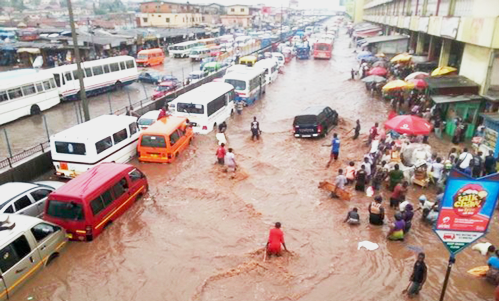
• Rains cause havoc in Accra every year
I live on Osabiede Street, a flood prone area of Mataheko in Accra. This area used to have a seven-year cycle of flooding. The first I experienced was on June 20, 2002. The second was June 19, 2009. I was preparing for the next one in June 2016 when June 3 happened in 2015.
Osabiede, or Kaneshie, is just one of the numerous flood prone areas of the capital and other places in this country. We all remember the fire that came with the flood at the Kwame Nkrumah Circle that took scores of lives, including my landlord’s grandnephew who found himself at Circle by default. It took us all by surprise.
Then we were told there was the need for a storm drain in front of the Accra Academy Senior High School that would solve the perennial flooding of the highway christened Dr. Busia Highway. When I visited the construction site I knew what was done was not a storm drain. I am told when President Akufo-Addo went to inaugurate the project he was mad at what he saw.
I am no engineer in hydrology, but common sense told me that would solve nothing. The next raining season saw the southern wall of Accra Academy come tumbling down. The asphalt on the stretch opposite the Kaneshie market folded up like a roll of linoleum. Osabiede Street was impassable and I could not move my car out of the driveway.
I went to the area office of the Department of Urban Roads where the Maintenance Engineer informed me that the roads in the general area of Central University had been given on contract and they would be fixed before the next rains set in. When I went to check I realised laterite had been spread on the street named after the celebrated musicologist, Dr. Ephraim Amu. Till date, the streets have remained undone and deteriorating.
I called the then Member of Parliament (MP) for the Ablekuma Central Constituency who told me it did not come under his remit. He forwarded the contact of the Municipal Chief Executive (MCE) to me because, according to him, the Assembly was responsible for such things.
When the MP lost in the 2020 elections I was not surprised since the constituency had a notorious reputation of making their MPs one-term office holders.
I agree it was not his job as MP, but I wondered if he could not lobby the Assembly on our behalf. I placed a call to the MCE who picked it on the second ring. It was a woman and she agreed to meet with me at her office on a date and time.
I was at the offices of the MCE ahead of time. She was four minutes ahead of the agreed time and quickly asked her Secretary after me. Madam Mariama Marley Amui was a very comely and motherly woman. She informed me that she was appointed to the job a month or so and was new to the terrain. After conferring with her administrator, one Tagoe was summoned to her office.
Tagoe said he knew the problem of my area too well but said he had to check if it was still under the jurisdiction of the Accra Metropolitan Assembly (AMA) or if it was ceded to Ablekuma Central.
I asked him to give me his contact so I could check back on him. He declined and wanted mine so he could give me an update. Over four years on Tagoe has not been in touch and, knowing how public officers behave, I have not bothered to go back to the Assembly.
The Municipal Engineer, Justice Abdoni, drove in just as I was about to leave the premises. He told me in professional terms that our area needed a huge capital inflow to fix. It turned out that the engineer was right and I gave up on trying to go round offices talking to people who knew next to nothing about drains. I mean proper drains. He said a proper drainage was needed from the area near the GRA offices at Mataheko eastwards through the Abossey Okai area into the Korle, then into the Gulf of Guinea.
A couple of months before last year’s rains I was told some people had come to our area, marking spots for what they referred to as areas to consider for expansion of the drains to forestall further flooding. I later understood they were talking about the World Bank funding the project. Knowing that the World Bank would not give out money without ensuring it was expended properly I was a little relieved.
Nothing was done and the rains came to destroy the street the more. A young entrepreneur decided to make a stretch of the street motorable, in concrete, for his delivery trucks. After about 60 metres and over a few hundreds of thousands of cedis, someone showed up claiming he was the contractor chosen to do the drains and asked the young entrepreneur to discontinue his effort and save his money. He said he would commence work in September.
September came and went and we are in February. We have not seen or heard from the man claiming to be the contractor. The street remains unmotorable save the concrete stretch. In a couple of months the rains will come again and the cycle will continue one more time.
I have already asked my compatriots up north to make the perennial floods from the spillage of water from the two dams in Burkina Faso their election issue next year. We elect and appoint people to fix our problems yet the problems remain unsolved and, in some cases, get worsened. We have engineers who should foresee issues and advise policy makers but some are either in bed with the politicians or simply do not know their job.
Without having an engineering mind I can determine that a lack of legislation on how we build our homes and offices takes flooding into consideration. There must be a law that prohibits tiling compounds of homes so that the ground can soak some of the water.
The worst case scenario must be to allow pavement blocks not to take more than 20 per cent of the compound space. Home owners must be encouraged to grow grass in their compound.
Our technocrats must push our policy makers to do the needful in the interest of the people. Until a little over a decade ago, my birthplace of Koforidua knew no flooding. Almost every home in the Eastern Regional capital is now tiled, giving rainwater little chance of being absorbed into the soil thus opening the city to annual flooding anytime it rains.
Metropolitan, Municipal and District Assemblies must make it mandatory for homeowners to build troughs to harvest rain water on their property. Many of our estate developers leave very little or no space for their grounds to take water. I wonder if common sense asks them where they think water will go whenever it rains.
Many natural disasters cannot be predicted, but measures we put in place have the potential of mitigating their devastating effects. This is what leadership is about. What happened in southeastern Turkiye and northwest Syria could not have been prevented but the number that died could have been averted if the homeowners had followed guidelines for building in earthquake zones.
How prepared are we since Accra is sitting on a tectonic plate or an earthquake fault line? Let’s not forget that the last very severe earthquake to hit Turkiye was in 1939, the very year Ghana had its most severe earthquake. Does this tell us anything? Is history about to repeat itself? We will see the dredging of our drains after the rains have started. This is our idea of preparedness.
The rainy season is not waiting for our politicians and their communicators to finish screaming at one another in the media space before it comes. Let them settle down to what Ghanaians voted for them to do. Meanwhile, how ready are our leaders when the rains come?
Writer’s email address:
akofa45@yahoo.com
By Dr. Akofa K. Segbefia

Features
Environmental stewardship is an act of worship: The Islamic response to climate change, environmental degradation (Part 4)

The environmental consequences of illegal mining have reached alarming levels in Ghana. Several major rivers, including the Pra, Ankobra, Offin, Birim and Tano, have experienced significant pollution from illegal mining activities, increasing the cost and complexity of water treatment while threatening the availability of potable water for millions of citizens (Water Resources Commission, 2024; Ghana Water Limited, 2024). These developments underscore the urgent need for stronger environmental governance and collective action.
Islam equally emphasises accountability in governance. The Prophet Muhammad (peace be upon him) taught that every leader is responsible for those under his or her authority (Sahih al-Bukhari, Hadith 7138; Sahih Muslim, Hadith 1829). This principle extends to public officials entrusted with environmental regulation, traditional authorities responsible for communal lands, mining companies, local assemblies, and community leaders. Environmental protection cannot succeed
where accountability is absent.
At the same time, addressing galamsey requires more than law enforcement. Sustainable solutions must tackle the underlying socio-economic realities that drive individuals into illegal mining. Many young people are motivated by unemployment, poverty, and limited economic opportunities. Islamic principles of social justice therefore call for the creation of alternative livelihoods through sustainable agriculture, vocational training, responsible small-scale mining under strict environmental standards, entrepreneurship, and skills development. Environmental protection and economic empowerment should not be viewed as competing priorities but as complementary goals that promote human dignity and national development.
Faith communities also have an indispensable role to play. Mosques, churches, schools, traditional councils, and civil society organisations possess significant influence in shaping public attitudes and behaviours. Imams, in particular, should consistently remind congregations that wealth acquired through actions that destroy communities and Allah’s creation cannot be regarded as a blessing. Religious education should cultivate environmental ethics alongside spiritual devotion, reinforcing the understanding that protecting rivers, forests, and farmlands is an expression of gratitude to Allah and a fulfilment of the trust of Khalifah.
Ultimately, the struggle against galamsey is more than a campaign to protect natural resources; it is a struggle to uphold justice, preserve human dignity, and honour the trust that Allah has placed upon humanity. Lasting solutions will require strong governance, responsible citizenship, sustainable economic opportunities, and renewed moral leadership. Only when these elements
work together can Ghana safeguard its natural heritage for present and future generations.
Water conservation, waste management and sustainable development: Practical expressions of Islamic stewardship
Religious education should cultivate environmental ethics alongside spiritual devotion, reinforcing the understanding that protecting rivers, forests, and farmlands is an expression of gratitude to Allah and a fulfilment of the trust of Khalifah.
Ultimately, the struggle against galamsey is more than a campaign to protect natural resources; it is a struggle to uphold justice, preserve human dignity, and honour the trust that Allah has placed upon humanity. Lasting solutions will require strong governance, responsible citizenship, sustainable economic opportunities, and renewed moral leadership. Only when these elements
work together can Ghana safeguard its natural heritage for present and future generations.
Islam is not merely a religion that condemns environmental destruction; it also provides practical guidance for preserving and sustaining the natural world. Through its teachings on moderation, cleanliness, conservation, and responsible consumption, Islam cultivates an environmental ethic that remains remarkably relevant to contemporary challenges such as water scarcity, pollution, waste management, and climate change. These teachings encourage Muslims to become
responsible custodians of Allah’s creation in both private and public life.
Water conservation: A sacred responsibility
Water occupies a unique position in Islam as the source of life and an essential element of worship. Allah says, “And We made from water every living thing. Then will they not believe?” (Qur’an 21:30, Sahih International). This verse reminds believers that water is not merely an economic resource but a divine blessing upon which all living creatures depend. The importance of water is further reflected in Islamic acts of worship. Muslims perform ablution (wudu) before the five daily prayers and ritual bathing (ghusl) under prescribed circumstances.
Yet, despite its central role in purification, Islam strongly discourages wastefulness. The Prophet Muhammad (peace be upon him) once advised one of his companions not to waste water while performing ablution, even when using water from a flowing river (Sunan Ibn Majah, Hadith 425). This timeless guidance establishes the principle that abundance does not justify extravagance.
Conservation remains a religious obligation regardless of the apparent availability of natural resources.
This Prophetic teaching carries profound implications for contemporary Ghana. Illegal mining has severely polluted many rivers, increasing the cost of water treatment and limiting access to safe drinking water for numerous communities. Climate change has also intensified seasonal variability in rainfall, placing additional pressure on freshwater resources (IPCC, 2023). Against this
backdrop, conserving water is no longer simply an environmental preference—it is a moral imperative grounded in Islamic teaching.
Water conservation should therefore become a shared responsibility among households, educational institutions, industries, and places of worship. Simple practices such as repairing leaking pipes, harvesting rainwater, protecting riverbanks, avoiding contamination of water bodies, and promoting efficient irrigation contribute to safeguarding one of Allah’s greatest blessings. Every effort to preserve water is an investment in public health, food security, and the
wellbeing of future generations.
Unfortunately, indiscriminate disposal of refuse remains a significant challenge in many communities. Plastic waste clogs drainage systems, contributes to flooding during the rainy season, pollutes rivers and beaches, and threatens marine ecosystems. Open burning of waste further degrades air quality and poses serious health risks, particularly for children and the elderly (UNEP,2024).
The author is Chief Imam of Katamanso Municipal and Certified Counsellor and Governnace Expert.
SKIP THE QUEUE, TAP THE NEWS
You can now read the Ghanaian Times and The Spectator newspapers from the comfort of your device via TimesNewsPlus.
Join our WhatsApp Channel: https://whatsapp.com/channel/0029VbBElzjInlqHhl1aTU27
Management Development and Productivity Institute (MDPI), Ghana
Pillars for making productivity a national movement
3. Strengthen and resource productivity institutions
MDPI was established precisely to champion productivity improvement in Ghana’s public and private sectors. Yet like many institutions of its kind across Africa, it has often operated with budgets and staffing levels inconsistent with its strategic mandate. This must change. Institutions like MDPI should be treated as strategic national assets equipped with modern training infrastructure, incentivised to deploy consultants into enterprises and public institutions, and empowered to set national standards for workforce productivity. Regional- and district-level productivity extension services, analogous to agricultural extension officers, could provide practical, hands-on support to SMEs and local governments across the country.
4. Incentivise productivity in the public sector
The public sector remains the single largest employer in Ghana and sets the tone for national work culture. If productivity is rewarded and celebrated in government, it will radiate outward. Ghana should revisit its performance management frameworks for the civil and public service, moving away from input-based assessments (attendance, processes followed) toward outcome-based evaluations (results delivered, service quality achieved). Linking promotions, bonuses, and recognitions explicitly to productivity outcomes will signal, powerfully, that the state is serious. Ghana’s productivity movement must not be left to the private sector alone.
5. Harness technology as a productivity multiplier
Digital technology is the great productivity equaliser of our age. Mobile money has already transformed financial productivity for millions of Ghanaians. The question is how to extend this digital dividend to agriculture, healthcare, education, logistics, and governance. Ghana’s digital transformation agenda, including Ghana Post GPS, the digitisation of government services, and the rollout of broadband infrastructure must be purposefully linked to productivity outcomes. Beyond infrastructure, Ghanaian enterprises need support to adopt enterprise resource planning systems, data analytics tools, and digital supply chain solutions that allow them to do more with less.
The role of leadership: Modelling the movement
National movements do not sustain themselves on policies and pillars alone. They need visible, credible leaders who embody their values in practice. Ghana’s productivity movement needs champions in the Presidency, in the boardrooms of our largest companies, in the media, in our universities, in our traditional leadership structures etc, who will speak about productivity not as a development cliché but as a personal and collective commitment.
Consider how Singapore’s transformation was driven as much by Lee Kuan Yew’s relentless personal discipline and public messaging around hard work, meritocracy, and efficiency as it was by any specific policy. Or how Rwanda’s monthly Umuganda community work days, where citizens, including the President, collectively clean, build, and improve their environment, have created a visible, embodied culture of collective industry. Ghana has its own rich tradition of communal labour and shared responsibility. We need to revive and modernise these values as the cultural architecture of our productivity movement.
SMEs: The engine room of Ghana’s productivity future
Small and medium enterprises account for the overwhelming majority of employment and output in Ghana’s economy. Any serious national productivity movement must place SMEs at its centre. Currently, most Ghanaian SMEs operate with limited access to management training, modern business tools, or productivity consulting support. The result is a large swathe of the economy running at a fraction of its potential efficiency.
A national productivity movement for SMEs would involve: accessible, subsidised business management training at district level; productivity clinics staffed by MDPI consultants and retired business executives; peer-learning networks where successful SME owners share improvement strategies; and financial incentives such as tax relief or grants for enterprises that can demonstrate measurable productivity improvements. Digital platforms can democratise access to these resources far beyond what physical infrastructure alone could achieve.
Conclusion: The movement starts now
Making productivity a national movement in Ghana is not a matter of waiting for the perfect policy, the right government, or a more favourable economic environment. It begins now — with each institution deciding to be more effective, each leader choosing to model the values they preach, each worker holding themselves to a higher standard of output and quality.
Ghana’s history shows that when our people mobilise around a shared goal, be it independence, democratic consolidation, or national disaster response, we are capable of extraordinary collective achievement. Productivity is the next frontier of that mobilisation. It is quieter than political revolution, less dramatic than peacekeeping, but ultimately more transformative than either.
The policy frameworks exist. The institutions are in place. The international partnerships through initiatives like the Africa Kaizen Initiative are ready to support us. What remains is the will to move from paper to practice, from aspiration to action, and from isolated efforts to a movement that every Ghanaian feels part of.
The time for Ghana’s productivity movement is not tomorrow. It is now.
By Ethel Ansah-Antwi
SKIP THE QUEUE, TAP THE NEWS
You can now read the Ghanaian Times and The Spectator newspapers from the comfort of your device via TimesNewsPlus.
Join our WhatsApp Channel: https://whatsapp.com/channel/0029VbBElzjInlqHhl1aTU27