Features
From fufu to fast food: Ghana is eating faster and getting sicker


At 6:30 a.m. in Accra, a young office worker scrolls through her phone, ordering fried rice and chicken to arrive before traffic thickens. Across town, a trotro driver grabs a sugary drink and pastry at a roadside stop.
In a nearby school, children line up for fried snacks at break time. None of these moments feels extraordinary.
Yet together they capture a quiet revolution in Ghana’s food system — what public health experts call the nutrition transition: the shift from traditional, minimally processed diets to meals dominated by convenience foods, refined carbohydrates, added sugar, and ultra-processed products. This shift is reflected in Ghana’s own health data.
According to the WHO Ghana STEPwise Survey (2023), approximately 20.9 per cent of adults are overweight and 13.4 per cent are obese, with obesity prevalence in urban areas nearly twice that of rural populations (WHO, 2023).
The same survey estimates that about 19–20 per cent of adults aged 18–69 have raised blood pressure, meaning roughly one in five Ghanaian adults lives with hypertension (WHO, 2023).
Furthermore, the Ghana Health Service Annual Health Sector Performance Reports consistently rank hypertension among the top causes of adult outpatient department (OPD) attendance nationwide, with diabetes also listed among the leading chronic conditions managed at district and regional facilities (GHS, 2022; GHS, 2023).
These trends are visible in workplaces, classrooms, and clinics where front-line health workers now manage far more cases of diet-related chronic diseases than they did a decade ago.
These patterns do not emerge by accident, rather, they are driven by deeper structural changes in how Ghanaians live and eat. The most visible driver is urbanisation and time poverty.
Traditional meals such as banku with okro stew, fufu with light soup, apapransa, yam with kontomire often require time, planning, and space. Urban life strips those away.
Long commutes, irregular work hours, and crowded living conditions make “cook from scratch” a luxury for many. In that setting, convenience becomes a survival strategy, not indulgence.
At the same time, economic pressure reinforces this dependence on convenience.
When food prices rise, households prioritise what is filling and affordable. Energy-dense foods rich in oil, refined flour, and sugar deliver many calories at a low price, even when they deliver fewer vitamins, minerals, and fibre.
This is why Ghana can face a “double burden”: overweight and obesity alongside micronutrient deficiencies, sometimes within the same household. (WHO CDN) Moreover, these structural forces are especially powerful in shaping children’s habits. The next, is the children’s food environment -the most decisive battleground. Children learn taste, habit, and “normal” from what surrounds them.
When the school perimeter is saturated with sugary drinks, pastries, and fried snacks, and when advertising links these items to fun and success, we are programming future disease.
Ghana’s nutrition transition becomes self-reinforcing: the earlier unhealthy habits begin, the harder they are to reverse. And then there is the digital accelerator: delivery platforms and algorithmic convenience.
Apps do not merely respond to demand; they shape it -highlighting what sells quickly and consistently. If “popular” means sugary drinks and fried meals, those become the default. The transition from mortar-and-pestle to mobile apps is not just cultural. It is commercial. As a result of these interconnected drivers, the consequences are becoming increasingly visible.
The downstream effects are no longer theoretical
Ghana’s NCD burden is rising, and risk factors are showing up earlier in life. The 2023 STEPS report indicates that raised blood pressure (hypertension) is common among adults, with prevalence estimates around 19.6 per cent in the 18–69 age group. (WHO File Repository)
Meanwhile, data from Ghana’s population surveys show worrying patterns in weight trends. Analyses of the 2022 Ghana Demographic and Health Survey report substantial levels of overweight and obesity among women of reproductive age (commonly reported figures include about 28 per cent overweight and 22 per cent obesity in women).
These are not just statistics; they translate into strokes, kidney disease, diabetic complications, pregnancy risks, and lost productivity. The economic implications are brutal. Unlike many infectious diseases, chronic diseases require lifelong management.
That means repeated clinic visits, medicines, lab tests, dietary adjustments, and time off work. Families pay out of pocket; health systems stretch; national productivity suffers. Prevention is not merely healthier -it is cheaper.
Therefore, confronting these challenges requires more than individual willpower: it requires coordinated policy. Ghana doesn’t need to abandon tradition. We need to modernise protection.
The solution is not to romanticise the past or shame people for buying what they can afford. Ghana needs a modern public health response that matches a modern food environment — practical, enforceable, and pro-family.
Steps Ghana can take now
First, protection must begin where habits are formed: in schools. The Ghana Education Service (GES), district assemblies, and PTAs should implement clear, enforceable standards for school canteens and vendors by limiting sugar-sweetened beverages, requiring healthier snack options, and ensuring access to clean drinking water.
When children encounter nourishing foods daily, healthy preferences are built early.
However, safeguarding schools alone is not enough. If children leave a protected school environment only to face aggressive marketing elsewhere, progress will be undermined. Therefore, the next step must be to strengthen regulation of unhealthy food advertising.
The Food and Drugs Authority (FDA) already has guidance on food advertising, but enforcement and child-specific protections require strengthening.
Restricting the promotion of high-sugar, high-salt, and high-fat products during children’s programming and in and around schools -an approach advocated by organisations such as Meals4NCDs- would reinforce school-based protections.
At the same time, broader consumer empowerment is essential. Even with marketing controls in place, households need clear information to make informed choices.
Strengthening front-of-pack labelling through the Food and Drugs Authority using simple warning labels or traffic-light systems-would allow busy shoppers to quickly identify products high in sugar, salt, and saturated fat.
Yet information alone is insufficient if healthy options remain physically inaccessible. This is where urban planning becomes critical.
District assemblies can support fresh produce markets, promote safe walking spaces, and regulate the clustering of junk food outlets near schools, thereby reshaping neighbourhood food environments to support healthier decisions.
The fork is in our hands -but the system holds the plate. When the easiest foods are the least healthy, disease follows. We still have a window to act.
Our food culture is rich, diverse, and worth preserving -not as nostalgia, but as a living resource for health.
The question is whether policy, planning, and public health will move fast enough to protect families in a fast-changing food system. Because what Ghana eats today is quietly shaping how the nation will live tomorrow.
By Agyemfrah Rachel Akonnobea

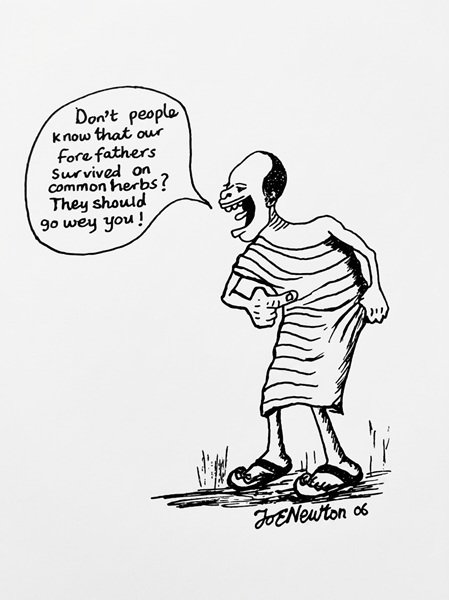
THE typical itinerant salesman in Sikaman is a herbalist. He is normally a slim macho with the capacity to perambulate the expanse of area covering the triangle of Accra-Tema-Ashiaman. In short, he can walk a total of 60 miles a day, marketing a product that cures every disease, including poverty. 
The door-to-door herbal pharmacist advertises his product by word of mouth. He has nothing to do with the Food and Drugs Board (FDB). After all, his concoctions do not feature on FM stations.
Those herbalists who cannot walk to propagate the herbal gospel, liaise with drivers of mass transportation and their mates. They are, therefore, given the chance to sell their products on Benz buses that ply the routes.
Normally, the herbalist starts his sales message with a prayer and Bible study. He asks the passengers to bow down their heads in supplication to God the father, the son, the Holy Spirit.
When a herbalist asks the passengers to close their eyes and bow their heads, Moslems on board naturally feel offended. They feel that the herbalist has no right to assume that every passenger is a Christian. They think such an assumption is an affront to Islam.
So a Moslem on board will raise the hand for a point of order. He’ll remind the herbalist that it would be in his own interest to mind his language.
“Be careful the way you address people in a public place. Not every person here is a Christian,” he’d state assertively.
Of course, the herbalist will promptly ignore him, but would all the same “watch” his tongue. Who knows whether or not the Moslem brother is inspired by Quoranic zeal to defend the tenets of Islam to the hilt?
When he starts saying, “Wallahi!” and “Inshallah!” it could be the beginning of proclaiming Islam as supreme, a point which must be driven home with talibanic precision.
So the herbalist must tread carefully lest he steps on fire.
The herbalist could even add a measure of mirth to it all, by announcing that Christians on board today have very interesting company on the journey, but that should not detract from the business of the day.
The Moslem brother will weigh the words carefully and offer a wry smile.
He must be careful the occasion does not degenerate into the use of semantics and proverbial oration to deride his conviction that public utterances must be mindful of religious sensibilities. He has made his point very clear and expects that it is taken in good faith in the interest of a peaceful journey.
The herbalist will now open the New Testament and preach salvation, stating clearly that salvation can come only through Jesus Christ and NOBODY else.
The Moslem brother will now start twitching his moustache. The visible and almost revolutionary reflexes of his upper lip can be an indication that sentiments have begun superseding reason, and the outcome could well be tragic now shift uneasily in his seat.
The time has come for him to also express his right to the religion of his fore-bears. He’ll put his hand into his pocket and rise to his feet. The time has indeed come!
This article was first published on Saturday, September 9, 2006
When the cause of a particular problem like sickness, disease, sudden illness, a social issue etc. are not known, it stands to reason that resolving it becomes a huge challenge.
Citizens would understand the government when public announcements are made to the effect that government is trying to find a solution to the issue, even though it is taking a while for it to be resolved because citizens are rational beings.
On the other hand, if the solution to a particular issue is known to everybody but the government for whatever reason, is dragging its feet in resolving it, citizens become frustrated and begin to lose trust in their leaders.
One such issue is the heavy traffic along a section of the Kasoa – Odokor road. A short stretch of bad road between the traffic light at the Weija Government Hospital and the entrance to the entrance of the overhead that leads to the N1, is the cause of the problem but nothing is being done about it, day after day, week after week, month after month. Thus is clearly unacceptable.
Another issue that requires urgent attention is the lack of pavements along a lot of streets in parts of the various Municipal Assemblies. Exercise is a prerequisite for long life and healthy living and for those of us who it has become a way of life, this issue of people putting up structures right to the edge of the drains beside the roads, are making life difficult for us.
We are compelled to walk along the roads, putting our lives at serious risk. Pedestrians should never be compelled to compete with vehicles on our streets and roads. Roads and streets are made for vehicles and pavements are made for pedestrians. That is the norm. Any attempt to normalise a situation where pedestrians are mingling with vehicles is insanity.
It is the road regulations that makes it so and therefore district or municipal assemblies are to take responsibility and ensure that spaces for pavements are not encroached upon. Citizens have rights that must be protected by their leaders and making pavements available to pedestrians, is one of them.
When we hear of teachers having sex with students, it appears it is something recent. It is not a new phenomenon. It has been there since Adam. Perhaps this issue is getting much attention due to the proliferation of social media. It was an open secret in times past when Teachers were in relationships with female students and some married them immediately after completion of school.
Some teachers were also known to be having unholy interactions with female pupils but due to the times that these acts occurred, human rights issues and the awareness around it, allowed such unscrupulous teachers to get away with their crimes.
Now we are in a different era and so a Headmaster is now in hot waters. He is alleged to have raped about 19 female students and as usual, some officials tried to cover it up and are also in hot waters and their actions or inactions in the matter are under investigation.
Why the man has been allowed to roam freely without being arrested is simply mind boggling. It appears that the law applies differently, depending on who you are. This issue came to public attention sometime in August this year, yet the police had not arrested or invited this man for question regarding the rape allegation.
It has come out that he is a Constituency Secretary of the ruling party and the question in the public domain is that, is it because he is a political figure that is why he is still walking around without questioning? I believe in the rule of law so let us hold our breadth and let the proper thing be done.
The police must however be seen to be active in this matter. God bless.
SKIP THE QUEUE, TAP THE NEWS
You can now read the Ghanaian Times and The Spectator newspapers from the comfort of your device via TimesNewsPlus.
Join our WhatsApp Channel: https://whatsapp.com/channel/0029VbBElzjInlqHhl1aTU27