News
Confusion in Tema (Final part)


Tema is a city that has something truly mysterious about it. Check Site 21 and ask to see Lama and he’d brief you all about the genesis, exodus and revelations of the harbour city.
Crash into Kwame Korkorti and he’d analyse the chemistry underlying the behaviour of Tema residents. And I invite you to meet honourable Kofi Owuo alias Death-By-Poverty who is happiest when cost of living is high.
It started as an industrial city, a workers’ paradise, born of Kwame Nkrumah, suffered under Busia (he sold TDC houses), was crucified on the cross of scanty rainfall and high cost of cocoyam. Today, Tema is like Hong Kong, a very expensive city. You even have to pay for rubbish you dispose yourself.
Even Ashaiman otherwise known as Hanoi is better, enjoying a very low cost of living. The only difference is that in Hanoi, you sometimes have to live with pigs, and pigs are not gentlemen at all. They don’t have character!
Yes, talk about Tema and you’re talking about a place like Bronx or Manhattan, a boiling pot of all ethnicities and races.
People come from the deepest jungle of Brong Ahafo where monkeys are next-door neighbours. You’ll find a confused teenager fresh from Jamasi shoe-shining and addicted to kokonte. You won’t fail to notice a retired seaman who has forgotten he is from Elmina and needs to go back home and die. And you’d find an array of East Asians but you’ll never know which is the Chinese, Japanese, Korean or Filipino. They sneeze the same way!
Home life in Tema is serene except that when a housewife is peeling cassava for fufu, a stubborn goat may approach her and ask for a bite. If she refuses, the goat may decide to take a chunk by force. You can’t drive it away using a kitchen-fan, so you have to use blows. But if the animal is a southpaw, it becomes a challenge for the angry housewife.
The cosmopolitan nature of the city makes night life interesting. You’ll meet people of all kinds, shapes, haircuts and mentality and you learn a lot from each other. It is even more enjoyable when you can blow beer and kebab regularly without developing financial constipation.
Tema used to be a very peaceful, orderly place until recent times when the Black Cat incident caused a big stir. Instead of the Tema Metropolitan Assembly (TMA) taking time to review the method used in dealing with the floating drivers, they discharged Black Cat and replaced him with a more formidable gun-wielding task force. The move was seen largely as a sure recipe for imminent clash, because the LTs and minibuses were still being chased around in the metropolis, this time with warning shots.
At least, Black Cat wasn’t using firearms for the operation. He used muscle and ferociousness. Compared to the new task force, Black Cat was a more benevolent enforcer. And with the new task force, even taxi drivers were not permitted to stop and pick passengers. What a regulation!
It didn’t take a prophet of the calibre of Elijah to predict that another nasty incident was in the pipeline. What beat the imagination of everybody was why the Metropolitan Chief Executive still endorsed the use of the task force following the turbulent Black Cat incident.
Well it happened again that a taxi driver was arrested by task force men and during the confrontation, the man was allegedly brutalised and killed. News spread city-wide about the death and angry drivers, allegedly supported by other residents, charged on the premises of the TMA.
On the occasion, the Chief Executive, Nii Armah Ashittey, was reported to have been smarter than a rat. With incredible speed, he dashed downstairs, dived into his car, and his experienced driver changed gears and fired the accelerator and wheeled him to safety. God bless his soul!
There was wanton destruction of property and looting. By the following day, it turned out that the dead man whose obituary notice caused the commotion was alive, after all, hale and hearty. Another miraculous resurrection was registered in the annals of the harbour city. The dead man was said to have only been treated and discharged.
The next day, suspects were rounded-up- 239 of them including a few women. They were brought to the Community One Police Station, screened and 18 put before court. The courts will decide their innocence or guilt and punishment thereof.
Meanwhile, certain issues must be resolved once and for all. First, much as the offending drivers are misconducting themselves and defying metropolitan rules and regulations, the mode of arresting them is crude and uncivilised.
You don’t forcibly arrest a taxi driver and start dragging him for stopping to pick a passenger. If anything, he must be given a ticket or summoned.
In any case, Tema is the only city taxis are mandated to operate from a rank and must not pick passengers in town. So if you’re three miles from the taxi rank, you must walk there to pick a taxi. I don’t think this is fair to anybody!
Secondly, the GPRTU must find a solution to the problem of floating drivers without causing pandemonium because using a task force is proving dangerous for everybody and it has caused a major disquiet twice already, aside many minor ones.
When President Rawlings visited Tema a day after the disturbances that is on May Day he stressed on the need to maintain peace and order in the city. It goes without saying that violence and disturbances must be prevented at all cost. And if the task force which is currently still operating is not disbanded, another, even nastier incident, is bound to happen.
If Nii Armah Ashittey is still unable to comprehend the intricacies of the problem and foresee that with the task force still in place, trouble is again inevitable, then it is very unfortunate. It has happened twice already and we have still not learnt a lesson!
I urge him to sit down with the GPRTU executives and do some brainstorming about how best to solve the problem without using a task force.
Residents of Tema want to live peacefully and deserve that right!
This article was first published on Saturday May 18, 1996









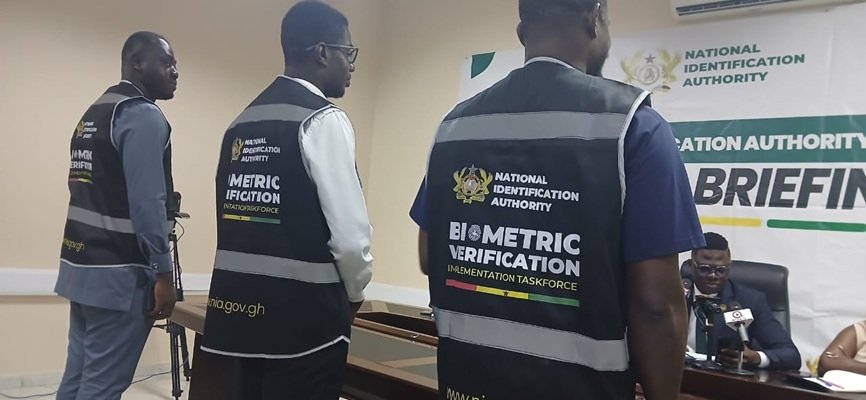
The National Identification Authority (NIA) has announced the commencement of enforcement of the National Identity Register (Amendment) Regulations, 2026 (L.I. 2523), warning institutions that fail to comply with the new requirements of possible fines of up to 2,000 penalty units.
The Authority says it will deploy a Biometric Verification Implementation Task Force to inspect institutions and ensure they comply with the regulations, following the expiration of a three-month grace period granted to businesses and public institutions.
Speaking at a press briefing in Accra on Monday, November 2, 2026, the NIA’s Corporate Affairs representative, William Ampomah Emmanuel Darlas, said the Authority had completed its public education and stakeholder engagement activities and was now moving into the enforcement and compliance monitoring phase.
He explained that the regulations require institutions that verify the identities of customers or applicants as part of their operations to use the NIA’s approved biometric verification platform instead of relying solely on visual inspection of the Ghana Card.
Under the new rules, institutions are prohibited from photocopying, scanning or keeping copies of the Ghana Card for identity verification purposes.
Mr Darlas stressed that simply collecting a customer’s Ghana Card, looking at the photograph and comparing it with the person presenting it would no longer be accepted as a valid method of identity verification.
He, however, clarified that the Ghana Card remains the country’s official national identity document and that citizens are not required to register for a new card or capture their biometrics again under the new regulations.
He said the new system is intended to reduce identity fraud, impersonation and other crimes by ensuring that the person presenting the Ghana Card is the actual owner.
According to him, the biometric verification process will rely on information already captured during Ghana Card registration, including fingerprints, iris details and facial features stored in the card’s chip.
Mr Darlas warned institutions against using third-party companies or individuals to access the NIA’s identity verification platform, insisting that the Authority does not work with intermediaries.
He said institutions seeking access to the National Identity Register must deal directly with the NIA and complete its official onboarding process.
The process requires institutions to prove that they are legally registered companies in Ghana, obtain certification from the Data Protection Commission and work with the NIA’s technical team to establish the necessary connection to its platform.
He further cautioned institutions already connected to the platform against subletting their access to other businesses, particularly small and medium-sized enterprises.
He disclosed that the Authority had received reports of some institutions providing their verification services to other businesses without the NIA’s approval and warned that those involved would face legal action.
Mr Darlas said organisations that fail to comply with L.I. 2523 could face fines ranging from 500 to 2,000 penalty units, depending on the nature of the offence.
He explained that the NIA does not have the authority to impose the fines directly but would take offenders to court for the appropriate punishment.
He indicated that Institutions found guilty could also face additional administrative measures, including being barred from accessing the NIA’s verification platform in the future.
The NIA representative further clarified that the new regulations do not prohibit all institutions from physically using the Ghana Card during transactions.

The Managing Director of the Ghana Publishing Company Limited, Nana Kwesi Boatey, has revealed how he transformed a major overstaffing challenge into a success story through the government’s 24-Hour Economy initiative.
Speaking at the Government Accountability Series on Monday, November 2, Mr. Boatey disclosed that when he assumed office in February 2025, and inherited a bloated workforce of 250 employees doing work that could be efficiently handled by 150 people, a situation that created serious liquidity challenges for the state-owned company.
Instead of resorting to downsizing, he adopted an innovative approach by instituting a 24-hour operational system.
Under the new system, staff were redistributed across three shifts: 7 a.m. – 4:30 p.m., 10 a.m. – 7 p.m., and 10 p.m. – 4:30 a.m.
This not only ensured optimal use of labour but also maximized machine utilization and improved overall output.
According to him, the single move redefined the productivity culture within the company, reinforcing discipline, accountability, and efficiency.
The Ghana Publishing Company’s turnaround is being cited as a practical example of how the 24-Hour Economy policy can drive growth without job losses.
By Edem Mensah-Tsotorme