News
Vice President Jane Naana Opoku-Agyemang commends local government ministry for progress in decentralisation

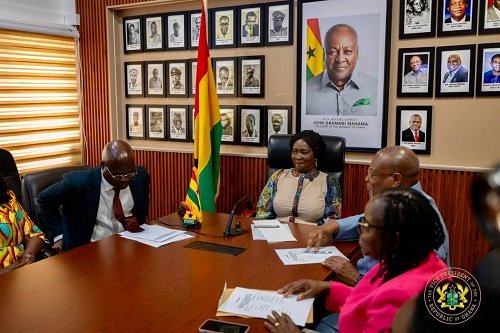
Vice President of the Republic of Ghana, Prof. Jane Naana Opoku-Agyemang, has praised the Ministry of Local Government, Chieftaincy and Religious Affairs for its key role in bringing governance closer to the people through decentralisation.
She made this known after she visited the Ministry to engage with its leadership and staff.
According to her, the visit was to better understand the progress being made in responsive governance and effective service delivery across the country.
“The Ministry is truly at the heart of government, especially as we work to reset the decentralisation agenda and strengthen our institutions,” she said.
During the meeting, the Minister for Local Government, Chieftaincy and Religious Affairs, Ahmed Ibrahim, briefed the Vice President on several achievements since he took office.
He said the Ministry had successfully organised orientation programmes for Metropolitan, Municipal and District Chief Executives (MMDCEs), and had issued clear guidelines on how the District Assemblies Common Fund (DACF) should be used.
He also spoke about the National Decentralisation Dialogue, which he described as an important platform that allows stakeholders to contribute ideas toward the future of Ghana’s decentralisation process.
Ahmed Ibrahim further noted that the Ministry has strengthened its relationship with traditional authorities.
He said engagement with chiefs and queen mothers has increased significantly, adding that the government has approved about a 300 percent increase in allowances for paramount chiefs and queen mothers.
According to him, this move shows government’s recognition of the important role traditional leaders play in promoting unity, development, and local governance.
The Minister announced the launch of National Sanitation Day work plans.
He explained that this forms part of preparations to roll out a 24-hour sanitation programme aimed at improving hygiene and sanitation across the country.
He added that there is renewed confidence among investors and development partners because of the growing stability and clear direction under the current administration.
In her remarks, the Vice President stressed that decentralisation must be used to improve the daily lives of Ghanaians.
She said social governance is key to maintaining peace and national stability.
She commended the Ministry for its efforts to ensure that public funds, especially the DACF, are used for their intended purposes.
“I appreciate the steps being taken to ensure accountability and that these funds truly benefit the people,” she stated.
Prof. Opoku-Agyemang said the engagement was not only to encourage the Ministry but also to listen, support, and strengthen cooperation in delivering better results for communities.
She reminded all stakeholders that governance is a shared responsibility.
“Government does not work alone. We must continue to treat every stakeholder, at every level, with the respect they deserve,” she said.
By: Jacob Aggrey










A 30-year-old man has been sentenced to 25 years imprisonment with hard labour by the Bekwai Circuit Court for his role in a 2022 robbery at a mining site at Manso Akwasiso in the Ashanti South Region.
The convict, Dominic Ofori, also known as Fanta, was arrested on 16th February 2026 after years on the run. He pleaded guilty before the Bekwai Circuit Court to robbery contrary to Section 149 of the Criminal Offences Act, 1960 Act 29, and was accordingly sentenced to 25 years imprisonment with hard labour.
On March 20, 2022, the Manso Adubia District Police received intelligence that a group of armed men from Manso Abodom were planning to attack a mining site at Manso Akwasiso to rob the owner of gold concentrate. Acting on the information, police mounted a coordinated operation and laid an ambush at the site.
At about 5:30 pm the same day, four-armed men arrived at the site, fired indiscriminately, and robbed the miners of their gold concentrate. The police team on surveillance intervened, resulting in an exchange of gunfire.
Three of the suspects, Abu Abubakar, Musah Latif, and Gideon Takyi, sustained gunshot wounds and were pronounced dead on arrival at St Martins Catholic Hospital at Agroyesum. Dominic Ofori escaped at the time but was later arrested and put before the court.
The Ashanti South Regional Police Command has assured the public of its continued commitment to combating violent crimes and bringing offenders to justice.
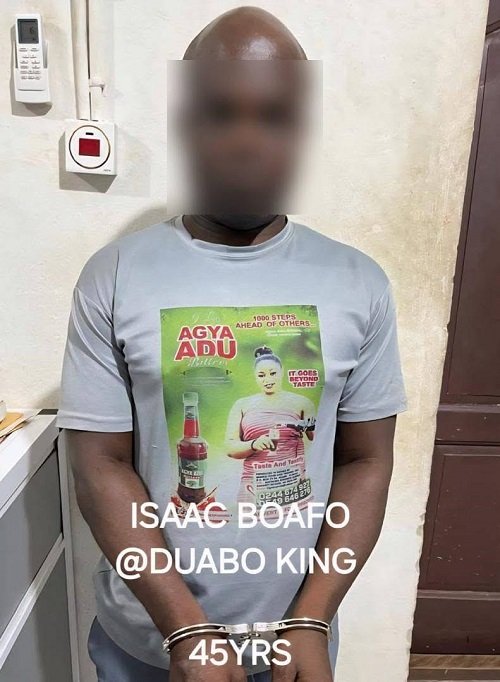
The Ashanti Regional Police Command has arrested 45-year-old Isaac Boafo, also known as “Duabo King,” for allegedly publishing false news intended to cause fear and panic.
Police said the arrest follows a viral TikTok video in which Boafo claimed that four officers at the Central Police Station in Kumasi engaged in inappropriate conduct with commercial sex workers during night patrols in Asafo.
Officers from the Police Intelligence Directorate (Ashanti Region) apprehended Boafo after receiving intelligence about the video.
During questioning, he admitted to creating the video to attract views and engagement online, and acknowledged that he could not prove the allegations.
Boafo also admitted making comments about the President of the Republic for content purposes and could not defend those statements.
He has been formally charged and is in detention as investigations continue.
The Ashanti Regional Police have warned the public against publishing or sharing false information on social media, noting that such acts can cause fear, panic, and damage reputations.
They said anyone found engaging in similar conduct will face legal action.
By: Jacob Aggrey