News
‘Varsity, industry collaboration key to national development’


To manufacture vaccines particularly COVID- 19 products requires huge doses of investment, the Vice Chancellor of the University of Health and Allied Sciences (UHAS), Prof. John Owusu Gyapong, has said.
He has established also the critical relationship between science and vaccine development.
Prof. Gyapong made the argument when he delivered a talk on ‘Impact of COVID-19 pandemic on higher education in Ghana: Threats and Opportunities’ at the just -ended 2021University Teachers Association of Ghana (UTAG) Congress at the University of Mines and Technology (UMaT),Tarkwa, in the Western Region.
He said, scientists in the universities needed huge investmnts to conduct researches for products,noting that, the United States of America spent huge dollars in such a venture.
This,he explained involved series of trials in communities to erase all reasonable doubts.
Again, Prof. Gyapong said, there was the need to provide protection to the communities,stressing “it’s about billion of dollars.”
To achieve this goal, he encouraged universities in Ghana to collaborate with one another in their research work in this era of science, in order to make the needed impact in the country.
“Many of us like to work in our small corners but this requires that we work together through consortia across the world and even in this country, there is no reason universities should not work closer”. he said.
Prof.Gyapong stated that the COVID-19 pandemic should be a wake -up call for research capabilities, science, technology and innovation systems, manufacturing capabilities, inter-institutional and interdisciplinary collaboration through existing consortia.
He said, “Despite innovations made in some universities the scale of collaboration with the industry that takes headline-making innovation beyond the walls of an institution, is conspicuously missing.
“This can provide an opportunity for further validation and a path to widespread adoption and commercialisation.” he told the delegates.
The UHAS Vice Chancellor explained that “When the pandemic broke in Ghana, we met leaders in the educational sector and they gave us all the promises but when the rubber hit the road, we were found wanting.
“We could have thrown our hands in the air and said, we don’t have it, so that is the end.But as university managers, administrators and academia, we have to do the teaching — to get things going.The digital dividehad been a very key transformational issue when it comes to managing COVID in the educational environment.”
According to Prof.Gyapong”even in the event that the COVID-19 pandemic should end, with the kind of infrastructure that we have developed, it would be very unwise to throw away all the online teaching platforms.This requires very good and effective policy.
“The policies that l have seen are not good enough and we need to collaborate as institutions to ensure that we are on top of the issues. Since we are the knowledge hub we can take advantage of the opportunities that come our way to develop science and make sure that we are on top of issues.”
Funding of research in universities, he believed, should not just be a talk it should be materialised and hoped that national research fund would be operationalised so hat researhers can access monies for research across various disciplines.
“The pandemic has really brought a major challenge to the educational institutions. We need to examine and re- consider how we would manage our digital educational system because it is now becoming part of us”
From Clement Adzei Boye, Tarkwa


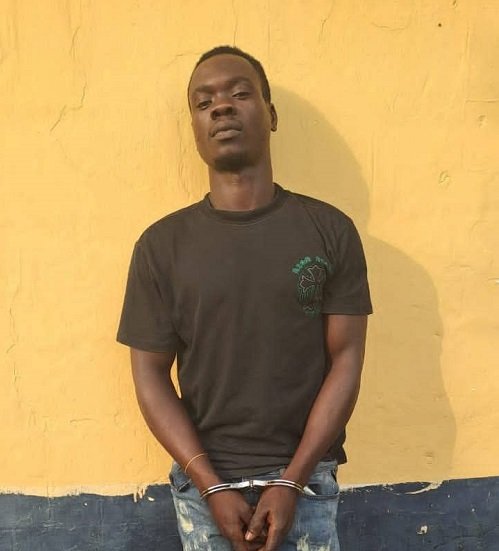
A 30-year-old man has been sentenced to 25 years imprisonment with hard labour by the Bekwai Circuit Court for his role in a 2022 robbery at a mining site at Manso Akwasiso in the Ashanti South Region.
The convict, Dominic Ofori, also known as Fanta, was arrested on 16th February 2026 after years on the run. He pleaded guilty before the Bekwai Circuit Court to robbery contrary to Section 149 of the Criminal Offences Act, 1960 Act 29, and was accordingly sentenced to 25 years imprisonment with hard labour.
On March 20, 2022, the Manso Adubia District Police received intelligence that a group of armed men from Manso Abodom were planning to attack a mining site at Manso Akwasiso to rob the owner of gold concentrate. Acting on the information, police mounted a coordinated operation and laid an ambush at the site.
At about 5:30 pm the same day, four-armed men arrived at the site, fired indiscriminately, and robbed the miners of their gold concentrate. The police team on surveillance intervened, resulting in an exchange of gunfire.
Three of the suspects, Abu Abubakar, Musah Latif, and Gideon Takyi, sustained gunshot wounds and were pronounced dead on arrival at St Martins Catholic Hospital at Agroyesum. Dominic Ofori escaped at the time but was later arrested and put before the court.
The Ashanti South Regional Police Command has assured the public of its continued commitment to combating violent crimes and bringing offenders to justice.
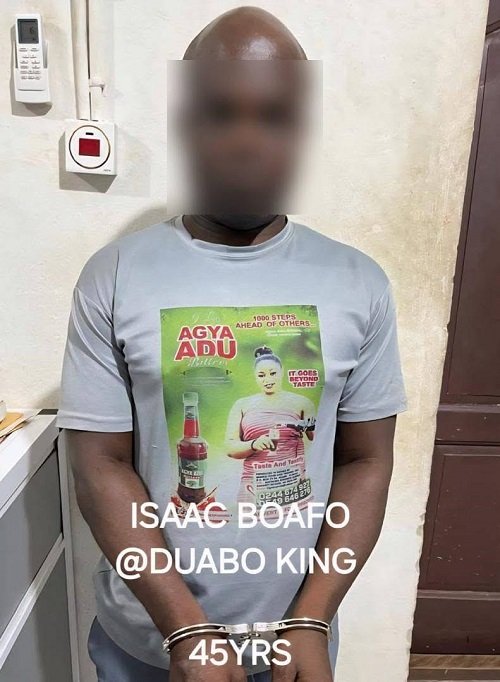
The Ashanti Regional Police Command has arrested 45-year-old Isaac Boafo, also known as “Duabo King,” for allegedly publishing false news intended to cause fear and panic.
Police said the arrest follows a viral TikTok video in which Boafo claimed that four officers at the Central Police Station in Kumasi engaged in inappropriate conduct with commercial sex workers during night patrols in Asafo.
Officers from the Police Intelligence Directorate (Ashanti Region) apprehended Boafo after receiving intelligence about the video.
During questioning, he admitted to creating the video to attract views and engagement online, and acknowledged that he could not prove the allegations.
Boafo also admitted making comments about the President of the Republic for content purposes and could not defend those statements.
He has been formally charged and is in detention as investigations continue.
The Ashanti Regional Police have warned the public against publishing or sharing false information on social media, noting that such acts can cause fear, panic, and damage reputations.
They said anyone found engaging in similar conduct will face legal action.
By: Jacob Aggrey