Features
Today is yesterday’s prediction


• Prediction and prophesy has become the stock-in-trade for some pastors
If you read Nostradamus you were likely to be confused by his prediction of world events. Though Nostradamus died in the 16th Century he predicted the attack on the twin towers of the World Trade Centre in 2001 in New York. He is credited with accurate prediction of scores of other events.
But because some people in his day thought he was a wizard, which he was not, he decided to couch his prediction in such ‘twisted’ prose that it could take very few people to decipher what he meant. Therefore, he wrote Quatrains, which are four-line paragraphs.
Mostly, the world is able to tell his prediction after the event. Nostradamus was a physician, scientist, psychic and astrologer. Astrology is the science of using astronomy to know and understand the heavenly bodies and how they relate to one another and the art of interpreting the effect of those relationships.
But because these heavenly bodies do not compel us, astrology is normally seen and described as steeped in the Law of Probabilities, no matter how accurate readings might be. If everyone understood the subject of astrology, the world would be at peace with itself.
Nostradamus’s Quatrains do not teach the subject but there are many books that do. Hiram Butler’s ‘Solar Biology’ gives an insight and Max Heindel’s ‘Message of the Stars’ and ‘Simplified Scientific Astrology’ are very good materials. I cannot list all good materials in this write-up. There are a thousand and one if them.
I am yet to find out from his book if he predicted COVID 19, though I have read other people’s prediction of the pandemic decades before it struck the world in 2019. Indeed, there are many predictions documented in a lot of publications out there.
I must state that astrology is not the only way to predict the future or any events. People are imbued with many esoteric capabilities. It could be spiritual or psychic. Some have the power to voluntarily or involuntarily vacate their dense bodies and have astral experiences where many events are revealed to them. What they do with the knowledge is entirely up to them. However, these are meant to be to the benefit of humanity.
Sadly, the penchant for predicting the future through prophecy, has become the stock-in-trade of pastors, some with dubious predilection for personal aggrandizement. They have become social media freaks selling their stuff to the highest bidder.
Others rely on dreams to predict events. Clinical psychologists and some psychiatrists have their scientific takes on dreams, but others rely on biblical ascription to the phenomenon and are quick to interpret dreams of dreamers.
Personally, I believe dreams can present many signs but my prescription is for the dreamer to have a diary to write down their dreams after they wake up. As the days roll by, they should read what they wrote against each daily event. That way they can easily determine what their dreams seek to tell them.
I overheard the Inspector General of the Ghana Police Service lamenting the activities of these doomsday prophecies. According to Dr. Akuffo Dampare, none of these characters prophesied that he would become the IGP, but are quick to prophesy his death after his appointment. It looks like these people wait till you come into the public eye, then you become a target for their chicanery.
The actions of these frauds have made it difficult for genuine and lifesaving predictions to be accepted or believed. A friend who was contesting the position of flagbearer of his party prior to the 2008 elections consulted with me. He wanted to succeed the then president who was from his own party.
I told him what to do if he wanted to win over their delegates, else he would be lucky to get a certain number of votes. As politicians are noted, he thought he had convinced the delegates enough to carry the day. When the votes were tallied he got the exact number I said he would get.
If you read my Astrological prediction and analysis for Election 2020 on this page in the December 4 edition of this paper, you will not be surprised about what is happening in this country at this time.
I also predicted turmoil in the National Democratic Congress (NDC) because of the negative influence of Pluto that’s transiting the party’s fortunes till 2026. I don’t know if anyone in that party took note. What erupted in the NDC just a few days ago is a foretaste to cleansing it needed for a more cohesive and solid party all their members will be proud to associate with.
The NDC should brace itself for more eruptions in their ranks, but a steadfast steering of the ship is what will benefit them in the long run. If operatives of the group flail on emotions, the party is likely to self-destruct.
Now, I have people tell me they see a horoscope column in one newspaper or the other giving weekly predictions. I see nothing wrong with such weekly generalisations. The fact is there are distinct characteristics of the various signs of the zodiac. There are common traits among those under Leo just as there are for Sagittarius, for example.
But to cast a horoscope for an individual involves certain personal data. Because the constellation is always on the move, it is vital to provide your exact date of birth, place of birth and, most importantly, the exact time of birth.
Many ignorant midwives and nurses in the delivery wards choose to round-off the time of birth. Astrology records the exact time a baby utters its first cry as the time of birth. A child is delivered at exactly 13:12 hours, but the nurse decides the time of delivery to be either 13:15 or even 13:30.
Knowing the latitudinal and longitudinal positions at birth are important for accurate delianation for a correct prediction. In our parts we give the nearest big town as place of birth.
Many public office holders have a notorious habit of changing the records of their dates of birth. It sticks with them when they seek political elections. An astrologer, having been given the “official” date, uses that to predict an outcome.
At the end of the contest this politician is likely to condemn astrology, forgetting he gave the wrong data on their birth.
My twin daughters were born eight minutes apart. The eight minutes were significant in determining their paths in life. My forecasts have been proved right. Though they are strikingly identical, the only other similarity is their handwritings. One graduated in the Sciences and the other in the Arts as I did forecast.
Our life as a nation is governed by the date and time we were born as a nation, March 6, 1957. However, whatever we do as a people crystalizes to what our future will be. Our today is yesterday’s prediction. Remember we reap what we sow.
When our thought forms and actions, whether positive or negative today crystallize they create a reflecting effect on us tomorrow. We are the architects of our individual and collective national lives. What is important is to play our individual roles to serve the collective well.
Writer’s email address:
akofa45@yahoo.com
By Dr. Akofa K. Segbefia


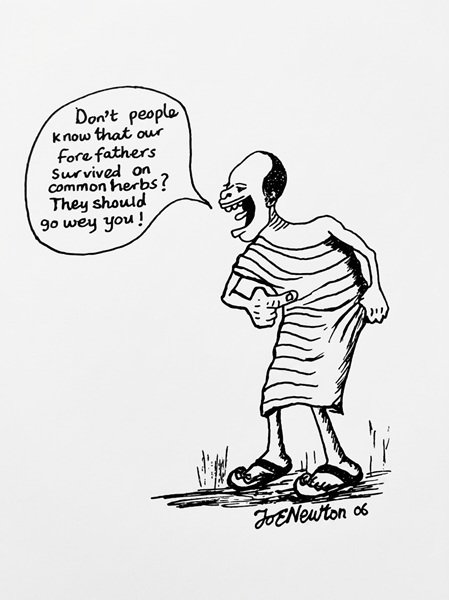
THE typical itinerant salesman in Sikaman is a herbalist. He is normally a slim macho with the capacity to perambulate the expanse of area covering the triangle of Accra-Tema-Ashiaman. In short, he can walk a total of 60 miles a day, marketing a product that cures every disease, including poverty. 
The door-to-door herbal pharmacist advertises his product by word of mouth. He has nothing to do with the Food and Drugs Board (FDB). After all, his concoctions do not feature on FM stations.
Those herbalists who cannot walk to propagate the herbal gospel, liaise with drivers of mass transportation and their mates. They are, therefore, given the chance to sell their products on Benz buses that ply the routes.
Normally, the herbalist starts his sales message with a prayer and Bible study. He asks the passengers to bow down their heads in supplication to God the father, the son, the Holy Spirit.
When a herbalist asks the passengers to close their eyes and bow their heads, Moslems on board naturally feel offended. They feel that the herbalist has no right to assume that every passenger is a Christian. They think such an assumption is an affront to Islam.
So a Moslem on board will raise the hand for a point of order. He’ll remind the herbalist that it would be in his own interest to mind his language.
“Be careful the way you address people in a public place. Not every person here is a Christian,” he’d state assertively.
Of course, the herbalist will promptly ignore him, but would all the same “watch” his tongue. Who knows whether or not the Moslem brother is inspired by Quoranic zeal to defend the tenets of Islam to the hilt?
When he starts saying, “Wallahi!” and “Inshallah!” it could be the beginning of proclaiming Islam as supreme, a point which must be driven home with talibanic precision.
So the herbalist must tread carefully lest he steps on fire.
The herbalist could even add a measure of mirth to it all, by announcing that Christians on board today have very interesting company on the journey, but that should not detract from the business of the day.
The Moslem brother will weigh the words carefully and offer a wry smile.
He must be careful the occasion does not degenerate into the use of semantics and proverbial oration to deride his conviction that public utterances must be mindful of religious sensibilities. He has made his point very clear and expects that it is taken in good faith in the interest of a peaceful journey.
The herbalist will now open the New Testament and preach salvation, stating clearly that salvation can come only through Jesus Christ and NOBODY else.
The Moslem brother will now start twitching his moustache. The visible and almost revolutionary reflexes of his upper lip can be an indication that sentiments have begun superseding reason, and the outcome could well be tragic now shift uneasily in his seat.
The time has come for him to also express his right to the religion of his fore-bears. He’ll put his hand into his pocket and rise to his feet. The time has indeed come!
This article was first published on Saturday, September 9, 2006
When the cause of a particular problem like sickness, disease, sudden illness, a social issue etc. are not known, it stands to reason that resolving it becomes a huge challenge.
Citizens would understand the government when public announcements are made to the effect that government is trying to find a solution to the issue, even though it is taking a while for it to be resolved because citizens are rational beings.
On the other hand, if the solution to a particular issue is known to everybody but the government for whatever reason, is dragging its feet in resolving it, citizens become frustrated and begin to lose trust in their leaders.
One such issue is the heavy traffic along a section of the Kasoa – Odokor road. A short stretch of bad road between the traffic light at the Weija Government Hospital and the entrance to the entrance of the overhead that leads to the N1, is the cause of the problem but nothing is being done about it, day after day, week after week, month after month. Thus is clearly unacceptable.
Another issue that requires urgent attention is the lack of pavements along a lot of streets in parts of the various Municipal Assemblies. Exercise is a prerequisite for long life and healthy living and for those of us who it has become a way of life, this issue of people putting up structures right to the edge of the drains beside the roads, are making life difficult for us.
We are compelled to walk along the roads, putting our lives at serious risk. Pedestrians should never be compelled to compete with vehicles on our streets and roads. Roads and streets are made for vehicles and pavements are made for pedestrians. That is the norm. Any attempt to normalise a situation where pedestrians are mingling with vehicles is insanity.
It is the road regulations that makes it so and therefore district or municipal assemblies are to take responsibility and ensure that spaces for pavements are not encroached upon. Citizens have rights that must be protected by their leaders and making pavements available to pedestrians, is one of them.
When we hear of teachers having sex with students, it appears it is something recent. It is not a new phenomenon. It has been there since Adam. Perhaps this issue is getting much attention due to the proliferation of social media. It was an open secret in times past when Teachers were in relationships with female students and some married them immediately after completion of school.
Some teachers were also known to be having unholy interactions with female pupils but due to the times that these acts occurred, human rights issues and the awareness around it, allowed such unscrupulous teachers to get away with their crimes.
Now we are in a different era and so a Headmaster is now in hot waters. He is alleged to have raped about 19 female students and as usual, some officials tried to cover it up and are also in hot waters and their actions or inactions in the matter are under investigation.
Why the man has been allowed to roam freely without being arrested is simply mind boggling. It appears that the law applies differently, depending on who you are. This issue came to public attention sometime in August this year, yet the police had not arrested or invited this man for question regarding the rape allegation.
It has come out that he is a Constituency Secretary of the ruling party and the question in the public domain is that, is it because he is a political figure that is why he is still walking around without questioning? I believe in the rule of law so let us hold our breadth and let the proper thing be done.
The police must however be seen to be active in this matter. God bless.
SKIP THE QUEUE, TAP THE NEWS
You can now read the Ghanaian Times and The Spectator newspapers from the comfort of your device via TimesNewsPlus.
Join our WhatsApp Channel: https://whatsapp.com/channel/0029VbBElzjInlqHhl1aTU27