Features
Senior High School placement system fraught with corruption?

The Computerised School Selection and Placement System (CSSPS) was introduced in the year 2005 after two years of piloting to replace the manual system which was so hectic and difficult to manage.
The objective of this computerized system has been to fully automate school placement process in order to reduce human errors and to promote efficiency and fairness in the selection and placement of students in the Senior High Schools (SHSs) in the country.
RAW SCORE AS DETERMINING
FACTOR
The CSSPS, uses the raw scores of candidates of the Basic Education Certificates Examination (BECE) as a determinant factor for the selection process. This is done automatically based on aggregate of the candidate including the choice of school and programme made by the candidate. For a candidate to qualify for placement, he or she has to satisfy the total raw score of not less than 200.
Placement is done on the basis of the vacancies declared by the schools and once these vacancies have been filled by the CSSPS in a particular school, it is unable to do any further placement. If a candidate’s aggregate falls within the merit of the programme chosen for the first choice, the CSSPS, then checks the student’s preferred residential status for space and places him or her accordingly. If the desired residential status is full, the system moves him or her to the second choice.
SIGNIFICANCE OF SCHOOL PLACEMENT
It is significant to note that work experience and student placement programmes are designed to provide the student with an opportunity to help develop positive insight, experience and skills that may assist him or her with future employment or to make informed decisions regarding his or her performed career choice.
Prior to the introduction of the CSSPS, placement of graduates in SHS, was done manually. Heads of SHS, would have to gather at regional conferences to go through records of individual candidates as presented by the West African Examination Council (WAEC) and their basic schools and hand-pick students’ performance cards and communicate feedback to parents and guardians, usually through school notice boards.
MANUAL PLACEMENT
In fact, the manual system of placement has its own challenges and disadvantages which are cumbersome in character. For instance, a parent whose child chose schools such as St Augustines College in Cape Coast in the Central Region, Ghana Secondary School in Koforidua in the Eastern Region and Tamale SHS in the Northern Region, in that order of preference, would have to travel all the way to those schools, just to find out which of them had selected his or her child. That to me was so stressful, herculean and difficult task to accomplish.
Besides, there were other weaknesses within that system such as school heads taking longer time to select students based on performance, difficulty of school heads giving equal attention to all candidates at the same time and rising cases of favouritism rather than on performance merit among others. The uncontrolled frustration of parents to the old system, motivated and encouraged the government at that time through the Ministry of Education (MoE) and the Ghana Education Service (GES) together with think tanks within the education sector to come out with the CSSPS as a way of minimising if not to eliminate the stress, toil and sweat of parents and guardians who were anxious to provide their children with good, credible and quality education.
ACHIEVEMENTS OF CSSPS
Indeed, the new computerised system ever since its introduction has stood the test of time and facilitated the placement of students in the Junior High level to that of the SHSs across the country. The Free Education policy by the government has also increased the level of enrolment from the basic to the SHS level, thus putting a lot of stress on the enrollment of students into the SHS and the tertiary education levels. The high level of enrollment has left in its trail difficult moments and brought about corruption and other serious malpractices within the school placement system. Among challenges raised by some parents and guardians was the fact that male students were placed in female schools and vice versa, students placed in day schools in locations far from their homes as well as the inability to successfully go through the self- placement process.
SHORTCOMINGS OF CSSPS
In fact, the CSSPS, has become fertile grounds for bribery and corruption among parents, guardians and officials managing the system in our dear country. The major challenge facing the system has been the human factor in terms of refusal of parents, guardians and students to accept placement into schools apart from their chosen endowed schools. There were numerous instances in which parents and guardians have thronged to resolution centres in the country, furiously protesting against the CSSPS which they claimed had denied their children and wards access to their preferred choice of schools, even though they believed their wards had made the grades. Most parents continue to criticise the system saying that it has messed things up just because their children could not be selected to their preferred schools.
BRIBERY AND CORRUPTION BY PARENTS
Aside all these challenges, some parents were ready to pay huge sums of moneys to officials handling the system including watchmen and security guards in an attempt to induce them to facilitate the placement of their children into the Category A SHSs such as Achimota School, Prempeh College, Pope John SHS, Opoku Ware SHS, Aburi Girls SHS, St Augustine College, Legon PRESEC Boys, among others. That is indeed outrageous and criminal in nature and should not be tolerated or encouraged whatsoever in our educational system.
Recent indications on social media spoke about the arrest of eight persons by the police following Joy News and Fourth Estate’s latest investigative piece “School for Placement for Sale” which uncovered widespread fraud in the CSSPS. The suspects have since been charged and arraigned before court. Investigations revealed that some parents paid up to GH¢20,000 to get their children enrolled in top-tier SHSs. In some cases, people paid as much as Gh¢10,000 to maintain a slot, according to the investigation. That case is pending before the law courts and, therefore, it is advisable not to comment further but to live it to the judiciary to determine the outcome.
CASE OF CORRUPTION PENDING IN COURT
While we allow the court to do justice to the case and bring the culprits to book in order to bring sanity into the CSSPS, it is equally important to call on the MoE and the GES to find ways of addressing the root cause of the problems that have brought about corruption within the system. The authorities must provide inputs in time to the least endowed schools and also upgrade the infrastructural facilities in these schools to make them more attractive to students. By so doing, the pressure on the highly-endowed schools will reduce as most parents are anxious to enroll their children in some of this grade A SHSs in the country. Besides, there is the need to revisit the policy of developing some of these SHSs in each region into model schools with all the modern facilities required in a standard second cycle schools.
ADVICE TO PARENTS AND GUARDIANS
It is equally important to caution parents to refrain from bribing the officials in-charge of the CSSPS to influence them to change the schools of their children even though they knew very well that they did not select some of these grade A schools as their first choice. Parents need to exercise maximum patience and allow the system to work perfectly since it is far better than the old manual system which was fraught with teething challenges. More importantly, officials working at the CSSPS secretariat must be circumspect in their work by showing diligence and be incorruptible in their daily activities.
The CSSPS is currently the best option for placement of students into the SHSs in the country and we must all support it for better results. Let us free the system of the eminent corruption in any form.
Contact email/WhatsApp of author:
ataani2000@yahoo.com
0277753946/0248933366
By Charles Neequaye


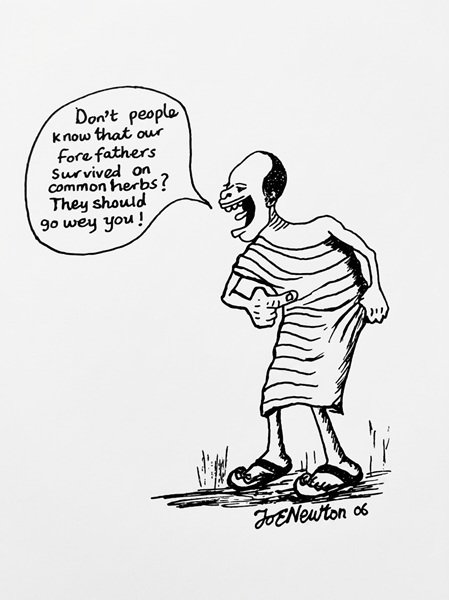
THE typical itinerant salesman in Sikaman is a herbalist. He is normally a slim macho with the capacity to perambulate the expanse of area covering the triangle of Accra-Tema-Ashiaman. In short, he can walk a total of 60 miles a day, marketing a product that cures every disease, including poverty. 
The door-to-door herbal pharmacist advertises his product by word of mouth. He has nothing to do with the Food and Drugs Board (FDB). After all, his concoctions do not feature on FM stations.
Those herbalists who cannot walk to propagate the herbal gospel, liaise with drivers of mass transportation and their mates. They are, therefore, given the chance to sell their products on Benz buses that ply the routes.
Normally, the herbalist starts his sales message with a prayer and Bible study. He asks the passengers to bow down their heads in supplication to God the father, the son, the Holy Spirit.
When a herbalist asks the passengers to close their eyes and bow their heads, Moslems on board naturally feel offended. They feel that the herbalist has no right to assume that every passenger is a Christian. They think such an assumption is an affront to Islam.
So a Moslem on board will raise the hand for a point of order. He’ll remind the herbalist that it would be in his own interest to mind his language.
“Be careful the way you address people in a public place. Not every person here is a Christian,” he’d state assertively.
Of course, the herbalist will promptly ignore him, but would all the same “watch” his tongue. Who knows whether or not the Moslem brother is inspired by Quoranic zeal to defend the tenets of Islam to the hilt?
When he starts saying, “Wallahi!” and “Inshallah!” it could be the beginning of proclaiming Islam as supreme, a point which must be driven home with talibanic precision.
So the herbalist must tread carefully lest he steps on fire.
The herbalist could even add a measure of mirth to it all, by announcing that Christians on board today have very interesting company on the journey, but that should not detract from the business of the day.
The Moslem brother will weigh the words carefully and offer a wry smile.
He must be careful the occasion does not degenerate into the use of semantics and proverbial oration to deride his conviction that public utterances must be mindful of religious sensibilities. He has made his point very clear and expects that it is taken in good faith in the interest of a peaceful journey.
The herbalist will now open the New Testament and preach salvation, stating clearly that salvation can come only through Jesus Christ and NOBODY else.
The Moslem brother will now start twitching his moustache. The visible and almost revolutionary reflexes of his upper lip can be an indication that sentiments have begun superseding reason, and the outcome could well be tragic now shift uneasily in his seat.
The time has come for him to also express his right to the religion of his fore-bears. He’ll put his hand into his pocket and rise to his feet. The time has indeed come!
This article was first published on Saturday, September 9, 2006
When the cause of a particular problem like sickness, disease, sudden illness, a social issue etc. are not known, it stands to reason that resolving it becomes a huge challenge.
Citizens would understand the government when public announcements are made to the effect that government is trying to find a solution to the issue, even though it is taking a while for it to be resolved because citizens are rational beings.
On the other hand, if the solution to a particular issue is known to everybody but the government for whatever reason, is dragging its feet in resolving it, citizens become frustrated and begin to lose trust in their leaders.
One such issue is the heavy traffic along a section of the Kasoa – Odokor road. A short stretch of bad road between the traffic light at the Weija Government Hospital and the entrance to the entrance of the overhead that leads to the N1, is the cause of the problem but nothing is being done about it, day after day, week after week, month after month. Thus is clearly unacceptable.
Another issue that requires urgent attention is the lack of pavements along a lot of streets in parts of the various Municipal Assemblies. Exercise is a prerequisite for long life and healthy living and for those of us who it has become a way of life, this issue of people putting up structures right to the edge of the drains beside the roads, are making life difficult for us.
We are compelled to walk along the roads, putting our lives at serious risk. Pedestrians should never be compelled to compete with vehicles on our streets and roads. Roads and streets are made for vehicles and pavements are made for pedestrians. That is the norm. Any attempt to normalise a situation where pedestrians are mingling with vehicles is insanity.
It is the road regulations that makes it so and therefore district or municipal assemblies are to take responsibility and ensure that spaces for pavements are not encroached upon. Citizens have rights that must be protected by their leaders and making pavements available to pedestrians, is one of them.
When we hear of teachers having sex with students, it appears it is something recent. It is not a new phenomenon. It has been there since Adam. Perhaps this issue is getting much attention due to the proliferation of social media. It was an open secret in times past when Teachers were in relationships with female students and some married them immediately after completion of school.
Some teachers were also known to be having unholy interactions with female pupils but due to the times that these acts occurred, human rights issues and the awareness around it, allowed such unscrupulous teachers to get away with their crimes.
Now we are in a different era and so a Headmaster is now in hot waters. He is alleged to have raped about 19 female students and as usual, some officials tried to cover it up and are also in hot waters and their actions or inactions in the matter are under investigation.
Why the man has been allowed to roam freely without being arrested is simply mind boggling. It appears that the law applies differently, depending on who you are. This issue came to public attention sometime in August this year, yet the police had not arrested or invited this man for question regarding the rape allegation.
It has come out that he is a Constituency Secretary of the ruling party and the question in the public domain is that, is it because he is a political figure that is why he is still walking around without questioning? I believe in the rule of law so let us hold our breadth and let the proper thing be done.
The police must however be seen to be active in this matter. God bless.
SKIP THE QUEUE, TAP THE NEWS
You can now read the Ghanaian Times and The Spectator newspapers from the comfort of your device via TimesNewsPlus.
Join our WhatsApp Channel: https://whatsapp.com/channel/0029VbBElzjInlqHhl1aTU27