Features
The beauty of rural Easter


SOMETIMES, it is good tonic going to the village to celebrate an occasion like Easter. But it all really depends on whether you know your hometown or not. You can’t go where you don’t know unless you are led like a blind man.
The problem is that many have been born outside their ancestral homes and have since then not had the courage or the money to travel and see the birth place of their forefathers.
For those who know their home-town, going back to celebrate the Easter is normally easy especially when they are not suffering from a financial disease.
However, my former classmate Kwame Korkorti has just reiterated that he would never go to his hometown again because he is the target of witches.
Yes, it is twelve good years now since the guy touched his roots. The last time he was there, he was nearly converted into a billy goat to be slaughtered for groundnut soup. He had about 13 nightmares in a single night and courtesy calls from witches of all kinds, profile and red-eye.
Apparently, they had come at mid-night to welcome back the great Korkorti Asamoah from the capital city. But the welcome ceremony was rather unorthodox. Instead of sitting down and exchanging greetings and telling of their mission, they rather held Korkorti’s limbs and started dragging him to where he didn’t know.
If the great Korkorti had not turned to Christ and shouted “Jesus!” for seven consecutive times, he would have ended up in the soup-pot, clean! But God was on his side and Jesus heard his cry. Korkorti has never been a religious person, but when it comes to matters of life and death, he knows where power lies.
Witch or no witch, going back to your hometown on an occasion is always a refreshing idea. Rural life is particularly exciting when palm wine is in season. The price is not like that of beer.
Moreover, palm wine is a health-drink. The dregs are laden with what any ‘unbeliever’ would term impurities. But believe me, the chemistry concerning the benefits of these ‘impurities’ is not far-fetched. The dregs have yeast in unusually large quantities.
Legend also has it that the impurities have been the magic that has kept wives from divorcing their husbands, even when the husbands are poor to the point of hopelessness.
At least, when these husbands drink the dregs of palm wine, they fulfil their marital obligations in style, keeping the marital bed hot and throbbing. The secret of a happy home indeed lies in the dregs of palm wine. Unfortunately, people do not know.
Yeah, Easter in the village is not a bad idea at all. Right from Palm Sunday, the action starts because most people equate Palm Sunday with palm nut soup.
There are certain rare herbs that are introduced in palmnut soup to make it delicious albeit rural. You won’t find such herbs in Accra. Bush meat also makes a difference.
Then comes GOOD FRIDAY when Jesus was betrayed by one of his right-hand men JUDAS ISCARIOT. He is the man who deserves the most honour, being the person who gave out Jesus to be crucified, so that mankind can be saved.
Those who hate Judas should repent today and start loving him. Without him, there would have been no hope for you and me.
In the villages, people consciously or unconsciously acknowledge the role played by Judas the bad boy. They express this in the course of what can be termed an alcoholic festival during which mixtures are permitted.
You can combine akpet with palmwine, add a little beer and finally top it with gin and akpet again. If the next dawn you find yourself sprawled in a dirty gutter, don’t be surprised. It all goes to confirm the fact that Judas’ role was indeed a hard one.
Holy Saturday is normally a day that begins with a hangover. And the ‘ghost’ must be cleared otherwise you’ll still be seeing things in twos and threes although you’re not suffering from kooko. Two tots of gin clears the eye and also opens the stomach for food.
Easter Sunday or is it Holy Sunday? Is more religious in outlook. People dress in their best clothes and their style of walking to church is always varied depending on where they come from to spend the Easter. In fact, it all depends on whether they come from Accra, Kumasi, Obo Kwahu, Tapa Abotoase or Teteman.
Those from Accra normally want to show a bit of class and therefore dance to church rather than walk. And before they sit on the pew, they spin round to see if people are admiring them. In fact, they are stylish.
You can also observe that those from Kumasi are often flamboyantly dressed. And when they walk to church, you’d think they are about to fly. Even the proverbial vulture in all his pomp and majesty, fully bedecked in royal kente will not be that airborne. Kumasi is not a cheap city, you know!
Other celebrants are of course also finely dressed and some walk to the church as if they are hurrying to catch grasscutter. The sermon is normally lively primarily because people from Accra are around.
The pastor becomes charged with the spirit and he delivers the word while employing heavenly gestures to stress biblical points.
As for the catechist, this is his day of glory. He is extra holy and he is the centre of attraction. The entire church revolves around him. It is he who can ask the Holy Spirit not to descend.
After the church service, everything becomes easy-going again with ‘palms’ featuring prominently and pestles crashing against motars to signify that fufu is being manufactured.
Monday is picnic-time. It is usually a sort of bring-your bottle and ‘supply your own food’ palaver. But it is always prudent to make allowance for gate-crashers. They bring nothing but go home the most bellyful.
Well, it is all a matter of loving your neighbour as yourself.
Even if you’re given a slap on the left cheek, you must reckon that is not enough; and you musn’t slap back. Instead, you have to turn your right cheek too and invite the slappist or the slapper to do the job on this one too. That is the only way you can go to heaven. So those who are always thinking about revenge should take note.
Monday! Everybody who comes from ‘away’ goes back to base. The next day, the cart pullers would start work, the civil servants would continue with their demand for more pay, traders would start quarrelling and selling and life grinds on and on.
The Easter is over and this shows clearly in the slimness of the back-pocket. But wasn’t it worth it? It was! You’ve at least gone to the village and taken the dregs of palm wine to make your wife happy. But remember there is something called Family Planning.
This article was first published on Saturday April 22, 1995

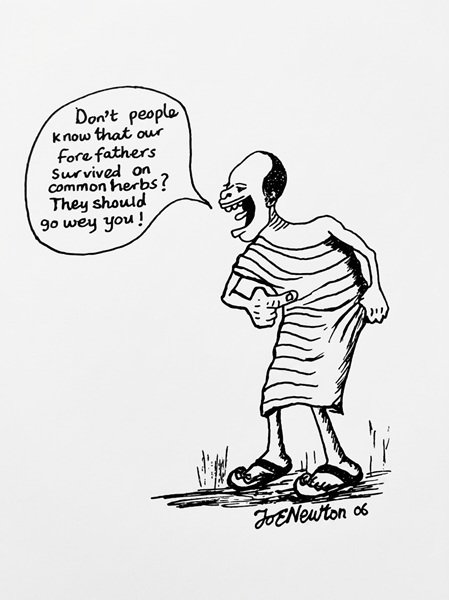
THE typical itinerant salesman in Sikaman is a herbalist. He is normally a slim macho with the capacity to perambulate the expanse of area covering the triangle of Accra-Tema-Ashiaman. In short, he can walk a total of 60 miles a day, marketing a product that cures every disease, including poverty. 
The door-to-door herbal pharmacist advertises his product by word of mouth. He has nothing to do with the Food and Drugs Board (FDB). After all, his concoctions do not feature on FM stations.
Those herbalists who cannot walk to propagate the herbal gospel, liaise with drivers of mass transportation and their mates. They are, therefore, given the chance to sell their products on Benz buses that ply the routes.
Normally, the herbalist starts his sales message with a prayer and Bible study. He asks the passengers to bow down their heads in supplication to God the father, the son, the Holy Spirit.
When a herbalist asks the passengers to close their eyes and bow their heads, Moslems on board naturally feel offended. They feel that the herbalist has no right to assume that every passenger is a Christian. They think such an assumption is an affront to Islam.
So a Moslem on board will raise the hand for a point of order. He’ll remind the herbalist that it would be in his own interest to mind his language.
“Be careful the way you address people in a public place. Not every person here is a Christian,” he’d state assertively.
Of course, the herbalist will promptly ignore him, but would all the same “watch” his tongue. Who knows whether or not the Moslem brother is inspired by Quoranic zeal to defend the tenets of Islam to the hilt?
When he starts saying, “Wallahi!” and “Inshallah!” it could be the beginning of proclaiming Islam as supreme, a point which must be driven home with talibanic precision.
So the herbalist must tread carefully lest he steps on fire.
The herbalist could even add a measure of mirth to it all, by announcing that Christians on board today have very interesting company on the journey, but that should not detract from the business of the day.
The Moslem brother will weigh the words carefully and offer a wry smile.
He must be careful the occasion does not degenerate into the use of semantics and proverbial oration to deride his conviction that public utterances must be mindful of religious sensibilities. He has made his point very clear and expects that it is taken in good faith in the interest of a peaceful journey.
The herbalist will now open the New Testament and preach salvation, stating clearly that salvation can come only through Jesus Christ and NOBODY else.
The Moslem brother will now start twitching his moustache. The visible and almost revolutionary reflexes of his upper lip can be an indication that sentiments have begun superseding reason, and the outcome could well be tragic now shift uneasily in his seat.
The time has come for him to also express his right to the religion of his fore-bears. He’ll put his hand into his pocket and rise to his feet. The time has indeed come!
This article was first published on Saturday, September 9, 2006
When the cause of a particular problem like sickness, disease, sudden illness, a social issue etc. are not known, it stands to reason that resolving it becomes a huge challenge.
Citizens would understand the government when public announcements are made to the effect that government is trying to find a solution to the issue, even though it is taking a while for it to be resolved because citizens are rational beings.
On the other hand, if the solution to a particular issue is known to everybody but the government for whatever reason, is dragging its feet in resolving it, citizens become frustrated and begin to lose trust in their leaders.
One such issue is the heavy traffic along a section of the Kasoa – Odokor road. A short stretch of bad road between the traffic light at the Weija Government Hospital and the entrance to the entrance of the overhead that leads to the N1, is the cause of the problem but nothing is being done about it, day after day, week after week, month after month. Thus is clearly unacceptable.
Another issue that requires urgent attention is the lack of pavements along a lot of streets in parts of the various Municipal Assemblies. Exercise is a prerequisite for long life and healthy living and for those of us who it has become a way of life, this issue of people putting up structures right to the edge of the drains beside the roads, are making life difficult for us.
We are compelled to walk along the roads, putting our lives at serious risk. Pedestrians should never be compelled to compete with vehicles on our streets and roads. Roads and streets are made for vehicles and pavements are made for pedestrians. That is the norm. Any attempt to normalise a situation where pedestrians are mingling with vehicles is insanity.
It is the road regulations that makes it so and therefore district or municipal assemblies are to take responsibility and ensure that spaces for pavements are not encroached upon. Citizens have rights that must be protected by their leaders and making pavements available to pedestrians, is one of them.
When we hear of teachers having sex with students, it appears it is something recent. It is not a new phenomenon. It has been there since Adam. Perhaps this issue is getting much attention due to the proliferation of social media. It was an open secret in times past when Teachers were in relationships with female students and some married them immediately after completion of school.
Some teachers were also known to be having unholy interactions with female pupils but due to the times that these acts occurred, human rights issues and the awareness around it, allowed such unscrupulous teachers to get away with their crimes.
Now we are in a different era and so a Headmaster is now in hot waters. He is alleged to have raped about 19 female students and as usual, some officials tried to cover it up and are also in hot waters and their actions or inactions in the matter are under investigation.
Why the man has been allowed to roam freely without being arrested is simply mind boggling. It appears that the law applies differently, depending on who you are. This issue came to public attention sometime in August this year, yet the police had not arrested or invited this man for question regarding the rape allegation.
It has come out that he is a Constituency Secretary of the ruling party and the question in the public domain is that, is it because he is a political figure that is why he is still walking around without questioning? I believe in the rule of law so let us hold our breadth and let the proper thing be done.
The police must however be seen to be active in this matter. God bless.
SKIP THE QUEUE, TAP THE NEWS
You can now read the Ghanaian Times and The Spectator newspapers from the comfort of your device via TimesNewsPlus.
Join our WhatsApp Channel: https://whatsapp.com/channel/0029VbBElzjInlqHhl1aTU27