Hot!
RMU, DMI gears up for 3rd Blue Economy Conference


Dr Brooks (right) interacting with Rector, DMI, Dr Tumaini S. Gurumo
(middle) and a colleague during their recent visit to Ghana
The third edition of the Blue Economy Conference (BEC2024) is set for July 4-5 at the Julius Nyerere International Convention Center in Tanzania.
The conference organized by the Dar es Salaam Maritime Institute (DMI), Tanzania in collaboration with the Regional Maritime University (RMU) in Accra, would be under the theme, “Navigating the Future: Integrating Maritime Safety and Security, Climate Change Actions and Technological Advancements for Blue Economy.”
The conference is aimed at bringing together international stakeholders, focusing on promoting the blue economy to lead development across the continent.
The blue economy every year, has an estimated turnover of between US$3 and six billion. This includes employment, ecosystem services provided by the ocean and cultural services. It is also estimated that fisheries and aquaculture contributes US$100 billion per year and about 260 million jobs to the global economy, according to United Nations (UN) Department of Economic and Social Affairs (DESA) report.
With the huge potential of the blue economy, Africa through the conference, is looking forward to developing the maritime sector to tap into its benefits for socio-economic growth.
The conference is also aimed at establishing a platform for capacity building and networking among stakeholders, fostering the blue economy in alignment with maritime safety and security, climate change considerations and technological advancements as outlined in the relevant Sustainable Development Goals (SDGs).
The conference would tackle other areas including sustainable exploitation and utilisation of blue economy resources, ship seaworthiness and on board-ship competency challenges, business models for the blue economy, women in maritime sector, fishing industry and climate action policy and environmental protection.
There would also be discussions on Artificial Intelligence(AI) in maritime practices and the blue economy, renewable energy solutions for maritime transportation, information systems in maritime education and training, logistics, shipping and supply chains for the blue economy, climate-responsive maritime practices and coastal management, blue economy governance, law and policy as well as coastal and marine tourism development.
Keynote Speaker for the event would be the Deputy Minister for Transport, Tanzania Mr David Mwakiposa Kihenzile, with other speakers including Secretary General, Maritime Organisation of West and Central Africa (MOWCA), Dr Paul Ikongshul Adalikwu, Maritime Law and Management Consultant, Dr Kofi Mbia, Special Advisor for Maritime and Blue Economy, Amb. Nancy Karigithu, Executive Director,Sierra Leone Maritime Authority Paul Sobba Massaquoi and Climate Specialist, Mr Pa Ousman Jarju.
The DMI had held the Blue Economy Conference for the past two years and now joining forces with the RMU to hold the third edition this year, following a Memorandum of Understanding (MoU) between the two giants in maritime education and training in February.
The MoU covers areas of research and publication, staff capacity building, organisation of conferences and seminars and workshops among others, hence the collaboration to hold this year’s conference.
Speaking ahead of the conference, the Ag. Vice Chancellor of the RMU, Dr Jethro W. Brooks Jr said, both institutions have committed to transforming economies across Africa by providing quality training and education that would ensure that young people were equipped and positioned to drive the maritime sector.
“We look forward for an insightful conference that would support the transformation of the African continent through the maritime industry,” he stated.


The Diaspora Affairs Office at the Office of the President has hosted a delegation of African diaspora women who are in Ghana ahead of a planned Presidential Conferment of Citizenship ceremony.
The Director of Diaspora Affairs, Kofi Okyere Darko, explained in a Facebook post that the visit was a gesture of appreciation by the delegation to the Government of Ghana for its continued efforts to reconnect Africans in the diaspora with their ancestral homeland.
He indicated that the ceremony, scheduled for next Monday, will officially grant Ghanaian citizenship to members of the delegation as part of the country’s broader engagement with the African diaspora.
The delegation was led by Erica Bennett, Founder of the Diaspora Africa Forum.
According to Mr Okyere Darko, her years of advocacy have played an important role in strengthening ties between Africa and people of African descent living abroad.
He noted that the group’s journey towards citizenship represents not only a legal process but also a cultural and spiritual return to their roots.
Also present at the meeting was Natalie Jackson, an attorney who is also expected to receive Ghanaian citizenship during the ceremony. She works closely with renowned civil rights lawyer Ben Crump.
Mr Okyere Darko emphasised that Ghana remains committed to strengthening relationships with the African diaspora and promoting unity, identity, and shared heritage among people of African descent worldwide.
By: Jacob Aggrey
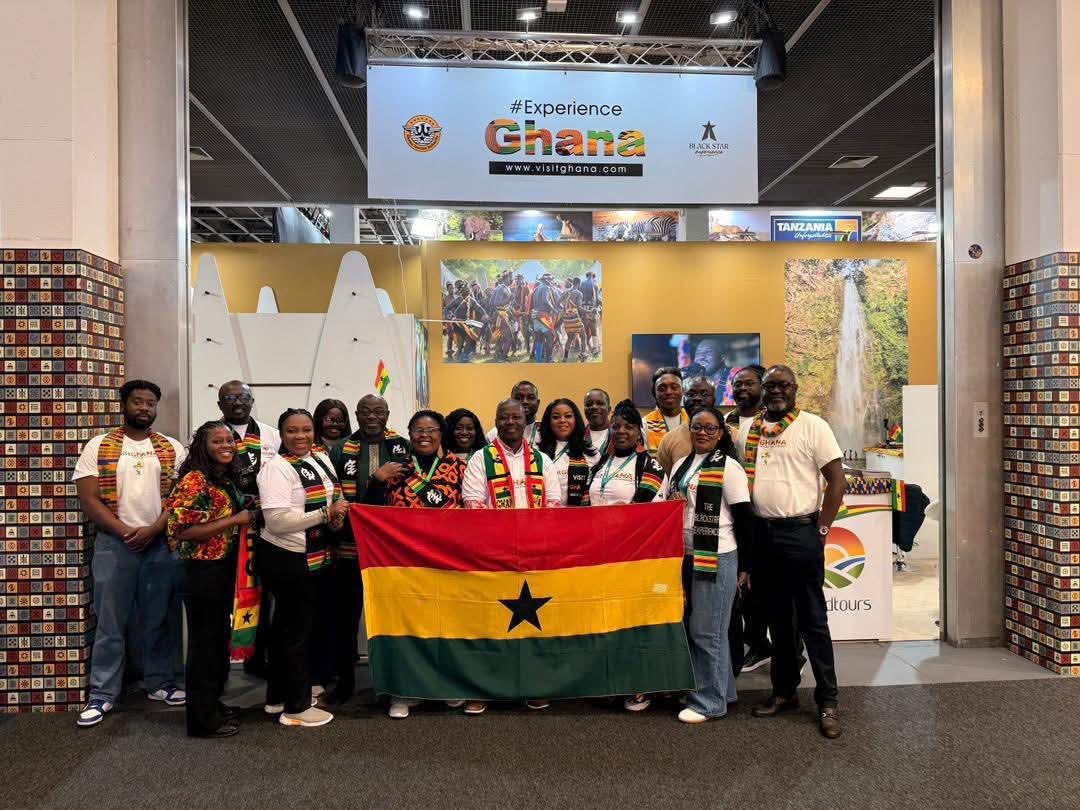
Ghana Tourism Authority is leading Ghana’s participation at ITB Berlin, which opened in Berlin with a vibrant national pavilion highlighting Ghana’s rich cultural heritage, tourism destinations and investment opportunities.
March 5 has been designated as Ghana Day, a special platform to promote Ghana’s languages, cuisine, Kente, festivals and business prospects to the global tourism community. The stand has already drawn strong interest with traditional arts and crafts displays, immersive multimedia presentations and popular Ghanaian snacks.
Seven private-sector players are exhibiting alongside government officials as part of efforts to deepen trade partnerships, expand market access, and attract investment across the hospitality, heritage tourism, ecotourism, and creative arts sectors.
Ahead of the official opening, the Ghana delegation also engaged young Ghanaian investors in Germany in collaboration with V Afrika-Verein and the Ghana Embassy, strengthening diaspora investment linkages and highlighting opportunities within the tourism value chain.
Ghana’s coordinated presence at ITB Berlin 2026 reinforces its strategy to position the country as the Gateway to Africa and a competitive destination for leisure travel and global investment.

 News2 days ago
World Mission Society Church of God organises cleanup exercise
- News1 week ago
Finance Minister outlines new gold policies to boost reserves and curb smuggling
- News1 week ago
Sam George launches the 2026 Meteorological Awareness Month; presents the 2026 seasonal forecast for southern Ghana