News
Right to Information Law: a framework to combat corruption?

Dear Editor,
Over the years, journalists, civil society and anti-corruption advocates have campaigned for the passage of the Right to Information (RTI) Bill and argued that the inexistence of the law inhibits people from knowing what is happening in public institutions, and this breeds corruption.
Even though the right to information is a basic right enshrined in the 1992 Constitution of Ghana, it took decades for the country to promulgate the RTI to provide the legal framework for the implementation of the constitutional right to access information from public institutions.
After years of long winding parliamentary processes, the bill was finally passed on March 26, 2019 and assented to by President Nana Dankwa Akufo-Addo on May 21, 2019.
The Act explains the procedures for access to official information, and also highlights some exemptions.
From section five (5) to 17 of the RTI Act, 2019 (Act 989) is about information exempted from the Act, which include information for the President, Vice President or Cabinet.
Others are related to public safety, law enforcement, economic information of third parties, personal matters, parliamentary privilege, issues affecting international relations and security of the state.
Just like other critics of the Act, I also hold the view that some of the exemptions raise question over whether or not sections of the law could be a deliberate cover up for wrongdoings of public institutions or governments.
For instance, the section 10(f) in the Act exempts the disclosure of information where “the information contains questions or methodology to be used in an examination, recruitment or selection process and the release is likely to jeopardise the integrity of that examination, recruitment or selection process.”
Despite the use of public safety as an excuse to conceal wealth of public information, the Act recognises the principle of utility as it is stated in the section 17 (1) that, if the benefits of disclosure of the information outweigh the harm that disclosure will cost and it is of public interest, then the information is not exempted from disclosure.
Persons who have taken a closer look at the Act suggest there are too many exemptions that do not provide an enabling environment to assess public institutions and subject them to proper scrutiny to help fight corruption.
Even as public education on the law is gathering momentum, there have been calls for a review of the exemptions in the Act. Those that do not qualify the “harm and public interest” test be expunged.
Meanwhile, Parliament was yet to approve fees applicable to the request of public information under the Act. That must also be fast tracked.
Cinderella Arhinful-Mensah
Student, Ghana Institute of Journalism (GIJ)



A 30-year-old man has been sentenced to 25 years imprisonment with hard labour by the Bekwai Circuit Court for his role in a 2022 robbery at a mining site at Manso Akwasiso in the Ashanti South Region.
The convict, Dominic Ofori, also known as Fanta, was arrested on 16th February 2026 after years on the run. He pleaded guilty before the Bekwai Circuit Court to robbery contrary to Section 149 of the Criminal Offences Act, 1960 Act 29, and was accordingly sentenced to 25 years imprisonment with hard labour.
On March 20, 2022, the Manso Adubia District Police received intelligence that a group of armed men from Manso Abodom were planning to attack a mining site at Manso Akwasiso to rob the owner of gold concentrate. Acting on the information, police mounted a coordinated operation and laid an ambush at the site.
At about 5:30 pm the same day, four-armed men arrived at the site, fired indiscriminately, and robbed the miners of their gold concentrate. The police team on surveillance intervened, resulting in an exchange of gunfire.
Three of the suspects, Abu Abubakar, Musah Latif, and Gideon Takyi, sustained gunshot wounds and were pronounced dead on arrival at St Martins Catholic Hospital at Agroyesum. Dominic Ofori escaped at the time but was later arrested and put before the court.
The Ashanti South Regional Police Command has assured the public of its continued commitment to combating violent crimes and bringing offenders to justice.
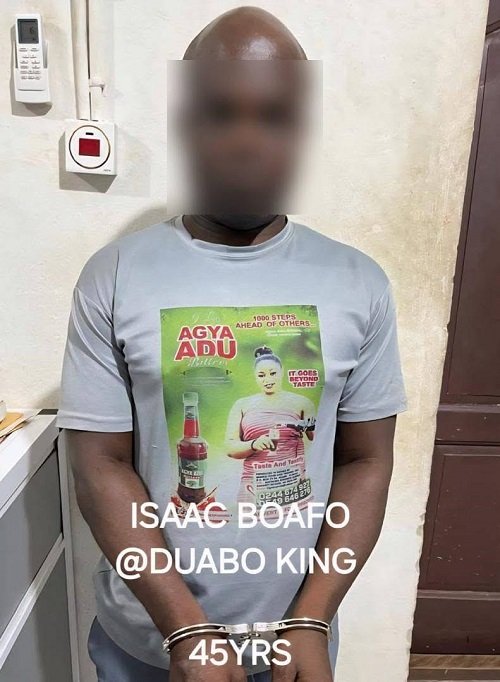
The Ashanti Regional Police Command has arrested 45-year-old Isaac Boafo, also known as “Duabo King,” for allegedly publishing false news intended to cause fear and panic.
Police said the arrest follows a viral TikTok video in which Boafo claimed that four officers at the Central Police Station in Kumasi engaged in inappropriate conduct with commercial sex workers during night patrols in Asafo.
Officers from the Police Intelligence Directorate (Ashanti Region) apprehended Boafo after receiving intelligence about the video.
During questioning, he admitted to creating the video to attract views and engagement online, and acknowledged that he could not prove the allegations.
Boafo also admitted making comments about the President of the Republic for content purposes and could not defend those statements.
He has been formally charged and is in detention as investigations continue.
The Ashanti Regional Police have warned the public against publishing or sharing false information on social media, noting that such acts can cause fear, panic, and damage reputations.
They said anyone found engaging in similar conduct will face legal action.
By: Jacob Aggrey