Hot!
Revolutionising STEM education among SHS students …Nana Afrah Sika Mensah’s passion


● Nana Afrah Sika Mensah
It is without doubt, that harnessing the expertise and techniques of students in second-cycle institutions is a requisite for building a buoyant nation which has the potency of making a resilient economy.
The Spectator, in this week’s profile, has spotted a phenomenal woman whose interest in the area of education, is to help students in senior high schools churn out innovative and inventive modules while studying science, technology and its related programmes.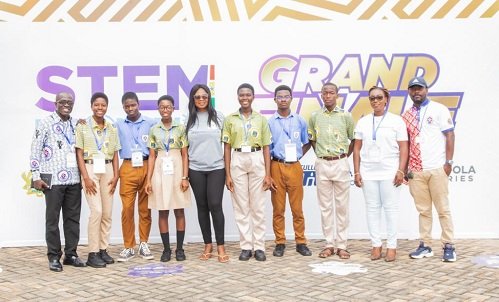
some students
Nana Afrah Sika Mensah, Deputy Coordinator for Free SHS is a public official who is passionately increasing awareness and making a paradigm shift to enhance the interest of Science, Technology, Engineering and Mathematics among SHS students to help in improving the technological advancement of Ghana.
The Deputy Coordinator during the exclusive interview, underscored the need for more investment in the field of STEM education because there are myriad of opportunities for the students offering such programmes.


STEM, a gateway to socio-economic development
Nana Afrah with a voice of optimism told The Spectator, STEM was an essential tool that has a significant impact on the socio-economic advancement of the country which tasks students to invent mind-boggling technologies for the benefit of all.
According to the change agent, it is very crucial to imbibe technical know-how to SHS students in order to help them manufacture technological tools and devices while in school to impact society through the innovations created.
The Deputy Coordinator explained that, the Free SHS Secretariat of the Ministry of Education ‘STEMNNOVATION’ contest introduced this year, witnessed Senior High/Technical, Technical and Vocational Education and Training (TVET) institutions battle the supremacy of bringing out best projects.
The practical contest, she indicated, touched on three thematic areas including Coding and Programming for socio-economic development, Recycling for socio-economic development and Solar for socio-economic development.
In awe-amazement, Nana Afrah told The Spectator that she was marvelled by the projects undertaken by the students intended to solve societal problems.
Empowerment/ Supporting girls in STEM
The activist of STEM education among women debunked the assertion that the “woman’s place is in the kitchen” and described it as an archaic cliché which cannot be uttered in this modern era of technological advancement.
Nana Afrah encouraged female students to venture into areas of STEM because it is a possible field where girls can equally perform as their male counterparts and the opportunities available are also the same for females to also tap into.
The activist was hopeful that there would be a lot of women venturing into STEM in Ghana with the aid of the ‘STEMNNOVATION’ contest which would automatically dismantle barriers associated with gender gaps in the aforementioned areas.
“We would integrate STEM programmes right from the early stages and make it appealing for all especially girls by boosting their morale through merit and performance,” she reiterated the commitment of the Free SHS Secretariat.
She added that women in STEM can also offer a personal input on existing social issues that can be ridden with the help of science and technology innovations.
“Let’s defy all odds by overcoming obstacles that may pose itself in any form and stay focused to achieve our aspirations with determination and be careful about actions you take at this formative stage because it can make and unmake you,” the STEM advocate made this ardent call.
Motivation/Appreciation
Though Nana Afrah hilariously said “Education is in my genes,” she owed gratitude to the Education Minister and his Deputy for their staunch support by making her execute great mandates at the Free SHS Secretariat.
Her motivation spans from seeing students have education to the fullest without any hindrance and seeing children blossom to be responsible citizens in the society.
She expressed gratitude to all staff of the Free SHS Secretariat for their indefatigable hardworking nature to make a feat in all projects embarked by the secretariat.
“Let’s give a standing ovation to my parents, Mr and Mrs Mensah, for their phenomenal support and motivation which has brought me this far to serve with passion and help unleash talents among the young students,” she said.
She expressed profound appreciation to all her loved ones for the encouragement and motivation they give her.
Nana Afrah’s Journey of being a distinguished Educationist
Her enthusiasm of being an educationist stems from her fondness of seeing children become useful citizens in future.
That, nevertheless, Nana Afrah chronicled her dream of being an educationist by enrolling at the Holy Child College of Education at Sekondi-Takoradi in the Western Region where she read Diploma in Education.
The determined lady later proceeded to the University of Education, Winneba where she completed with a Bachelor’s Degree in Education and with the aim of putting herself on a higher pedestal, she went to China’s North East Normal University and bagged a Master’s in Educational Management, Leadership and Policy.
She rose through the ranks as a teacher and occupied administrative roles in the education field to become the Deputy Coordinator for Free SHS and still making significant impacts with her portfolio.
Interests
Nana Afrah is a Christian by religion and an Adventist who as usual cannot hide her love for music which soothes her at leisure hours but unfortunately cannot dance and only dances well while sitting.
The ampesi, banku, and fufu lover takes delight in seeing progress in students’ educational level and helping build a buoyant nation.
By Alfred Nii Arday Ankrah


The professor who spends his days exploring the intricacies of African languages found himself at the centre of a different kind of lesson on Friday, October 2, 2026. 
This time, there were no lecture notes, academic arguments or university classrooms. Instead, there was the weight of tradition, the rhythm of a community celebration and the solemnity of an oath at a royal palace.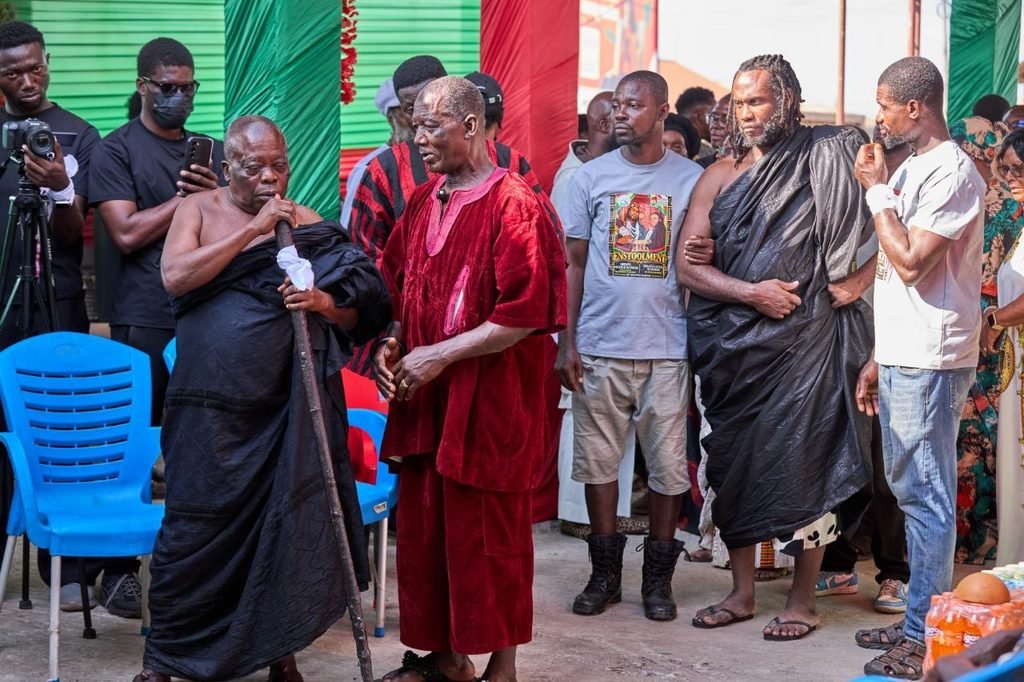
Professor Ọbádélé Kambon, a full Professor of African Linguistics at the University of Ghana, was enstooled as Apagyahene and Sunsum Ɔsahene of Akuapem Mampong in the Eastern Region in a ceremony that brought academia and traditional authority together.
For the professor, the occasion was more than a new title. It was a moment that connected his academic interests in African languages and indigenous knowledge with the living traditions of an Akan community.
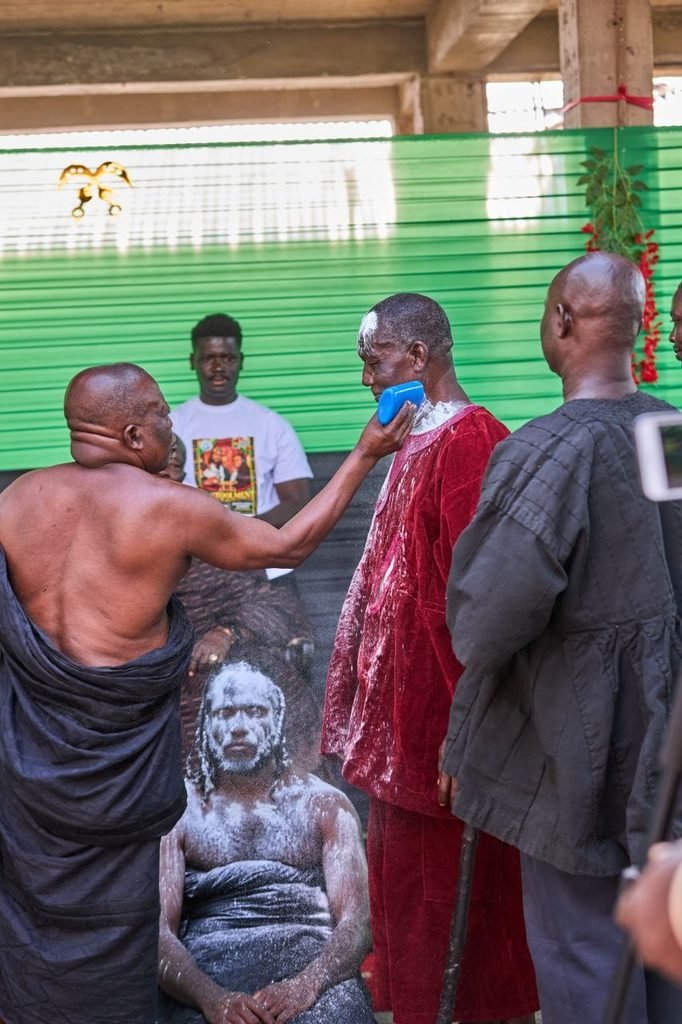
The day’s events unfolded through a series of customary observances. Kambon was first taken to the compounds of the Ɔkyeamehene and Gyasehene, where the preparations for his installation continued.
Then came the application of hyire, the white kaolin powder associated with traditional rites.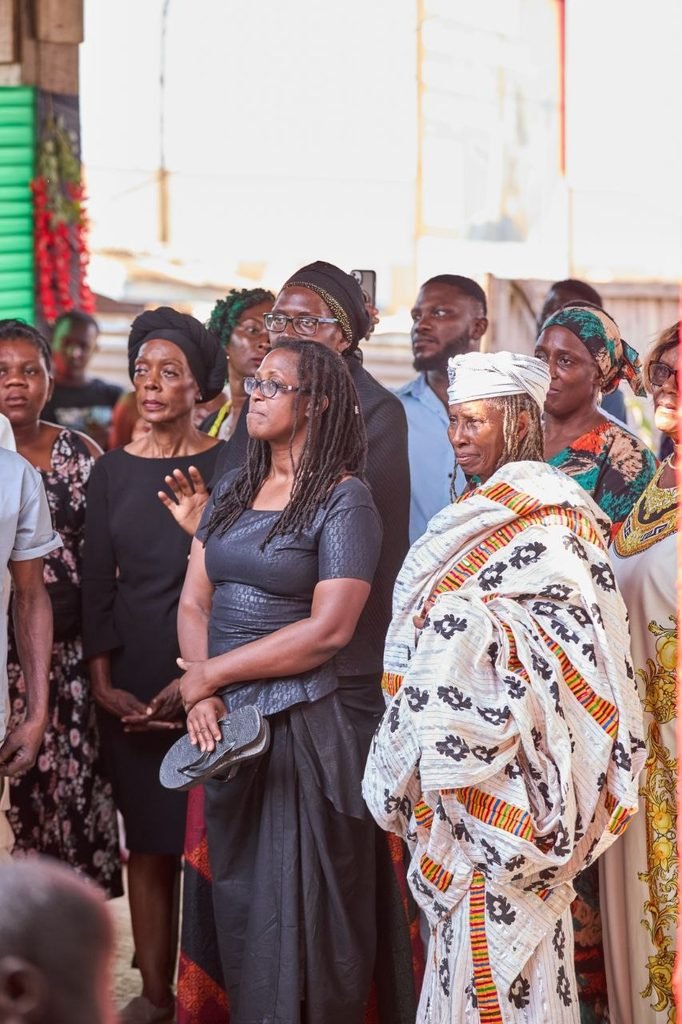
With the customary proceedings underway, the new chief was lifted onto the shoulders of celebrants and carried along the main thoroughfare of Akuapem Mampong.
The procession transformed the streets into a public stage for a ceremony rooted in the community’s traditional institutions.
There was something striking about the image, a university professor, accustomed to the measured language of academic discourse, being carried through the town in a display of traditional recognition.
Yet the celebration was not complete with the procession.
A ram was sacrificed at the Mamponghene’s compound before Kambon was taken to the palace, to swear the oath associated with his new offices.

The ceremony brought him formally into his roles as Apagyahene and Sunsum Ɔsahene.
Beyond the colourful proceedings, the titles themselves carry layers of historical meaning.
Kambon in his research explores the historical connections between Apagya and Akan political and military organisation.
Accounts cited in his work linked Apagya to an asafo, or military company, while historical writing traces an Apagya stool in Asante to the reign of Opoku Ware I in the eighteenth century.
These historical associations offer a glimpse into the institutions that have shaped Akan society over generations, although they do not automatically define the precise responsibilities of the office in Akuapem Mampong.
Kambon’s own professional life reflects a similar interest in preserving and examining African knowledge.
His work encompasses Akan language structure, naming practices across the Black world, proverbs and indigenous intellectual traditions.
Through Abibitumi, the platform he founded, he also promotes language learning, scholarship and cultural engagement.
But tradition was only one part of the story that day.
When the formal ceremony gave way to a reception, the occasion expanded into a celebration of three milestones: Kambon’s enstoolment, his promotion to full professor and his daughter Ama’s admission to the University of Ghana.
The gathering therefore carried a personal significance that went beyond the honours bestowed on one man. 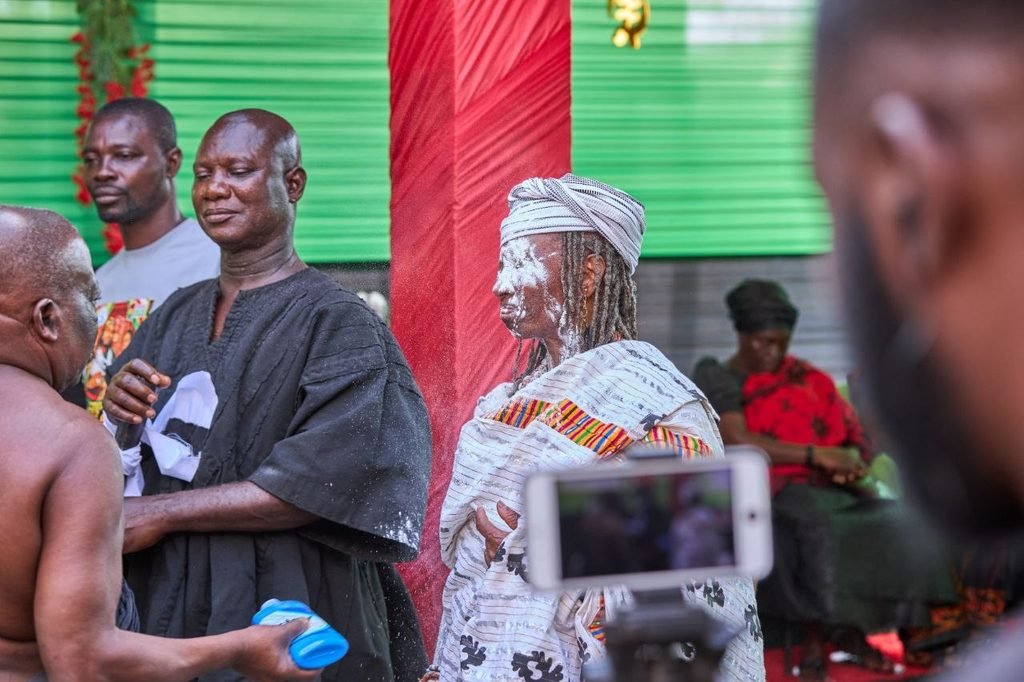
It celebrated professional advancement, the continuation of family aspirations and a connection to cultural heritage.
For a father, seeing a daughter gain admission to the same university where he holds a distinguished academic position offered another reason to celebrate.

For the professor, the moment placed family achievement alongside his own professional and traditional milestones.
Kambon had already established a place in the traditional life of Akuapem Mampɔn through an earlier installation as Banmuhene Kyidɔmhene, recorded in 2017.
His latest enstoolment adds another chapter to that relationship.
In Akuapem Mampɔn, the day brought together the university, the palace and the family table in one celebration. And for Kambon, the journey from the lecture room to the traditional procession showed how scholarship, cultural responsibility and family achievement could converge in a single memorable occasion.
By Enoch Ntiamoah Siaw
SKIP THE QUEUE, TAP THE NEWS
You can now read the Ghanaian Times and The Spectator newspapers from the comfort of your device via TimesNewsPlus.
Join our WhatsApp Channel: https://whatsapp.com/channel/0029VbBElzjInlqHhl1aTU27

Intercity STC Coaches Limited has interdicted a driver captured in a viral video allegedly hitting a Sprinter bus during an overtaking manoeuvre at Pokuase before driving away from the scene.
In a public notice, the company described the driver’s conduct as unacceptable, stressing that it did not reflect the safety standards and professionalism it upholds.
Management said it had commenced an immediate investigation into the incident and identified the driver, who has been interdicted pending the outcome of the disciplinary process.
The company added that it was awaiting an official report from the Pokuase Police Command to help establish the facts surrounding the incident.
STC reaffirmed its commitment to passenger safety and responsible road use, while thanking members of the public for bringing the incident to its attention.
Management assured the public that appropriate action would be taken following the investigation.
By: Jacob Aggrey