Hot!
Research scientists brainstorm on new rice breeding technology


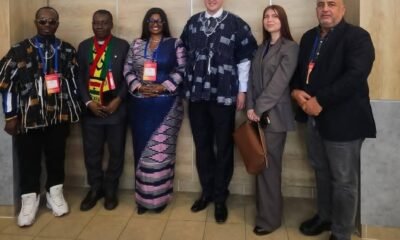
The research scientists after the programme
An international training workshop on new rice breeding technology has taken place here.
The training has been necessitated by the fact that the conventional method of rice breeding has become old and called for new technologies that could result in a faster, rapid and precise breeding.
Dubbed, “Accelerated Breeding Modernisation for Hi- Impact Rice Breeding, the four-day training brought scientists from Ghana,Senegal, Tanzania, Mozambique, Nigeria, India and Zimbabwe to the Crops Research Institute of the Council for Scientific and Industrial Research (CSIR-CRI),at Fumesua, near Ejisu in the Ashanti Region.
Speed breeding to shorten breeding cycle, smart breeding to enhance selection accuracy, breeding programme to enhance genetic gains, were some of the topics at stake.
According to Dr. Sanjay K. Katiyar, project coordinator, the global climate change was having a negative toll on rice production and to tackle that, there was the need for varieties that could grow very fast toward food security in Africa and the world as a whole.
Dr. Katiyar, who is a breeding modernisation lead at the International Rice Research Institute (IRRI), said there had been lot of surveys conducted in Africa which revealed the need to modernise the conventional way of breeding rice toward food security in the face of global climate change.
“We need to modernise the conventional method that has been in use for the past 60 years to be able to deliver high yielding crop varieties…there are now better ways or technologies for that”,he emphasised.
He said that the new technologies had nothing to do with the genetic modification, stressing “this is not an implementation of Genetic Modified Organism(GMO),we are only modernising the conventional system”.
Dr. Maxwell Darko Asante, Deputy Director of the CSIR-CRI, in an interview appealed to the government to operationalise the National Research Fund.
He explained that rice breeding was an expensive venture and needed heavy investment and stressed the importance of government to commit some amount of money to agricultural research in the country.
Dr.Asante observed that 1.4 million tonnes of rice was consumed yearly in Ghana while approximately half of that was produced, and that there was the need for government to be more dedicated to producing rice in the country to avoid huge amount of money used for its importation.
“We need heavy investment, without which the impact of our technologies and varieties would not be felt”,he noted, adding that government could dedicate about one per cent of the gross domestic product towards agricultural research in the country.
From Kingsley E.Hope, Fumesua



The Member of Parliament for Nsawam Adoagyiri, Frank Annoh Dompreh, has expressed concern over delays in the release of the District Assemblies Common Fund, warning that the situation is stalling development across the country.
On his facebook page, he described as a matter of urgent national importance, the Minority Chief Whip pointed to what he sees as a growing crisis of unpaid contractors, abandoned projects, and halted infrastructure works in many districts.
He noted that several communities are grappling with half completed schools, unfinished health facilities, abandoned markets, deteriorating roads, and stalled sanitation projects.
According to him, many contractors who have executed projects for district assemblies have not been paid, forcing some construction firms to demobilise from sites while workers lose their jobs.
He stressed that the District Assemblies Common Fund is not a discretionary allocation but a constitutional requirement under Article 252 of the 1992 Constitution, intended to support development at the local level.
In his view, years of delayed releases and accumulated arrears have weakened district development financing and disrupted projects meant to improve living conditions in communities.
He further argued that some payments made in recent years were largely the settlement of old debts rather than funding for new or ongoing projects, a situation he believes has affected contractor confidence and local economic activity.
He described the issue as more than a budgetary challenge, characterising it as a development emergency and a governance concern.
He therefore urged the appropriate authorities to pay outstanding DACF arrears, settle contractors who have completed their work, and ensure that transfers to districts are automatic and predictable.
He maintained that decentralisation can only succeed when district assemblies receive adequate and timely funding to carry out development projects.
He emphasised that stalled projects directly affect ordinary citizens, since they rely on such infrastructure for education, healthcare, transportation, sanitation, and economic activities.
He called for renewed attention to grassroots development, insisting that national progress should not be concentrated only in major cities but extended to all communities.
By: Jacob Aggrey

Richard Appiah, the footballer who killed two children and stored part of their bodies in a fridge at Abesim in the Bono Region in 2021 has been handed a lifetime sentence.
This was after a five member panel of judges at the Accra High Court returned a verdict of guilty against the convict.
Appiah, 32, also a draughtsman would spend the rest of his life in prison after he was convicted of murder.
More more more
BY MALIK SULLEMANA