News
Real reparations requires structural transformation, not gestures – Mahama


- /home/u249204778/domains/spectator.com.gh/public_html/wp-content/plugins/mvp-social-buttons/mvp-social-buttons.php on line 27
https://spectator.com.gh/wp-content/uploads/2026/09/WhatsApp-Image-2026-09-24-at-17.11.19-960x600.jpeg&description=Real reparations requires structural transformation, not gestures – Mahama', 'pinterestShare', 'width=750,height=350'); return false;" title="Pin This Post">
- Share
- Tweet /home/u249204778/domains/spectator.com.gh/public_html/wp-content/plugins/mvp-social-buttons/mvp-social-buttons.php on line 72
https://spectator.com.gh/wp-content/uploads/2026/09/WhatsApp-Image-2026-09-24-at-17.11.19-960x600.jpeg&description=Real reparations requires structural transformation, not gestures – Mahama', 'pinterestShare', 'width=750,height=350'); return false;" title="Pin This Post">
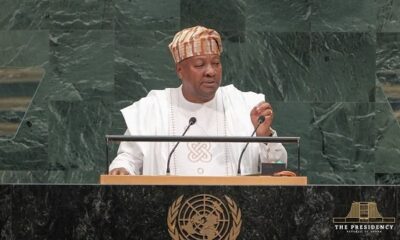
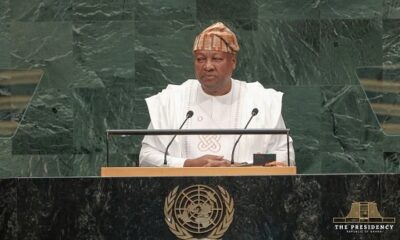
President John Dramani Mahama says the UN resolution affirming the transatlantic slave trade as the gravest crime against humanity must lead to structural transformation of the global system.
“We thank every nation that voted for justice, and I am deeply grateful to our brothers and sisters in the African Union, CARICOM, CELAC, and our partners across the Global South,” President Mahama said at the 81st UN General Assembly in New York today.
“That resolution was not a mere gesture. It was adopted because the structural legacies of those historic crimes continue to fuel systemic racism, economic marginalisation, and a global financial architecture weighted against Africa and people of African descent,” he stated.
He welcomed positive overtures since the passage of the resolution, noting that the Netherlands, Germany and France have made moves to join the conversation on reparatory justice and restitution.
“But real repair demands structural transformation. It requires dismantling the persistent engines of exploitation: unfair global trade regimes, predatory resource extraction, discriminatory credit ratings, unsustainable debt burdens, and the continued export of raw materials from Africa while real value addition and job creation occur elsewhere,” he said.
On global governance, President Mahama said the injustices of the past remain embedded in today’s power structures.
“Africa is home to 1.5 billion people, over 18 per cent of humanity, and constitutes the largest regional voting bloc in this General Assembly. Yet, Africa remains without a single permanent seat on the United Nations Security Council. This is fundamentally unacceptable in the 21st century,” he said.
“Africa must be granted permanent representation on the UN Security Council, complete with all the rights, responsibilities, and veto powers of such membership. We cannot credibly champion the sovereign equality of nations while preserving a global governance structure designed for the post-war geopolitical realities.
Security Council reform is not a favour to Africa; it is an imperative for the legitimacy, credibility, and survival of the United Nations.”
President Mahama said the same systemic inequality permeates the international financial architecture, with developing nations borrowing at interest rates up to eight times higher than industrialised nations.
“African and Caribbean nations struck by climate disasters are forced to take on crippling debt to rebuild from floods and droughts they did not cause. Governments are forced into a tragic choice: to service predatory debt or serve their people. We demand reform. We need long-term, affordable, and accessible concessionary financing that enables developing economies to invest in human capital, industrialisation, and climate adaptation,” he said.
“Africa does not seek charity. Africa seeks equal partnership anchored in mutual respect. Our continent possesses the world’s youngest population, vast arable land, unparalleled cultural vitality, and the critical minerals required to drive the global green energy transition.
But Africa will not remain a passive arena for a new scramble for resources. Critical mineral extraction must not replicate colonial-era exploitation. We will process our minerals at home, build local industries, create dignified jobs for our youth, and retain the value of our natural resources.”
By Edem Mensah-Tsotorme






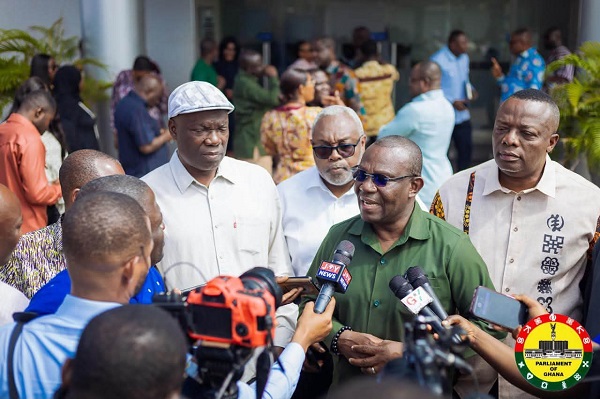
The Parliamentary Select Committee on Energy has appealed to the Ministry of Finance to release GH¢5.6 million to the Petroleum Commission to enable it to establish and operate a world-class data centre.
According to the Committee, access to the funds will strengthen the Commission’s capacity to manage critical upstream petroleum data and improve its operations.
Speaking during the appeal, Chairman of the Committee, Emmanuel Kwasi Bedzrah, said the move was crucial to efforts to revitalise Ghana’s upstream petroleum industry and increase oil production.
He noted that although investment and hydrocarbon production had declined in recent years, Parliament’s approval of an extension of the petroleum agreement to 2030 had attracted additional funding and contributed to an increase in production from about 80,000 to 120,000 barrels per day.
Meanwhile, concerns have been raised over repeated budget allocations for oil exploration in the Voltaian Basin.
Mr. Bedzrah stressed that funds approved for exploration must produce tangible results, adding that the Committee would require clear evidence of progress before supporting future budget allocations for the programme.
The appeal was made during a working visit to the Petroleum Commission as part of the Committee’s oversight activities to assess its operations and management procedures.
During the engagement, the Chief Executive Officer of the Petroleum Commission, Emeafa Hardcastle, took the Committee through the Commission’s working procedures and mandate, which includes regulating, managing and coordinating upstream petroleum activities.
She disclosed that since assuming office in 2025, government had pursued measures to reverse the decline in crude oil production, sustain output and reposition Ghana as an attractive destination for investment in Africa’s increasingly competitive petroleum sector.
In addition, she said government had secured fresh commitments of about US$35 billion to help revitalise the sector.
As part of the oversight exercise, the Committee is expected to conclude its monitoring visit with engagements at the National Petroleum Authority (NPA) and the Ghana Oil Company Limited (GOIL).
By Edem Mensah-Tsotorme
News
“No civilisation deserves to be annihilated” – Mahama calls for dialogue on global conflicts at UNGA 81
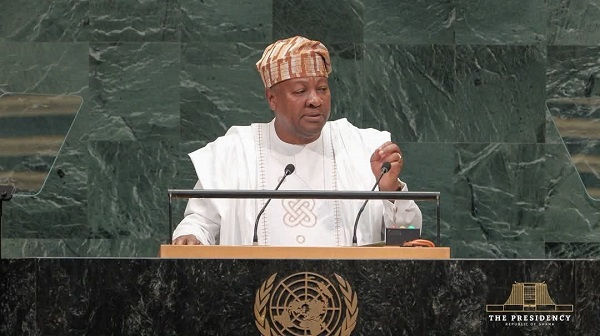
President John Dramani Mahama has called for solidarity and dialogue in resolving global conflicts, insisting that no civilisation deserves to be wiped out.
“No human civilisation deserves to be annihilated, certainly not a member state of the United Nations,” President Mahama stated in his address at the 81st United Nations General Assembly in New York.
He called for solidarity with nations facing terrorism, especially the Alliance of Sahel States (AES), and for a uniform approach to conflicts in Europe, the Middle East and Africa.
On the Middle East, the President called for a return to negotiations, saying “The current Middle East crisis is having a deleterious effect on the world economy.”
“I believe that dialogue can resolve even the most intractable of problems,” he added.
By Edem Mensah-Tsotorme

 Entertainment1 week ago
Rhythms On Da Runway returns November 28 with 16th edition themed ‘Unbound’
- Entertainment1 week ago
Ohemaa Mercy’s Tehillah Experience outfit was priestly regalia, not costume – Management clarifies
 News1 week ago
Janet Asana Nabla criticises Mahama over China curriculum controversy involving Haruna Iddrisu