Features
Questions for Europe

- /home/u249204778/domains/spectator.com.gh/public_html/wp-content/plugins/mvp-social-buttons/mvp-social-buttons.php on line 27
Warning: Trying to access array offset on false in /home/u249204778/domains/spectator.com.gh/public_html/wp-content/plugins/mvp-social-buttons/mvp-social-buttons.php on line 27
&description=Questions for Europe', 'pinterestShare', 'width=750,height=350'); return false;" title="Pin This Post">
- Share
- Tweet /home/u249204778/domains/spectator.com.gh/public_html/wp-content/plugins/mvp-social-buttons/mvp-social-buttons.php on line 72
Warning: Trying to access array offset on false in /home/u249204778/domains/spectator.com.gh/public_html/wp-content/plugins/mvp-social-buttons/mvp-social-buttons.php on line 72
&description=Questions for Europe', 'pinterestShare', 'width=750,height=350'); return false;" title="Pin This Post">
When I hear of Europe, I get confused as to who is referenced. I know who America is: one federation of states forming a union. Europe sounds, and is, very different. Countries that call themselves European used to be monarchies. Indeed, many of them remain monarchies, yet pander to constitutional governance.
Having plundered the human resources of the African continent through the most obnoxious crime ever committed against humanity in the form of slavery, European countries had the effrontery to spread the map of our continent and carve out countries and share them among themselves.
Calling those countries their colonies, they set out to plunder the natural resources even after the direct slave trade was abolished. Our forebears were shipped to the Americas, where European settlers had large plantations that needed human labour. The majority of the human cargoes were, however, discharged in US ports.
Many of the slave ships were commissioned by the Crown, aided by the Church, to transport the slaves. The Crown and the Church took commissions on each Negro, as the black Africans were called, and safely delivered them to their destinations.
Britain, France, Germany, Belgium, Italy, Spain, Holland, and Portugal were the main European nations that had colonies. That Portugal, the poorest country in Europe, also managed to have colonies, beats the mind. The Dutch and the Danes made incursions and retreated, and Germany lost its territories after its defeat in the Second World War.
My first question is: when the European sailors arrived at our shores, did they see us as humans or as commodities to be traded? How did we react to their arrival? When the epoch of conquests rocked Europe, how did the ‘victims’ react to their conquerors? When the Vikings from Scandinavia raided other countries, how did the ‘victims’ react? Europe must answer these questions.
I ask the above questions so as to understand what my forebears would have felt when they were hounded and either stolen or sold into slavery. When the Dutch East India Company, the progenitor of the obnoxious apartheid system in South Africa, arrived on the Western Cape in 1652, how did they treat the locals?
The Europeans have presented the Zulu King, Chaka, as a bloodhound who terrorised his own people by setting them against one another. Chaka’s crime was that he took up arms against the invading Boers and wanted them out of his land.
I have stated many times that nothing about the British excites me, but I give them credit for not fighting their colonies, who agitated for independence. The Brits had enriched themselves and knew they were done for if they expended that wealth on fighting their colonies and getting impoverished in the process.
But this does not absolve Britain from the atrocious mayhem it unleashed in Kenya, killing, maiming, and raping as a sport. I am yet to understand what gives the Caucasians their sense of superiority over everyone else.
If these Europeans saw us as savages, that would be their own thinking. But have they forgotten how their forebears lived in medieval times? Have they forgotten they lived in caves, hardly bathed for ages, and had hair left like the mane of a grown lion? They evolved into who they are today, but would not allow others their right to evolve.
The French took up arms against many of their colonies that had the nerve to demand independence. Algeria is a classic example of French brutality.
Ahmed Ben Bella led that country to independence, but French influence was pervasive, regardless.
Many patriots rose up to fight France to gain independence. I recall Modibo Keita in Mali, Maurice Yameogo in Burkina Faso, which was then called Upper Volta, Francois Tombalbaye in Chad, and Sekou Toure in Guinea. I have not forgotten Leopold Senghor in Senegal, Mouktar Ould Dada of Mauritania, and David Dacko of the Central African Republic. I cannot mention all the rest in this narrative.
But the French made a fast move. They assimilated all heads of government of their former colonies as members of the French Parliament, thus keeping a draconian economic stranglehold on those countries. Burkina Faso could not import fish directly from neighbouring Senegal. It must import the fish through Paris. None of their colonies could make direct phone calls among themselves unless they were routed through Paris.
Now that these countries are severing such a relationship, the French president, Emmanuel Macron, is frantically trying to salvage what the current wind is blowing away. In a recent visit to the DR Congo, Macron thought Mr. Tchisekedi should listen only to him. He was stunned when the Congolese leader put him in his place by telling him to listen to what he was saying, which was in response to what a journalist had stated.
Belgium ensured Rwanda and Burundi knew no peace. The genocide of 1994 in Rwanda shook Brussels to its foundation, but human life was the cost. Belgium asked the Hutu why they allowed the Tutsi, who constituted only 15% of the population, to run the country while they held 85%. What did they expect? Thankfully, Rwanda has dusted itself off the ashes and is on the mend.
They aided the American CIA to murder Patrice Lumumba, the Congolese Prime Minister, on suspicion that he was a Communist. His body was chopped up and dipped in acid.
America installed Mobutu Sese Sekou in power. He became a dictator, yet a stooge of the West for 32 years. He so plundered the wealth of his country that he was richer than the country. DR Congo has the capacity to give the whole of the African continent hydro power nonstop for fifty years. But the West cannot tolerate a non-dependent Africa.
While the West preaches against child labour, it finances and arms bandits who use child labour to mine cobalt and other precious minerals for tech industries in Silicon Valley. Indeed, the DR Congo is the richest country in Africa in terms of natural resources, but the West will not let that country be. In truth, the more unrest there is in our Great Lakes region, the more it suits the West economically.
Why can’t Europe and America leave Africa alone? Is it because Africa has the largest natural resources in the world? Or does Africa have dumb leaders who are stooges of Western interests? These two are easily the most palpable reasons. When Muammar Gaddafi wanted to finance Africa’s own telephone industry, the West got him murdered. When he wanted to finance an African drive for its own currency backed by gold under the banner of the Africa Union, some African leaders betrayed him, and the West murdered him.
All of a sudden, there is a Franco-Africa summit. There is the China-Africa summit and other summits where individual Western countries meet Africa as one whole entity. Meanwhile, DR Congo as a country is almost as big as all of Europe put together. These countries think Africa is a baby that must be guided by Senior Brother.
Why does Europe treat us like this? We must have an Africa that has the courage to boycott such summits unless they are organised on a continent-to-continent basis. It must be from Europe to Africa, from Asia to Africa, from North America to Africa, etc. What is the use of the British Commonwealth when there is no wealth common to its members?
The reality is that these Western leaders have a penchant for lecturing African leaders, never the other way around. They do not want Africa to talk to them. Africa must always listen and take instructions. Meanwhile, our leaders are so old and brain-fagged that by the time their buttocks touch their seats at these lecture sessions, they are already asleep.
Another question: why has Europe ceded leadership to America? Europe seems to fear the US so much that it has allowed American military bases all over their continent. Is this an admission that American interests supercede European interests?
Kamala Harris, the US Vice President, was in Ghana this week after Macron had come and left. Rishi Sunak may be next to visit in an effort to counter what they perceive as Sino-Russian inroads to the continent. The scramble for Africa has resurrected in earnest. My heart bleeds for a continent that is rich in natural and human resources yet is so bereft of a leadership that is expected to work for the good of all its people. This is sad.
Writer’s email address:
akofa45@yahoo.com
By Dr. Akofa K. Segbefia

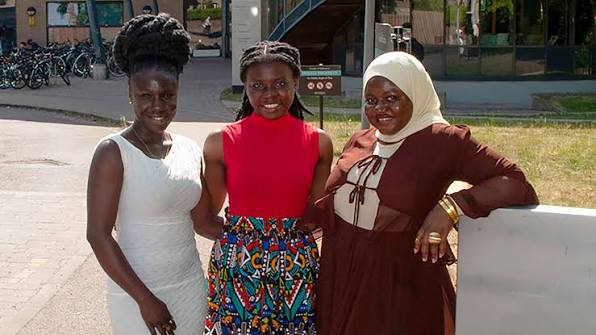
The average modern Gold Coaster born and bred in Sikaman is an adventurous creature. Go to any part of the world and you’ll find Ghanaman diligently slugging it out either in the snow or in hot sweltering weather, earning a decent living.
Go to Guinea and see Ghanaman in the garb of a herbalist, curing the sick of various ailments. He makes the Guinean understand that not all diseases are caused by James Lucifer alias Jimmy Satan. On the contrary, most diseases are caused by kooko which can even attack the human nose and turn it upside down.
That kooko is also the cause of poverty and the internal bleeding of personal back-pocket economies. And that kooko can be cured using the chemistry underlying Sikaman herbal medicine which has been blessed by the gods of Larteh.
And before Ghanaman starts dispensing his herbal concoctions, he must attract the passing crowd with some Sıkaman-originated choreography, akin to a combination of adowa and agbadza, such that the dancer can easily dislocate a shoulder and start crying for his mother.
When the crowd is enough to form a quorum, Ghanaman must perform magic as a side-attraction, and proceed to sell his drugs. The drugs are genuinely made from potent herbs which the Pharmacy Board of Sikaman says it has no confidence in. Believe me, Ghanaian herbalists are practising in neighbouring countries like Guinea, Cote d’Ivoire, Sierra Leone and Benin, while we are discouraging them from practising in Sikaman.
Go to Las Palmas and see Ghanaman as a fisherman. He sails on Korean-owned boats and is forced to eat garlic and raw tuna for radiant health. The garlic is also supposed to protect him against witches. But sometimes, he is not good bedfellows with some Korean crew members, and once in a while a fight breaks out.
The typical Korean is a Kung Fu expert and before displaying a golden dragon data. He must first terrify Ghanaman with a Korean dance which consists of wild arms and leg throwing. But Ghanaman is usually not daunted. Why has he been eating cancer kenkey all years without developing cancer? It mean is a superhuman capable of countering Kun fu side-kicks to the ribs.
Anyhow Ghanaman’s most potent arsenal lies in his fists. If he is a southpaw, it mean left fist is probably insured and can cause damage. When Ghanaman lands a cassava blow and it lands on a Korean chest, it has the effect of a cruise missile. If there is no ceasefire a funeral cannot be ruled out.
Greenland
Go to Alaska and find Ghanaman there. Greenland, Iceland, Brazil, Argentina, Madagascar, everywhere and you’ll find him. He has become an international citizen and is generally lauded for his hardwork, sincerity and honesty.
However, some bad nuts are also condemned and despised.
The world and all its parts and corners are for the human race, and anyone can choose to live anywhere and earn a decent living so long as he doesn’t misconduct himself or become a social misfit and a law unto himself.
Sıkaman for instance accepts foreigners, and we are so liberal that people just come in through our borders and we welcome them with the best palmwine in town and goat light soup. Who cares about passports and visas? Our hospitality is, as it were legendary.
So we have Liberians, Nigerians, Sierra Leoneans, Togolese, Europeans, Americans, Scandinavians and Koreans in Sikaman. And some of them have misinterpreted our overzealous accommodation to mean “foolishness” and are misconducting themselves.
The newspapers carry stories of some unscrupulous Nigerians stealing, defrauding and collaborating with their Sikaman counterparts to rob people. You’ll find some good and law-abiding Liberians around but some other Liberians are in the business of fraud, robbery, money printing, money doubling, anything criminal.
Ghanaian hospitality can no longer be extended to such people. I do not think Ghanaians will be treated kindly either, when they misbehave anywhere in the world. Those who come from outside with the intention of bringing down their evil deeds and to practise them here professionally must be getting ready because Ghanaians are getting fed up with the menace.
These days, you’ll find strange people following you as soon as you emerge from a bank. If you are not careful, they’ll wrestle your briefcase from you and speed away in a waiting taxi.
Someone was just saying that many foreign criminals are flocking to Ghana because in their countries, they are enable to operate either because they are being looked for by the police for offences committed or fear instant justice at the hands of mobs. Ghanaians, it is said, are humanitarian in dealing with criminals.
Well, in some African countries, a thief who is being chased runs directly to the police station in his own interest and begs the officer at the counter to lock him up. Otherwise he’ll be lynched or be burnt to death. In Ghana, it is the opposite. The thieves run far away from the cop stations.
The criminals must reform and stay peacefully in Sikaman or quit. No court case!
This article was first published on Saturday September 5, 1998
The human condition is defined by two absolute, biological bookends: the commencement of complex cellular animation and its ultimate, irreversible cessation.
For centuries, medicine treated life and death as strictly separate states. Today, modern pathology and molecular biology reveal a more profound truth: the mechanisms that allow us to live are the exact same mechanisms that dictate how we die.
Understanding this relationship is no longer just a philosophical pursuit. It is a clinical necessity for managing public health in the 21st century.
Part I: How we live – The mechanics of animation
At its core, biological life is a continuous, high-stakes battle against entropy (the natural tendency of systems to degrade into disorder). To maintain form, consciousness, and function, the human body relies on three fundamental pillars:
1. Cellular respiration and energy production
Every second of human life is powered by the conversion of oxygen and glucose into Adenosine Triphosphate (ATP), the universal energy currency of our cells. This process occurs within the mitochondria.
Without a constant supply of ATP, the microscopic pumps that maintain electrical gradients across our cell membranes fail, causing cellular collapse within minutes.
2. Homeostasis: The balancing act
To survive, the internal environment of the body must remain incredibly stable, regardless of external chaos. This balancing act, known as homeostasis, regulates:
Blood pH: Strictly maintained between 7.35 and 7.45.
Core Temperature: Ideally kept around 37°C (98.6°F).
Electrolyte Balance: Precise ratios of sodium, potassium, and calcium that allow nerves to fire and muscles to contract.
3. The Autonomic Nervous System (ANS)
The ANS acts as the invisible conductor of life, split into two complementary branches:
Part II: How we die – The path of cessation
Death is rarely a singular event; it is a progressive biological cascade. Whether caused by old age, chronic illness, or sudden trauma, the final pathways of mortality generally follow a predictable trajectory.
1. The cellular horizon: Senescence and Apoptosis
Every time a human cell divides, the protective caps at the ends of its chromosomes-telomeres-shorten. Eventually, telomeres become so depleted that the cell can no longer divide safely. It enters senescence (a state of permanent arrest) or triggers apoptosis (programmed cell death). This gradual, systemic loss of cellular renewal is the underlying engine of aging.
2. The clinical cascade of somatic death
When the body can no longer maintain homeostasis, somatic death (the death of the organism as a whole) begins. This occurs in a distinct sequence:
1
Clinical Death
Zero to four minutes
The heart stops pumping blood, and respiration ceases. While breathing and circulation have ended, the body’s tissues still contain residual oxygen and cellular energy reserves. At this stage, resuscitation is often still possible.
2
Brain Death (Infarction)
Four to six minutes
Deprived of fresh oxygenated blood, the brain’s highly sensitive neurons begin to starve. Lacking ATP, the brain cells lose their electrical charge, swell, and begin to burst. Permanent, irreversible neurological damage occurs within minutes.
3
Biological Death
Hours to days
The organs fail entirely. Without central control or blood flow, individual cells throughout the body consume their final energy reserves. Enzymes that once aided digestion begin to break down the body’s own tissues from the inside out, a process known as autolysis.
Part III: The modern collision of life and death
In the modern era, the boundary between how we live and how we die has blurred. Historically, humanity died primarily from infectious diseases and acute trauma. Today, global mortality is dominated by non-communicable, chronic lifestyle diseases.
Modern Pathology: How we live (the cause) how we die (the result)
Cardiovascular disease, chronic stress, poor diet, and lack of sleep keep the sympathetic nervous system hyper-activated, damaging blood vessels .Occlusion of coronary arteries leads to myocardial infarction (heart attack) or ischemic stroke.
Metabolic syndrome over nutrition and physical inactivity overwhelm cellular mitochondria, leading to systemic insulin resistance. Multi-organ failure, chronic kidney disease, and severe vascular complications.
Neurodegenerative Disorders Chronic systemic inflammation and sleep deprivation prevent the brain from clearing metabolic waste. Gradual loss of synaptic connections, leading to dementia and the eventual loss of basic autonomic functions.
Conclusion: The unified theory of health
Ultimately, how we live directly shapes the path of how we die. The micro-choices of daily existence-how we manage emotional stress, the quality of our rest, our communal connections, and our nutrition-either preserve the integrity of our homeostatic systems or accelerate their decline.
True medical advancement is shifting away from merely extending the final, frail stages of biological death. Instead, the focus is turning toward optimising our living years-ensuring that the intricate, beautiful machinery of human animation runs smoothly until its natural, quiet conclusion.
By Robert Ekow Grimmond-Thompson