Features
Questions for Europe

When I hear of Europe, I get confused as to who is referenced. I know who America is: one federation of states forming a union. Europe sounds, and is, very different. Countries that call themselves European used to be monarchies. Indeed, many of them remain monarchies, yet pander to constitutional governance.
Having plundered the human resources of the African continent through the most obnoxious crime ever committed against humanity in the form of slavery, European countries had the effrontery to spread the map of our continent and carve out countries and share them among themselves.
Calling those countries their colonies, they set out to plunder the natural resources even after the direct slave trade was abolished. Our forebears were shipped to the Americas, where European settlers had large plantations that needed human labour. The majority of the human cargoes were, however, discharged in US ports.
Many of the slave ships were commissioned by the Crown, aided by the Church, to transport the slaves. The Crown and the Church took commissions on each Negro, as the black Africans were called, and safely delivered them to their destinations.
Britain, France, Germany, Belgium, Italy, Spain, Holland, and Portugal were the main European nations that had colonies. That Portugal, the poorest country in Europe, also managed to have colonies, beats the mind. The Dutch and the Danes made incursions and retreated, and Germany lost its territories after its defeat in the Second World War.
My first question is: when the European sailors arrived at our shores, did they see us as humans or as commodities to be traded? How did we react to their arrival? When the epoch of conquests rocked Europe, how did the ‘victims’ react to their conquerors? When the Vikings from Scandinavia raided other countries, how did the ‘victims’ react? Europe must answer these questions.
I ask the above questions so as to understand what my forebears would have felt when they were hounded and either stolen or sold into slavery. When the Dutch East India Company, the progenitor of the obnoxious apartheid system in South Africa, arrived on the Western Cape in 1652, how did they treat the locals?
The Europeans have presented the Zulu King, Chaka, as a bloodhound who terrorised his own people by setting them against one another. Chaka’s crime was that he took up arms against the invading Boers and wanted them out of his land.
I have stated many times that nothing about the British excites me, but I give them credit for not fighting their colonies, who agitated for independence. The Brits had enriched themselves and knew they were done for if they expended that wealth on fighting their colonies and getting impoverished in the process.
But this does not absolve Britain from the atrocious mayhem it unleashed in Kenya, killing, maiming, and raping as a sport. I am yet to understand what gives the Caucasians their sense of superiority over everyone else.
If these Europeans saw us as savages, that would be their own thinking. But have they forgotten how their forebears lived in medieval times? Have they forgotten they lived in caves, hardly bathed for ages, and had hair left like the mane of a grown lion? They evolved into who they are today, but would not allow others their right to evolve.
The French took up arms against many of their colonies that had the nerve to demand independence. Algeria is a classic example of French brutality.
Ahmed Ben Bella led that country to independence, but French influence was pervasive, regardless.
Many patriots rose up to fight France to gain independence. I recall Modibo Keita in Mali, Maurice Yameogo in Burkina Faso, which was then called Upper Volta, Francois Tombalbaye in Chad, and Sekou Toure in Guinea. I have not forgotten Leopold Senghor in Senegal, Mouktar Ould Dada of Mauritania, and David Dacko of the Central African Republic. I cannot mention all the rest in this narrative.
But the French made a fast move. They assimilated all heads of government of their former colonies as members of the French Parliament, thus keeping a draconian economic stranglehold on those countries. Burkina Faso could not import fish directly from neighbouring Senegal. It must import the fish through Paris. None of their colonies could make direct phone calls among themselves unless they were routed through Paris.
Now that these countries are severing such a relationship, the French president, Emmanuel Macron, is frantically trying to salvage what the current wind is blowing away. In a recent visit to the DR Congo, Macron thought Mr. Tchisekedi should listen only to him. He was stunned when the Congolese leader put him in his place by telling him to listen to what he was saying, which was in response to what a journalist had stated.
Belgium ensured Rwanda and Burundi knew no peace. The genocide of 1994 in Rwanda shook Brussels to its foundation, but human life was the cost. Belgium asked the Hutu why they allowed the Tutsi, who constituted only 15% of the population, to run the country while they held 85%. What did they expect? Thankfully, Rwanda has dusted itself off the ashes and is on the mend.
They aided the American CIA to murder Patrice Lumumba, the Congolese Prime Minister, on suspicion that he was a Communist. His body was chopped up and dipped in acid.
America installed Mobutu Sese Sekou in power. He became a dictator, yet a stooge of the West for 32 years. He so plundered the wealth of his country that he was richer than the country. DR Congo has the capacity to give the whole of the African continent hydro power nonstop for fifty years. But the West cannot tolerate a non-dependent Africa.
While the West preaches against child labour, it finances and arms bandits who use child labour to mine cobalt and other precious minerals for tech industries in Silicon Valley. Indeed, the DR Congo is the richest country in Africa in terms of natural resources, but the West will not let that country be. In truth, the more unrest there is in our Great Lakes region, the more it suits the West economically.
Why can’t Europe and America leave Africa alone? Is it because Africa has the largest natural resources in the world? Or does Africa have dumb leaders who are stooges of Western interests? These two are easily the most palpable reasons. When Muammar Gaddafi wanted to finance Africa’s own telephone industry, the West got him murdered. When he wanted to finance an African drive for its own currency backed by gold under the banner of the Africa Union, some African leaders betrayed him, and the West murdered him.
All of a sudden, there is a Franco-Africa summit. There is the China-Africa summit and other summits where individual Western countries meet Africa as one whole entity. Meanwhile, DR Congo as a country is almost as big as all of Europe put together. These countries think Africa is a baby that must be guided by Senior Brother.
Why does Europe treat us like this? We must have an Africa that has the courage to boycott such summits unless they are organised on a continent-to-continent basis. It must be from Europe to Africa, from Asia to Africa, from North America to Africa, etc. What is the use of the British Commonwealth when there is no wealth common to its members?
The reality is that these Western leaders have a penchant for lecturing African leaders, never the other way around. They do not want Africa to talk to them. Africa must always listen and take instructions. Meanwhile, our leaders are so old and brain-fagged that by the time their buttocks touch their seats at these lecture sessions, they are already asleep.
Another question: why has Europe ceded leadership to America? Europe seems to fear the US so much that it has allowed American military bases all over their continent. Is this an admission that American interests supercede European interests?
Kamala Harris, the US Vice President, was in Ghana this week after Macron had come and left. Rishi Sunak may be next to visit in an effort to counter what they perceive as Sino-Russian inroads to the continent. The scramble for Africa has resurrected in earnest. My heart bleeds for a continent that is rich in natural and human resources yet is so bereft of a leadership that is expected to work for the good of all its people. This is sad.
Writer’s email address:
akofa45@yahoo.com
By Dr. Akofa K. Segbefia


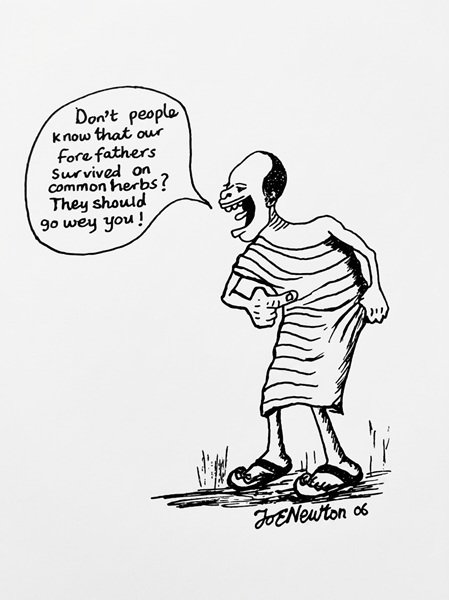
THE typical itinerant salesman in Sikaman is a herbalist. He is normally a slim macho with the capacity to perambulate the expanse of area covering the triangle of Accra-Tema-Ashiaman. In short, he can walk a total of 60 miles a day, marketing a product that cures every disease, including poverty. 
The door-to-door herbal pharmacist advertises his product by word of mouth. He has nothing to do with the Food and Drugs Board (FDB). After all, his concoctions do not feature on FM stations.
Those herbalists who cannot walk to propagate the herbal gospel, liaise with drivers of mass transportation and their mates. They are, therefore, given the chance to sell their products on Benz buses that ply the routes.
Normally, the herbalist starts his sales message with a prayer and Bible study. He asks the passengers to bow down their heads in supplication to God the father, the son, the Holy Spirit.
When a herbalist asks the passengers to close their eyes and bow their heads, Moslems on board naturally feel offended. They feel that the herbalist has no right to assume that every passenger is a Christian. They think such an assumption is an affront to Islam.
So a Moslem on board will raise the hand for a point of order. He’ll remind the herbalist that it would be in his own interest to mind his language.
“Be careful the way you address people in a public place. Not every person here is a Christian,” he’d state assertively.
Of course, the herbalist will promptly ignore him, but would all the same “watch” his tongue. Who knows whether or not the Moslem brother is inspired by Quoranic zeal to defend the tenets of Islam to the hilt?
When he starts saying, “Wallahi!” and “Inshallah!” it could be the beginning of proclaiming Islam as supreme, a point which must be driven home with talibanic precision.
So the herbalist must tread carefully lest he steps on fire.
The herbalist could even add a measure of mirth to it all, by announcing that Christians on board today have very interesting company on the journey, but that should not detract from the business of the day.
The Moslem brother will weigh the words carefully and offer a wry smile.
He must be careful the occasion does not degenerate into the use of semantics and proverbial oration to deride his conviction that public utterances must be mindful of religious sensibilities. He has made his point very clear and expects that it is taken in good faith in the interest of a peaceful journey.
The herbalist will now open the New Testament and preach salvation, stating clearly that salvation can come only through Jesus Christ and NOBODY else.
The Moslem brother will now start twitching his moustache. The visible and almost revolutionary reflexes of his upper lip can be an indication that sentiments have begun superseding reason, and the outcome could well be tragic now shift uneasily in his seat.
The time has come for him to also express his right to the religion of his fore-bears. He’ll put his hand into his pocket and rise to his feet. The time has indeed come!
This article was first published on Saturday, September 9, 2006
When the cause of a particular problem like sickness, disease, sudden illness, a social issue etc. are not known, it stands to reason that resolving it becomes a huge challenge.
Citizens would understand the government when public announcements are made to the effect that government is trying to find a solution to the issue, even though it is taking a while for it to be resolved because citizens are rational beings.
On the other hand, if the solution to a particular issue is known to everybody but the government for whatever reason, is dragging its feet in resolving it, citizens become frustrated and begin to lose trust in their leaders.
One such issue is the heavy traffic along a section of the Kasoa – Odokor road. A short stretch of bad road between the traffic light at the Weija Government Hospital and the entrance to the entrance of the overhead that leads to the N1, is the cause of the problem but nothing is being done about it, day after day, week after week, month after month. Thus is clearly unacceptable.
Another issue that requires urgent attention is the lack of pavements along a lot of streets in parts of the various Municipal Assemblies. Exercise is a prerequisite for long life and healthy living and for those of us who it has become a way of life, this issue of people putting up structures right to the edge of the drains beside the roads, are making life difficult for us.
We are compelled to walk along the roads, putting our lives at serious risk. Pedestrians should never be compelled to compete with vehicles on our streets and roads. Roads and streets are made for vehicles and pavements are made for pedestrians. That is the norm. Any attempt to normalise a situation where pedestrians are mingling with vehicles is insanity.
It is the road regulations that makes it so and therefore district or municipal assemblies are to take responsibility and ensure that spaces for pavements are not encroached upon. Citizens have rights that must be protected by their leaders and making pavements available to pedestrians, is one of them.
When we hear of teachers having sex with students, it appears it is something recent. It is not a new phenomenon. It has been there since Adam. Perhaps this issue is getting much attention due to the proliferation of social media. It was an open secret in times past when Teachers were in relationships with female students and some married them immediately after completion of school.
Some teachers were also known to be having unholy interactions with female pupils but due to the times that these acts occurred, human rights issues and the awareness around it, allowed such unscrupulous teachers to get away with their crimes.
Now we are in a different era and so a Headmaster is now in hot waters. He is alleged to have raped about 19 female students and as usual, some officials tried to cover it up and are also in hot waters and their actions or inactions in the matter are under investigation.
Why the man has been allowed to roam freely without being arrested is simply mind boggling. It appears that the law applies differently, depending on who you are. This issue came to public attention sometime in August this year, yet the police had not arrested or invited this man for question regarding the rape allegation.
It has come out that he is a Constituency Secretary of the ruling party and the question in the public domain is that, is it because he is a political figure that is why he is still walking around without questioning? I believe in the rule of law so let us hold our breadth and let the proper thing be done.
The police must however be seen to be active in this matter. God bless.
SKIP THE QUEUE, TAP THE NEWS
You can now read the Ghanaian Times and The Spectator newspapers from the comfort of your device via TimesNewsPlus.
Join our WhatsApp Channel: https://whatsapp.com/channel/0029VbBElzjInlqHhl1aTU27