Features
Questions for America

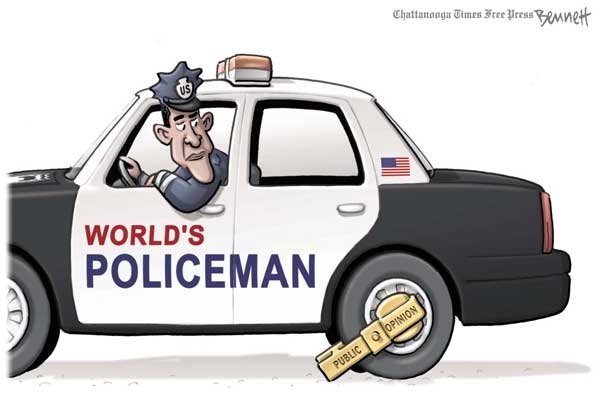
• World’s policeman
If there is one single country that fascinates me, it is the almighty United States of America. A very boastful nation, the US catches my attention every time there is news about that country.
I was taught by Americans during a period I consider critical in my development as a human. Ms. Elizabeth Suhre taught me English language for three years. Carol Wool and one Ms. Fenning taught me Physics and Mr. Brunner taught me Chemistry. They were Peace Corps Volunteers in the sixties and seventies.
I know the economic geography of the US at my fingertips, and I respect Americans for their work ethics, especially their farmers, ranchers, and manufacturers. Americans generally don’t care who occupies the White House so long as life is bearable for a comfortable existence. A democracy that suits America is made to work like clockwork.
The system set out in the articles of statehood is made to work, irrespective of who their president is. Now, my question is: Why doesn’t America allow other countries to run their affairs the way they are best suited to their own circumstances? Does America really believe Western democracy is the ideal and workable system for the rest of the world?
Conferring on itself the role of policeman of the world, America tries to impose its values on the rest of the world and whip ‘recalcitrant’ countries into line. Without recourse to the cultures of other nations, the US uses brute force, overthrowing some in the process.
Cases abound to prove this. Between the time the US invaded Iraq and the time they left that country, how many Iraqi and American souls were lost? If Saddam Hussein were still in charge, would that number of his countrymen have died? Would thousands of American soldiers have died needlessly? Has Iraq fared better after the Yankee invasion?
Let us ask the same of Libya. Libya has known no peace since America, aided and bamboozled by France, murdered Muammar Gaddafi. The late Libyan leader’s crime was to make Africa independent of foreign direction. Also, the West could not come to terms with the fact that Libya did not tie its economy to the apron strings of the Bretton Woods institutions.
America has not learnt any lessons from the humiliation it suffered in Vietnam, yet it has ventured out to Somalia, Iran, and Afghanistan. Not only that. With all the gloating over being the most powerful nation on earth, America cries out to the world about cyberattacks from outside its shores anytime there are elections. They blame this on China, Russia, Iran, and others they see as rogue states. How come?
I think America has the largest technology hub in the world, located in Silicon Valley. Yet they cannot build firewalls to fend off cyberattacks? So, wherein lies the might of the US? Aren’t there more questions for America than there are answers?
Why should any country be interested in who Americans elect? It is because the US is too loud-mouthed. They brag about almost anything under the sun while others sit quietly strategising about technological advancement. Every noisome pestilence has a soft underbelly that is exposed to attacks from the irritated enemy. And this fact is lost on the US.
Is the US aware it irritates the rest of the world by imposing its will on the rest of us? In the end, they end up paying the price for their misdeeds. Osama bin Laden was a progeny of American foolhardiness, yet he bloodied America’s nose on 9/11, not so? To the extent that the US has become so skittish, it has deployed $400,000 missiles to shoot down $25 balloons after the scare of a Chinese spy balloon. I can’t laugh well enough.
Can America point to just one country they went into and left a success story behind? I am not happy with Czar Putin’s war on Ukraine. It is my prayer that Ukraine drives the Russians out of its soil because no country has the right to want to annex another. This argument about Russia being wary of NATO expansion seems balderdash to me.
I believe that because many of these countries, including Russia, have too many stockpiles of weapons they need to dispose of and build new ones, Ukraine comes in handy. In the final analysis, Russia and NATO will be richer because Ukraine will end up paying billions of dollars for all the armament supplied to it.
I still have questions, though. Will America tolerate Russian military bases in the western hemisphere in, say, Cuba or Haiti? How about Mexico asking Czar Putin to build a nuclear plant on its soil? I will not claim to understand geopolitics, but this idea of “you are either with us or against us” must give way to the acceptance of every sovereign nation to choose their own path to suit their needs and circumstances.
By its posturing, America does not want any country to have a mind of its own. Meanwhile, Americans speak and write English language the way it suits them, and not even the English complain. Americans play football, not with their feet. America speaks descriptive English, not classical.
Americans do not ride horses; they ride ‘horse back.’ Simply put, they just want to be Americans. How come they don’t want others to be what or who they want them to be?
Haiti has descended into anarchy, insolvency, and failure just next door, but America will not help sanitise that hemisphere. What sense does it make to want to help Ukraine while there is bloodshed on a daily basis close by? I am not suggesting that Ukraine not be helped, but is it because Haiti is of little or no economic significance to America’s interests? Or because that country was a French territory?
I believe the rest of the world will applaud the US if it sends troops to take down the criminal gangs that seem to be taking the whole nation of Haiti hostage. That is what a big brother does. But America will talk so much about China without talking to the Chinese themselves.
They talk plenty about Russia yet stay away from talking to the Russians. It is the same with Iran.
About a week ago, Iran claimed it had almost reached an agreement on a prisoner swap with the US, but Washington quickly denied ever talking with the Iranians.
What hurts is the fact that there are many Americans who have become early veterans before age 25. I have children of friends and relatives who have seen action in Iraq and Afghanistan before they could mature as young adults. Many of their war veterans suffer lifelong post-war trauma. Some have become drug addicts, homeless, and destitute. Theirs is a wasted generation.
Now, francophone Africa seems to be awakening to France’s economic strangulation that has been their lot since that country colonised them and is breaking ranks. Mali and Burkina Faso are very recent examples, and the West has every reason to be worried. Worried, not because the people want to chart their own path but because of their romance with the criminal gang called the Wagner Group.
These are mercenaries who will plunder these countries’ mineral resources in return for their ‘services.’ America is not blind to the fact that France gets these poor countries to deposit their foreign reserves in France. When these countries need loans, France lends them its own money and charges interest on the same money. Has America ever called France’s attention to this immorality?
What kind of policeman is the US? Personally, I feel nervous about this Wagner Group on African soil. Those of our leaders who have opened their borders to this group are playing with a venomous reptile. But America and the West must admit that their actions are driving others into the arms of groups like Wagner.
This writer may be simplistic in looking at these things, but when common sense is ignored, it becomes rather expensive to mend destroyed fences.
Writer’s email address:
akofa45@yahoo.com
By Dr. Akofa K. Segbefia

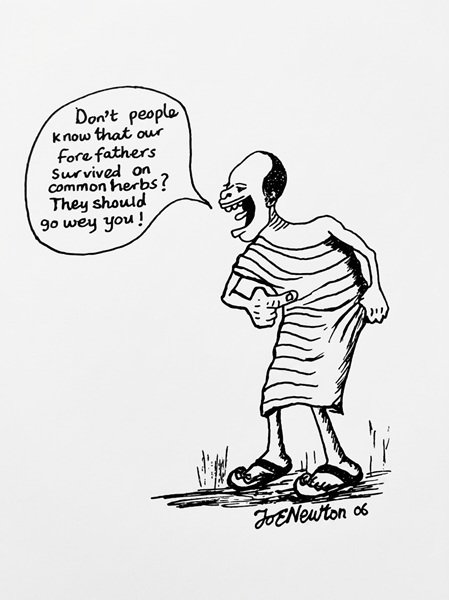
THE typical itinerant salesman in Sikaman is a herbalist. He is normally a slim macho with the capacity to perambulate the expanse of area covering the triangle of Accra-Tema-Ashiaman. In short, he can walk a total of 60 miles a day, marketing a product that cures every disease, including poverty. 
The door-to-door herbal pharmacist advertises his product by word of mouth. He has nothing to do with the Food and Drugs Board (FDB). After all, his concoctions do not feature on FM stations.
Those herbalists who cannot walk to propagate the herbal gospel, liaise with drivers of mass transportation and their mates. They are, therefore, given the chance to sell their products on Benz buses that ply the routes.
Normally, the herbalist starts his sales message with a prayer and Bible study. He asks the passengers to bow down their heads in supplication to God the father, the son, the Holy Spirit.
When a herbalist asks the passengers to close their eyes and bow their heads, Moslems on board naturally feel offended. They feel that the herbalist has no right to assume that every passenger is a Christian. They think such an assumption is an affront to Islam.
So a Moslem on board will raise the hand for a point of order. He’ll remind the herbalist that it would be in his own interest to mind his language.
“Be careful the way you address people in a public place. Not every person here is a Christian,” he’d state assertively.
Of course, the herbalist will promptly ignore him, but would all the same “watch” his tongue. Who knows whether or not the Moslem brother is inspired by Quoranic zeal to defend the tenets of Islam to the hilt?
When he starts saying, “Wallahi!” and “Inshallah!” it could be the beginning of proclaiming Islam as supreme, a point which must be driven home with talibanic precision.
So the herbalist must tread carefully lest he steps on fire.
The herbalist could even add a measure of mirth to it all, by announcing that Christians on board today have very interesting company on the journey, but that should not detract from the business of the day.
The Moslem brother will weigh the words carefully and offer a wry smile.
He must be careful the occasion does not degenerate into the use of semantics and proverbial oration to deride his conviction that public utterances must be mindful of religious sensibilities. He has made his point very clear and expects that it is taken in good faith in the interest of a peaceful journey.
The herbalist will now open the New Testament and preach salvation, stating clearly that salvation can come only through Jesus Christ and NOBODY else.
The Moslem brother will now start twitching his moustache. The visible and almost revolutionary reflexes of his upper lip can be an indication that sentiments have begun superseding reason, and the outcome could well be tragic now shift uneasily in his seat.
The time has come for him to also express his right to the religion of his fore-bears. He’ll put his hand into his pocket and rise to his feet. The time has indeed come!
This article was first published on Saturday, September 9, 2006
When the cause of a particular problem like sickness, disease, sudden illness, a social issue etc. are not known, it stands to reason that resolving it becomes a huge challenge.
Citizens would understand the government when public announcements are made to the effect that government is trying to find a solution to the issue, even though it is taking a while for it to be resolved because citizens are rational beings.
On the other hand, if the solution to a particular issue is known to everybody but the government for whatever reason, is dragging its feet in resolving it, citizens become frustrated and begin to lose trust in their leaders.
One such issue is the heavy traffic along a section of the Kasoa – Odokor road. A short stretch of bad road between the traffic light at the Weija Government Hospital and the entrance to the entrance of the overhead that leads to the N1, is the cause of the problem but nothing is being done about it, day after day, week after week, month after month. Thus is clearly unacceptable.
Another issue that requires urgent attention is the lack of pavements along a lot of streets in parts of the various Municipal Assemblies. Exercise is a prerequisite for long life and healthy living and for those of us who it has become a way of life, this issue of people putting up structures right to the edge of the drains beside the roads, are making life difficult for us.
We are compelled to walk along the roads, putting our lives at serious risk. Pedestrians should never be compelled to compete with vehicles on our streets and roads. Roads and streets are made for vehicles and pavements are made for pedestrians. That is the norm. Any attempt to normalise a situation where pedestrians are mingling with vehicles is insanity.
It is the road regulations that makes it so and therefore district or municipal assemblies are to take responsibility and ensure that spaces for pavements are not encroached upon. Citizens have rights that must be protected by their leaders and making pavements available to pedestrians, is one of them.
When we hear of teachers having sex with students, it appears it is something recent. It is not a new phenomenon. It has been there since Adam. Perhaps this issue is getting much attention due to the proliferation of social media. It was an open secret in times past when Teachers were in relationships with female students and some married them immediately after completion of school.
Some teachers were also known to be having unholy interactions with female pupils but due to the times that these acts occurred, human rights issues and the awareness around it, allowed such unscrupulous teachers to get away with their crimes.
Now we are in a different era and so a Headmaster is now in hot waters. He is alleged to have raped about 19 female students and as usual, some officials tried to cover it up and are also in hot waters and their actions or inactions in the matter are under investigation.
Why the man has been allowed to roam freely without being arrested is simply mind boggling. It appears that the law applies differently, depending on who you are. This issue came to public attention sometime in August this year, yet the police had not arrested or invited this man for question regarding the rape allegation.
It has come out that he is a Constituency Secretary of the ruling party and the question in the public domain is that, is it because he is a political figure that is why he is still walking around without questioning? I believe in the rule of law so let us hold our breadth and let the proper thing be done.
The police must however be seen to be active in this matter. God bless.
SKIP THE QUEUE, TAP THE NEWS
You can now read the Ghanaian Times and The Spectator newspapers from the comfort of your device via TimesNewsPlus.
Join our WhatsApp Channel: https://whatsapp.com/channel/0029VbBElzjInlqHhl1aTU27