News
Prez Mahama cuts sod for Big Push Agenda in Greater Accra

- /home/u249204778/domains/spectator.com.gh/public_html/wp-content/plugins/mvp-social-buttons/mvp-social-buttons.php on line 27
https://spectator.com.gh/wp-content/uploads/2025/09/WhatsApp-Image-2025-09-16-at-15.45.30-1.jpeg&description=Prez Mahama cuts sod for Big Push Agenda in Greater Accra', 'pinterestShare', 'width=750,height=350'); return false;" title="Pin This Post">
- Share
- Tweet /home/u249204778/domains/spectator.com.gh/public_html/wp-content/plugins/mvp-social-buttons/mvp-social-buttons.php on line 72
https://spectator.com.gh/wp-content/uploads/2025/09/WhatsApp-Image-2025-09-16-at-15.45.30-1.jpeg&description=Prez Mahama cuts sod for Big Push Agenda in Greater Accra', 'pinterestShare', 'width=750,height=350'); return false;" title="Pin This Post">
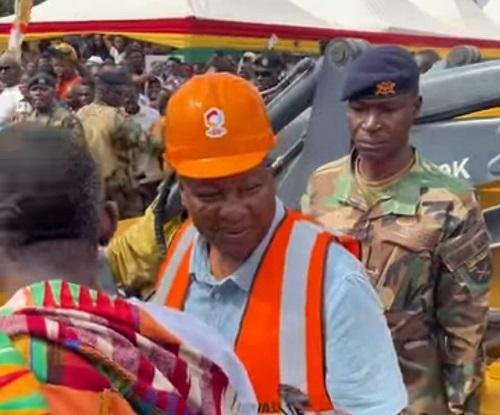
The President of the Republic of Ghana, John Dramani Mahama, has cut sod for the commencement of the Government’s Big Push Agenda for massive infrastructural development, starting with the construction of major road projects in the Greater Accra Region.
The ceremony took place on Tuesday September 15 at Afienya to mark the beginning of the Dawhenya Afienya Dodowa road project.
The President explained that the Big Push was a renewed commitment by his government to fix Ghana’s roads and open up the country for accelerated growth.
He recalled that the concept was first introduced in the National Democratic Congress manifesto in 2020 with plans to invest two billion dollars annually in infrastructure. However, the initiative was not implemented because the party lost the 2020 elections.
He noted that the plan was revived in 2024 when Ghanaians voted the NDC back into power. Since January 7 his government had been designing road projects across all sixteen regions, stressing that every region would benefit from the programme.
The President outlined three key criteria for the selection of projects under the Big Push. These include roads that connect regional capitals, roads that link district capitals, and roads located in food producing and industrial areas.
He announced that the first set of projects to commence included the Dawhenya Afienya Dodowa Road, the Tema Aflao dualization first phase, the Ashaiman Asikuma dualization, the Oyibi Apolonia Afienya Road, the Dodowa Somanya and Somanya Town Roads, and the Shai Hills Dodowa Road.
He further disclosed that stalled projects such as the Dome Kwabenya to Ketase Road, the Ofankor Nsawam Road, the Adenta Dodowa dualization, and the Beach Road from Black Star Square to Tema had been repackaged into the Big Push initiative.
The President emphasised that contractors for the projects were carefully selected based on their capacity, equipment, and ability to deliver on both quality and speed.
He explained that the majority of the contractors were Ghanaian in order to build local capacity.
He also made it clear that the programme was not meant for wheelbarrow contractors, although some foreign firms were included because they had ongoing contracts before the NDC returned to office.
He commended Oswal Investment Limited, one of the lead contractors, describing it as a reputable local firm committed to delivering speed and quality.
He assured Ghanaians that funding would not be a challenge and revealed that 13.9 billion Ghana cedis had been allocated for the Big Push in 2025, with an additional 30 billion set aside for 2026.
The President disclosed that the scope of the Big Push would expand in 2026 to include health, education, agriculture, agribusiness, and sports infrastructure.
He added that his government planned to introduce year round irrigation systems to boost food production, explaining that Ghana could no longer depend on six months of farming.
He also announced that 166 constituencies with the worst roads would each receive 10 kilometers of roads annually over four years, totaling 40 kilometers per constituency.
To ensure sustainability, he revealed that the Ghana Road Fund would dedicate 5 billion Ghana cedis annually to road maintenance, covering pothole patching, vegetation control, and desilting. He stressed that roads were vital for Ghana’s economic transformation, citing the example of how America’s development was boosted by early road and rail networks.
President Mahama concluded by assuring Ghanaians that his government was determined to deliver good roads across the country.
He expressed confidence that by 2027 citizens would see significant improvements in the quality and connectivity of roads nationwide.
The Minister for Roads and Highways, Governs Kwame Agbodz explained that the Big Push was not a campaign promise but a bold intervention by government to address Ghana’s road challenges.
The Minister disclosed that the Ministry of Roads and Highways owed contractors about 40 billion Ghana cedis, yet it was difficult to see what the money had been used for.
He noted that the new programme would be different and assured Ghanaians that results would be visible for all to witness.
He praised the staff of the ministry and its agencies for the work done in the past six months in preparing the projects.
He pledged that the projects under the Big Push would be completed within 24 months and expressed confidence that the contractor on the Afienya stretch could finish even earlier.
The Minister stressed that the programme would demonstrate the capacity of local contractors.
He stated that the Big Push would prove that Ghanaian contractors were as capable as their counterparts elsewhere while creating jobs and delivering lasting infrastructure.
He explained that all contractors and consultants working under the programme would be required to take insurance cover which would be cashed if they failed to deliver.
He urged that contractors must focus on the work and not run to government with complaints.
The Minister assured residents that all projects awarded under the initiative were starting simultaneously.
He cited ongoing works on stretches from Central University to the motorway, Kasoa, and from Ashaiman roundabout to Atimpoku, pledging their completion within 24 months.
He encouraged contractors to employ young graduates in engineering and surveying and invest in the training of the next generation of Ghanaian professionals.






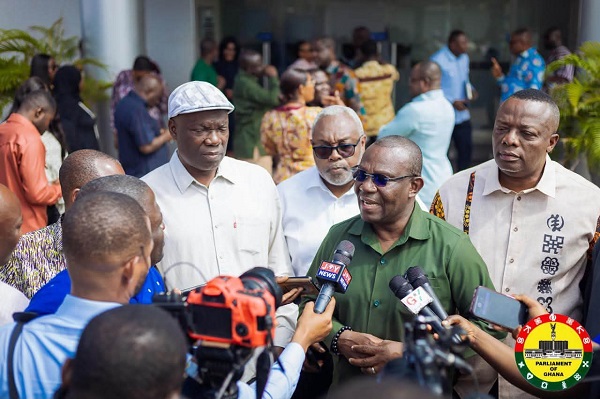
The Parliamentary Select Committee on Energy has appealed to the Ministry of Finance to release GH¢5.6 million to the Petroleum Commission to enable it to establish and operate a world-class data centre.
According to the Committee, access to the funds will strengthen the Commission’s capacity to manage critical upstream petroleum data and improve its operations.
Speaking during the appeal, Chairman of the Committee, Emmanuel Kwasi Bedzrah, said the move was crucial to efforts to revitalise Ghana’s upstream petroleum industry and increase oil production.
He noted that although investment and hydrocarbon production had declined in recent years, Parliament’s approval of an extension of the petroleum agreement to 2030 had attracted additional funding and contributed to an increase in production from about 80,000 to 120,000 barrels per day.
Meanwhile, concerns have been raised over repeated budget allocations for oil exploration in the Voltaian Basin.
Mr. Bedzrah stressed that funds approved for exploration must produce tangible results, adding that the Committee would require clear evidence of progress before supporting future budget allocations for the programme.
The appeal was made during a working visit to the Petroleum Commission as part of the Committee’s oversight activities to assess its operations and management procedures.
During the engagement, the Chief Executive Officer of the Petroleum Commission, Emeafa Hardcastle, took the Committee through the Commission’s working procedures and mandate, which includes regulating, managing and coordinating upstream petroleum activities.
She disclosed that since assuming office in 2025, government had pursued measures to reverse the decline in crude oil production, sustain output and reposition Ghana as an attractive destination for investment in Africa’s increasingly competitive petroleum sector.
In addition, she said government had secured fresh commitments of about US$35 billion to help revitalise the sector.
As part of the oversight exercise, the Committee is expected to conclude its monitoring visit with engagements at the National Petroleum Authority (NPA) and the Ghana Oil Company Limited (GOIL).
By Edem Mensah-Tsotorme
News
“No civilisation deserves to be annihilated” – Mahama calls for dialogue on global conflicts at UNGA 81
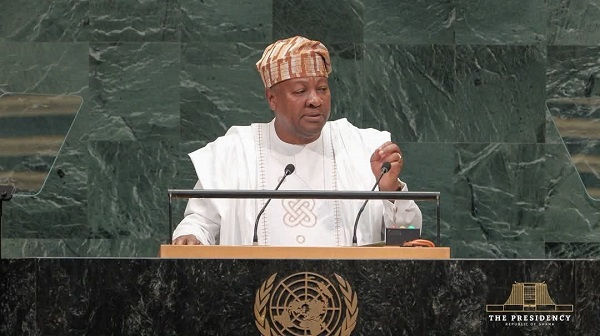
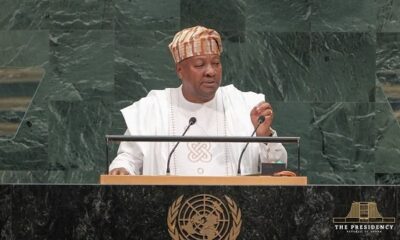
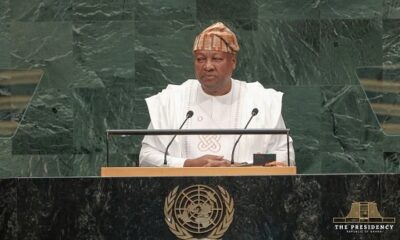
President John Dramani Mahama has called for solidarity and dialogue in resolving global conflicts, insisting that no civilisation deserves to be wiped out.
“No human civilisation deserves to be annihilated, certainly not a member state of the United Nations,” President Mahama stated in his address at the 81st United Nations General Assembly in New York.
He called for solidarity with nations facing terrorism, especially the Alliance of Sahel States (AES), and for a uniform approach to conflicts in Europe, the Middle East and Africa.
On the Middle East, the President called for a return to negotiations, saying “The current Middle East crisis is having a deleterious effect on the world economy.”
“I believe that dialogue can resolve even the most intractable of problems,” he added.
By Edem Mensah-Tsotorme

 Entertainment1 week ago
Rhythms On Da Runway returns November 28 with 16th edition themed ‘Unbound’
- Entertainment1 week ago
Ohemaa Mercy’s Tehillah Experience outfit was priestly regalia, not costume – Management clarifies
 News1 week ago
Janet Asana Nabla criticises Mahama over China curriculum controversy involving Haruna Iddrisu