News
President c’ssions Suhum Interchange

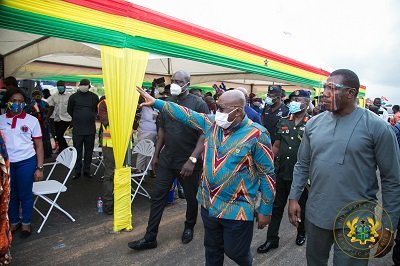
The President, Nana Addo Dankwa Akufo-Addo on Friday commissioned the Suhum Interchange and opened it to traffic.
The interchange, fully funded by the Government of Ghana consolidated fund, was part of the 31.7km Kwafokrom-Apedwa Junction Project.
It is one of the many projects along the Central corridor designated as National Route 6 (N 6) under the Ghana Highway Authority’s functional classification of road.
The project was executed by the Messrs China International Water and Electric Corporation (CWE) with Conptram Engineering Planning and Associates as the consultants.
The opening of the interchange which consisted of two bridges carrying a total of four lanes, with each of the bridges having 10 span reinforced concrete box grinder bridges with a total length of 250 metres, would provide safe and uninterrupted flow of traffic.
It would also facilitate trade between the northern and southern parts of the country and within the West African sub-region.
At a short ceremony to officially open the interchange to traffic, President Akufo-Addo explained that the project, which commenced in September 2008, was initially scheduled to be completed in March 2012.
However, it suffered several challenges mainly associated with payment delays, hence several suspension of the project by the contractor.
He revealed that work resumed in June 2017, on the south bound carriageway including the interchange after some negotiations and payments of arrears were made to the contractor, while the northern bound carriageway including the construction of eight footbridges along the road corridor were all repackaged with work commencing in January 2019, adding that the entire Kwafokrom to Apedwa junction project would be finally expected to be completed in April 2021.
President Akufo-Addo noted “the commissioning was evident of government’s commitment to continue with and complete successfully major infrastructural projects we have inherited from previous governments so that the expected socio-economic benefits can be enjoyed by all”.
He stated that the interchange would alleviate the plight of the general public who use the Accra to Kumasi road and afford residents the comfort of going about their normal activities without fear of being knocked down by vehicles and hence urged motorists and road users to follow the traffic and control management schemes that has been deployed on the road to ensure safety for all.
“Indeed, the improved conditions of our highways owes a collective duty on us the citizenry to be mindful of our responsibilities on the road and I urge motorists to be extra careful on our highways and also resist the temptation of overspeeding on good road sections, adding that improved roads should not be a catalyst of national development nor instruments of death and pain.
He however expressed gratitude of the workers, security agencies, contractors, and the supervising agencies, the GHA for a good work done on the project.
For his part, the Minister for Roads and Highways, Mr Kwesi Amoako-Atta said the project generated thousands of jobs to a number of local companies, adding that the government was committed to completing many road projects.
He called on motorists to be mindful of their act on the road and charged the police to undertake speed checks regularly to ensure safety on the road.
The Project Manager of CWE, Du Huglai said they were committed to completing the entire project if they receive more funding from government.
Source: Ghanaian Times


The Diaspora Affairs Office at the Office of the President has hosted a delegation of African diaspora women who are in Ghana ahead of a planned Presidential Conferment of Citizenship ceremony.
The Director of Diaspora Affairs, Kofi Okyere Darko, explained in a Facebook post that the visit was a gesture of appreciation by the delegation to the Government of Ghana for its continued efforts to reconnect Africans in the diaspora with their ancestral homeland.
He indicated that the ceremony, scheduled for next Monday, will officially grant Ghanaian citizenship to members of the delegation as part of the country’s broader engagement with the African diaspora.
The delegation was led by Erica Bennett, Founder of the Diaspora Africa Forum.
According to Mr Okyere Darko, her years of advocacy have played an important role in strengthening ties between Africa and people of African descent living abroad.
He noted that the group’s journey towards citizenship represents not only a legal process but also a cultural and spiritual return to their roots.
Also present at the meeting was Natalie Jackson, an attorney who is also expected to receive Ghanaian citizenship during the ceremony. She works closely with renowned civil rights lawyer Ben Crump.
Mr Okyere Darko emphasised that Ghana remains committed to strengthening relationships with the African diaspora and promoting unity, identity, and shared heritage among people of African descent worldwide.
By: Jacob Aggrey

Ghana has signed a debt restructuring agreement with the Kingdom of Belgium as part of efforts to restore the country’s economic stability after the financial crisis that hit the nation in 2022 and 2023.
The Minister of Finance, Cassiel Ato Forson, today disclosed that he signed the agreement on behalf of the Government of Ghana.
He explained that Ghana experienced a very difficult period during the crisis, which forced the government at the time to declare a debt default.
However, he indicated that the country is now recovering and witnessing a significant economic turnaround.
According to him, stronger systems are also being put in place to ensure that Ghana does not return to such a situation again.
Dr Forson noted that the agreement with Belgium is the eighth deal Ghana has concluded with countries under the Official Creditor Committee as part of its external debt restructuring programme.
He expressed appreciation to the Government of Belgium for its support and partnership with Ghana during the process.
The Finance Minister thanked Carole van Eyll, Ambassador of Belgium to Ghana, for her role in strengthening relations between the two countries.
The agreement forms part of Ghana’s broader effort to restructure its external debts and stabilise the economy following the crisis.
By: Jacob Aggrey

 News1 week ago
Finance Minister outlines new gold policies to boost reserves and curb smuggling
- News1 week ago
Sam George launches the 2026 Meteorological Awareness Month; presents the 2026 seasonal forecast for southern Ghana
- Hot!1 week ago
Breaking: Footballer who killed two children in Abesim handed lifetime sentence