Hot!
Poor roads: Enemy of development

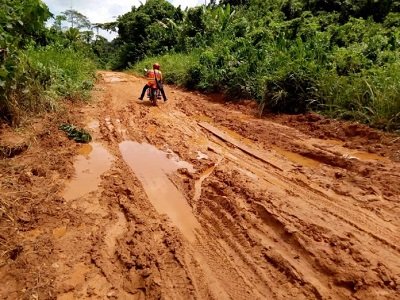
The state of our roads has been on my mind for some time now. No doubt there had been a major improvement in the overall road network in Ghana over the years. Yet, after 64years of Independence what Ghana can show on for its major highways is a complete disgrace.
For instance, the road linking our two major cities Accra-Kumasi is nothing more than a single-lane death trap! A distance of only 250 Km, it takes over five hours and if you are not lucky, it will take your life as well. How much more with the road networks linking deprived communities?
Sufficient evidence abounds that, the media houses are awash with complaints about bad roads and the need for the central government or district assemblies to step in to fix them.
Reliable and dependable roads help to facilitate the smooth movement of goods and people, create employment, support economic growth, enhance access to education and healthcare services, and connect people to families and places of entertainment. This also goes a long way in aiding in the fight against poverty.
In Ghana, road transport is one of the major keys which enhance economic potential. It is estimated that road transport alone accounts for 96 per cent of passenger and freight traffic and about 97 per cent of passenger in the country.
That is why sustainable development of our road infrastructure cannot be downplayed. As a result, I believe that placing a lot more premium on developing our road infrastructure will definitely be a step in the right direction.
Nonetheless, lately, there have been concerns across the country over the poor conditions of our roads. The country’s roads have seen further deterioration as a result of the heavy rains experienced recently.
For example, the pothole-ridden roads in Accra and other parts of the country are increasingly becoming alarming and worrying, which make the cost of road transport high and very risky.
Fortunately, Ghana has consistently been one of the countries in the top ranks of the African Development Bank’s Africa Infrastructure Development Index (AIDI), attracting funding for roads infrastructure.
That notwithstanding, there is still more road infrastructure deficit requiring urgent attention from the government. Efforts should, therefore, be put in place to save the situation.
Truth is, among the many modes of transport, road transport is the commonest. However, poor road infrastructure hinders road transport and curtails development and mobility.
It may interest readers to know that rural areas are places for the production of primary goods and services worldwide.
It is for this reason that the government should be able to take the necessary steps to invest more in road infrastructure so that the citizens can gain access to the remotest parts of the country in order to unlock the vast and untapped reservoir of productive potential in those areas.
Although the link between roads and human development is not well established, data from low-income countries demonstrate that communities living furthest from good roads experience higher levels of poverty, lower levels of school attendance and worse health outcomes.
This has become one of the reasons there are frequent agitations by some community members for the government to fix their roads.
The problem of poor road network can be addressed when a routine monitoring and evaluation mechanism is built into the road infrastructure investment policies to ensure that road construction carried out by contractors are properly done.
Furthermore, the government must always follow up on reports to check whether projects being implemented are done properly. This will become feasible when standards assessments are given the number one priority.
That is why, it is imperative that adequate investment is made into the road sector with proper monitoring and evaluation. Such measures when fully instituted, will ensure that the issue of poor roads and potholes will be a thing of the past.
The writer is a student of the Ghana Institute of Journalism
Email: Dona.esi.15@gmail.com
By Donatella Esinam Kudoto



The Member of Parliament for Nsawam Adoagyiri, Frank Annoh Dompreh, has expressed concern over delays in the release of the District Assemblies Common Fund, warning that the situation is stalling development across the country.
On his facebook page, he described as a matter of urgent national importance, the Minority Chief Whip pointed to what he sees as a growing crisis of unpaid contractors, abandoned projects, and halted infrastructure works in many districts.
He noted that several communities are grappling with half completed schools, unfinished health facilities, abandoned markets, deteriorating roads, and stalled sanitation projects.
According to him, many contractors who have executed projects for district assemblies have not been paid, forcing some construction firms to demobilise from sites while workers lose their jobs.
He stressed that the District Assemblies Common Fund is not a discretionary allocation but a constitutional requirement under Article 252 of the 1992 Constitution, intended to support development at the local level.
In his view, years of delayed releases and accumulated arrears have weakened district development financing and disrupted projects meant to improve living conditions in communities.
He further argued that some payments made in recent years were largely the settlement of old debts rather than funding for new or ongoing projects, a situation he believes has affected contractor confidence and local economic activity.
He described the issue as more than a budgetary challenge, characterising it as a development emergency and a governance concern.
He therefore urged the appropriate authorities to pay outstanding DACF arrears, settle contractors who have completed their work, and ensure that transfers to districts are automatic and predictable.
He maintained that decentralisation can only succeed when district assemblies receive adequate and timely funding to carry out development projects.
He emphasised that stalled projects directly affect ordinary citizens, since they rely on such infrastructure for education, healthcare, transportation, sanitation, and economic activities.
He called for renewed attention to grassroots development, insisting that national progress should not be concentrated only in major cities but extended to all communities.
By: Jacob Aggrey

Richard Appiah, the footballer who killed two children and stored part of their bodies in a fridge at Abesim in the Bono Region in 2021 has been handed a lifetime sentence.
This was after a five member panel of judges at the Accra High Court returned a verdict of guilty against the convict.
Appiah, 32, also a draughtsman would spend the rest of his life in prison after he was convicted of murder.
More more more
BY MALIK SULLEMANA