News
Peprah Oppong, Issahaku and Alidu Seidu named in squad for Central African Republic an d Comoros World Cup qualifiers

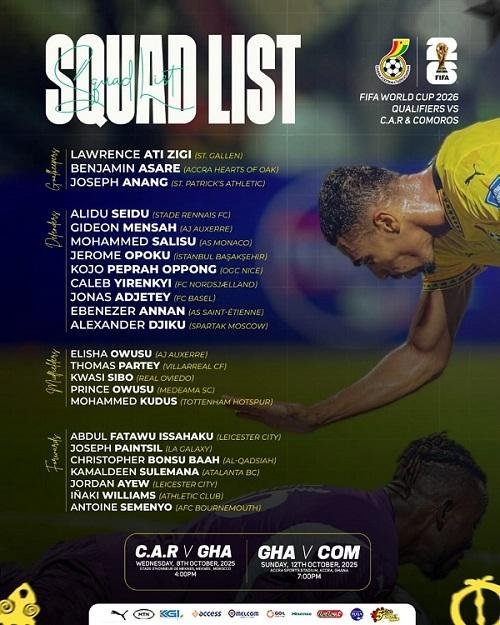
Youngster Kojo Peprah Oppong, Leicester City winger Abdul Fatawu Issahaku and Alidu Seidu have been named in Ghana’s squad for the forthcoming 2026 FIFA World Cup qualifiers against Central African Republic and Comoros.
Kojo Peprah Oppong, 21, has been impressive for OGC Nice in the French Ligue 1 this season, delivering outstanding performances. He began his career with Attram De Visser in the Division One League before moving to Europe two seasons ago.
Abdul Fatawu Issahaku returns to the squad after a stellar performance for Leicester City in the English Championship, having been sidelined since November due to an Anterior Cruciate Ligament injury.
Alidu Seidu also makes a return after recovering from a long-standing knee injury that kept him out of the squad since November last year.
Medeama SC midfielder Prince Owusu has been handed his debut call up following his brilliant start to the Ghana Premier League.
Ghana will play the penultimate World Cup qualifier against Central African Republic at Stade d’Honneur de Meknes at 16h00 GMT on Wednesday, October 8, 2025, before hosting Comoros at the Accra Sports Stadium at 19: 00 GMT on Sunday, October 12, 2025.
The Black Stars are chasing a fifth World Cup appearance as they currently sit at the top of Group I with 19 points with two matches to the end of the qualifiers.










A 30-year-old man has been sentenced to 25 years imprisonment with hard labour by the Bekwai Circuit Court for his role in a 2022 robbery at a mining site at Manso Akwasiso in the Ashanti South Region.
The convict, Dominic Ofori, also known as Fanta, was arrested on 16th February 2026 after years on the run. He pleaded guilty before the Bekwai Circuit Court to robbery contrary to Section 149 of the Criminal Offences Act, 1960 Act 29, and was accordingly sentenced to 25 years imprisonment with hard labour.
On March 20, 2022, the Manso Adubia District Police received intelligence that a group of armed men from Manso Abodom were planning to attack a mining site at Manso Akwasiso to rob the owner of gold concentrate. Acting on the information, police mounted a coordinated operation and laid an ambush at the site.
At about 5:30 pm the same day, four-armed men arrived at the site, fired indiscriminately, and robbed the miners of their gold concentrate. The police team on surveillance intervened, resulting in an exchange of gunfire.
Three of the suspects, Abu Abubakar, Musah Latif, and Gideon Takyi, sustained gunshot wounds and were pronounced dead on arrival at St Martins Catholic Hospital at Agroyesum. Dominic Ofori escaped at the time but was later arrested and put before the court.
The Ashanti South Regional Police Command has assured the public of its continued commitment to combating violent crimes and bringing offenders to justice.
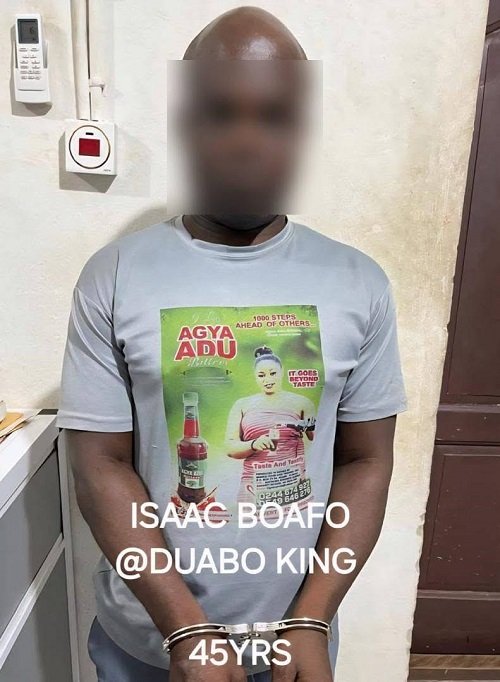
The Ashanti Regional Police Command has arrested 45-year-old Isaac Boafo, also known as “Duabo King,” for allegedly publishing false news intended to cause fear and panic.
Police said the arrest follows a viral TikTok video in which Boafo claimed that four officers at the Central Police Station in Kumasi engaged in inappropriate conduct with commercial sex workers during night patrols in Asafo.
Officers from the Police Intelligence Directorate (Ashanti Region) apprehended Boafo after receiving intelligence about the video.
During questioning, he admitted to creating the video to attract views and engagement online, and acknowledged that he could not prove the allegations.
Boafo also admitted making comments about the President of the Republic for content purposes and could not defend those statements.
He has been formally charged and is in detention as investigations continue.
The Ashanti Regional Police have warned the public against publishing or sharing false information on social media, noting that such acts can cause fear, panic, and damage reputations.
They said anyone found engaging in similar conduct will face legal action.
By: Jacob Aggrey