News
NIA resumes Ghana card registration for children in Volta and Oti regions


- /home/u249204778/domains/spectator.com.gh/public_html/wp-content/plugins/mvp-social-buttons/mvp-social-buttons.php on line 27
https://spectator.com.gh/wp-content/uploads/2026/05/WhatsApp-Image-2026-05-05-at-17.00.11.jpeg&description=NIA resumes Ghana card registration for children in Volta and Oti regions', 'pinterestShare', 'width=750,height=350'); return false;" title="Pin This Post">
- Share
- Tweet /home/u249204778/domains/spectator.com.gh/public_html/wp-content/plugins/mvp-social-buttons/mvp-social-buttons.php on line 72
https://spectator.com.gh/wp-content/uploads/2026/05/WhatsApp-Image-2026-05-05-at-17.00.11.jpeg&description=NIA resumes Ghana card registration for children in Volta and Oti regions', 'pinterestShare', 'width=750,height=350'); return false;" title="Pin This Post">
The National Identification Authority has resumed the Ghana Card registration exercise for children between the ages of 6 and 14 in the Volta and Oti regions.
According to the Authority, the exercise begins on Tuesday, May 5, 2026, in collaboration with the National Health Insurance Authority.
In a statement issued on May 4, the NIA said the exercise forms part of a nationwide campaign aimed at registering about 3.1 million children to strengthen Ghana’s national identity system.
The Authority explained that the Volta and Oti regions are the first areas selected for the phased national rollout, with each phase expected to last at least 21 days.
Registration teams are expected to move from school to school, covering both public and private institutions, to register eligible children.
The NIA said registration will take place daily from 8:00 a.m. to 5:00 p.m.
It added that children within the age bracket who are not in school can visit designated schools or registration centres in their communities to register.
According to the Authority, parents or guardians registering a child must present the child’s original birth certificate, valid Ghanaian passport or certificate of acquired citizenship.
Where these documents are unavailable, a parent, relative or legal guardian may complete an Oath of Identity form.
The NIA further explained that in cases where a child has no known relatives, two Social Welfare Officers may vouch for the child under oath.
Parents and guardians who have enrolled their children onto the National Health Insurance Scheme were encouraged to present the child’s NHIS card or number during registration.
The Authority stressed that persons presenting children for registration must be Ghanaian citizens, at least 18 years old, mentally sound and possess a valid Ghana Card.
The NIA also advised children who registered during the 2024 pilot phase but have not yet received their cards to visit their district offices for collection.
The Authority warned that providing false information or assisting in the registration of non-Ghanaians is a criminal offence punishable by law.
It reaffirmed its commitment to building a secure, reliable and inclusive national identity system for all Ghanaians.
By: Jacob Aggrey









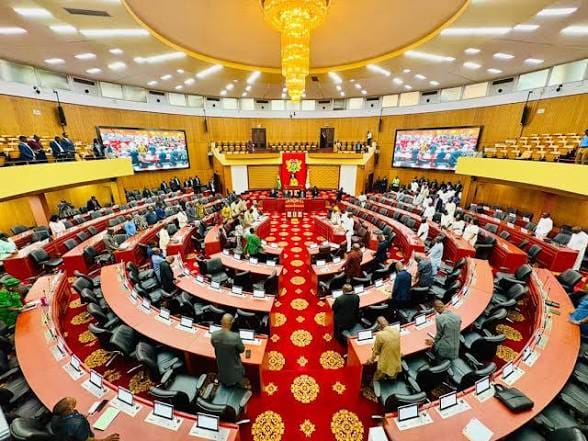
Parliament has clarified public commentary on social media regarding a notice on its notice board that read “No Vacancy for National Service Personnel 2026/2027. Kindly go for reposting.”
In a statement, signed by the Director of Media Relations, David Sebastian Damoah, Parliament said the notice has been misconstrued and was not a policy statement, a freeze on national service placements, or a change in its support for the National Service Scheme.
According to Parliament, the notice was a routine administrative message to prospective personnel who reported to the House, informing them that it has received more personnel than it can accommodate for the 2026/2027 service year and that they should seek reposting to other institutions.
It said it remains committed to the National Service Scheme and values the contribution of service personnel to its work, and regrets any confusion or inconvenience the wording may have caused.
By Edem Mensah-Tsotorme

Ghanaian public advocate Hopeson Yaovi Adorye has been elected to the Board of Directors of the World Taxpayers Association (WTA).
The election took place on Sunday, October 5, 2026, during the Association’s conference in Kraków, Poland.
His election marks a significant addition to his international leadership portfolio and provides a platform for Ghanaian and African perspectives to contribute to global discussions on taxpayer rights, responsible taxation, transparency and prudent management of public resources.
Reacting to his election, Mr. Adorye expressed appreciation to the leadership and members of the WTA for the confidence reposed in him.
“I am deeply honoured by this confidence and conscious of the responsibility that comes with it. Taxpayers are at the heart of every economy, and they deserve fairness, transparency, accountability and value for the taxes they pay. I look forward to working with colleagues from across the world to strengthen the voice of taxpayers and promote responsible fiscal governance,” he said.
According to him, taxation should not be viewed solely as a mechanism for raising government revenue, but also as an important component of the social contract between citizens and the state.
Mr. Adorye said governments have a responsibility to ensure taxes are collected fairly and public resources are utilised efficiently to deliver quality infrastructure, healthcare, education, security and other essential services.
His election also creates an opportunity to bring African experiences into international conversations on taxation and public expenditure.
Mr. Adorye, who is Executive Director of Taxpayers League Ghana, has previously served as Global Board Chairman of the International Youth Network for UN Security Council Resolution 2250, an NGO associated with the United Nations Economic and Social Council (ECOSOC).
He is expected to use his new role to champion fiscal accountability, taxpayer education, good governance and stronger citizen participation in public financial management.