Hot!
NCA poised to set price ceiling for telecommunication services


The Ministry of Communication has directed the National Communications Authority (NCA) to set a price ceiling on all telecommunications services to promote competition and address growing disparities in market and revenue shares in the sector.
The floor pricing of services, which includes voice calls, data, short messaging service (SMS), Mobile Money, among others, was to ensure a level-playing field for all network operators within the telecommunications industry.
A statement signed and issued by the Minister of Communications, Ursula Owusu-Ekuful in Accra yesterday, said, the move forms part of other specific measures to be implemented by the NCA to promote proper and healthy competition among telecommunications players, secure a much better pricing policy for the consumers and facilitate a sound regulatory regime.
Among the measures are asymmetrical interconnect rate in favour of the disadvantaged operators, review and approve all pricing by MTN network, which is considered the Significant Market Power (SMP), as required by law and require of the company not to have differential prices for on-net and off-net transactions.
Additionally, the NCA was to ensure various operator vendors were not subject to exclusionary pricing or behaviour, ensure that SMP’s access to information does not disadvantage any value added service of non-SMP operators and require operators to present implementation plans on National Roaming Services within the next 30 days for execution on or before the next 90 days.
Among other benefits, the implementation of the policy, would maximise consumers’ welfare, stimulate the activities of third party vendors such as Value Added Service providers and give them a choice to work with non-SMP operators and prevent the dominant operator from using predatory pricing to eliminate competition.
The statement noted that it would also create a catalyst for passive infrastructure sharing within the industry especially for national roaming services and increase service choice for consumers within areas where SMP is present and would not be permitted to charge a high price to call, SMS, or transfer money to other services, while keeping its own prices low.
The statement noted that the policy directive was due to growing market imbalance and creation of a near monopoly in the country’s telecom sector adding that the imbalance potentially exposes the country to the dictates of the dominant operator and negatively impacts on competition and choice for the consumer as well as investments within the sector.
Referring to statistics which indicate that MTN has almost 75 per cent of telecommunications market share, the statement said although it showed growth within the telecommunications and financial sectors, it also shows an uncompetitive and unprofitable environment for less dominant players in those industries.
It said the measures were in line with the NCA’s functions and duties outlined in the National Communications Authority Act 769 of 2008, Section 3e, which requires the Authority to ensure fair competition amongst licencees, operators of communications networks and service providers of public communications”.
It said the government acknowledges the investments MTN has made in their operations over the years however, its growing dominance has impacted negatively on competition and consumer choice, necessitating corrective action.
The statement called on all network operators to collaborate with the NCA to ensure the measures were implemented successfully.
BY TIMES REPORTER


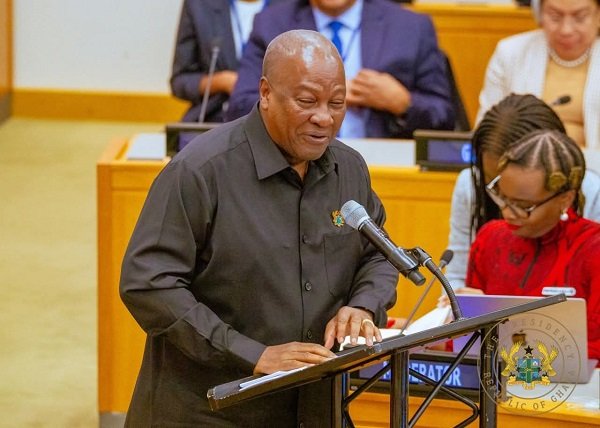
Photos from the High-Level Event on Reparatory Justice for the trafficking of enslaved Africans and the racialised chattel enslavement of African people, convened at the United Nations Headquarters, New York.
Delivering a powerful address, President John Dramani Mahama underscored the moral urgency of confronting historical injustices and advancing a global commitment to reparatory justice.
“The entire transatlantic slave trade was designed to deny African people their humanity,” the President stated.
Highlighting the significance of ongoing international efforts, he added:“This resolution allows us, as a global community, to collectively bear witness to the plight of the 18 million men, women, and children whose homes, communities, names, families, hopes, dreams, futures, and lives were stolen from them over the course of four centuries.”
In reaffirming the enduring truth of justice, President Mahama noted:
“Just because everybody is doing something doesn’t make it right. Slavery is wrong now, and it was wrong then. For as long as Africans have been trafficked and enslaved, there have been abolitionists who have spoken up against it.”
He further called for a deeper reflection on identity and dignity:
“We must also remember to reclaim our own humanity… when we absorb too much of the language of violence and erasure, our minds become enslaved.”

A member of the New Patriotic Party (NPP), Beatrice Siaw, has expressed mixed views about Ghana’s current leadership, saying she admires President John Dramani Mahama but is not fully satisfied with how the country is being governed.
Speaking in an interview on Metro TV on Tuesday, she said although she belongs to the NPP, she finds it difficult to criticise the President personally.
“I admire President Mahama, so it’s hard to speak against him. But I do love my party. I am impressed with the President, not necessarily impressed with how things are going” she said.
She acknowledged that the NDC has made efforts in managing the economy and improving some key indicators. She noted that the party appears determined to prove critics wrong after previously being voted out of office.
“They are trying to do a lot of things that Ghanaians thought they couldn’t do when they were in power,” she said.
However, she was quick to add that these efforts may not necessarily translate into electoral success in the next election cycle.
When asked whether the NDC’s performance could pose a strong challenge in 2028, she said she does not believe so, although she admitted there have been some improvements in certain areas.
“In some aspects, yes,” she said when asked if she had been impressed by the government’s performance.
By: Jacob Aggrey