Features
Organic farming: A national strategy for Ghana’s food strategy


The quiet crisis in the Ghanaian field
In many Ghanaian communities today, from the vegetable hubs of Akumadan to the grain belts of the Northern Region, farmers are being squeezed from both ends. On one side are the suffocating rising costs of imported inputs. Synthetic fertiliser prices that jump without warning and chemical pesticides that are not only expensive but often misused due to a lack of technical oversight. On the other side is the relentless pressure to produce in the face of exhausted soils, erratic rainfall patterns, and the emergence of aggressive new pest outbreaks like the Fall Armyworm.
The result is a quiet, systemic crisis; thus, our smallholder farmers are working harder and spending more of their meager capital on external inputs, yet they are struggling to secure stable yields or achieve decent profits.
Redefining organic: From boutique to backbone
In the current national conversation, organic farming is often misunderstood. It is frequently treated as a “boutique” label, something meant for the export shelves of Europe or the high-end health shops in suburban Accra. This narrow thinking is dangerous. Organic farming, properly understood, is not a niche lifestyle choice; it is a sophisticated biological system built around soil health, compost restoration, and integrated pest management.
For Ghana, this is not a fashionable trend; it is a vital National Resilience Strategy. If Ghana invests in organic and agroecological practices at scale, starting with decentralised compost production and credible safety standards, we can sever the cord of input vulnerability and rebuild our agricultural heritage from the ground up.
The problem: The trap of imported dependency
Ghana’s food production has become dangerously addicted to inputs we do not control. Our current model relies on a global supply chain that is increasingly volatile. Synthetic fertilisers and agro-chemicals are tethered to the price of natural gas and vulnerable to currency swings. When the Cedi fluctuates or global shipping is disrupted, the burden falls squarely on the Ghanaian farmer.
Organic approaches offer a practical escape from this dependency trap by shifting the center of productivity back to local Biological Capital: compost, green manure, and cover crops. These methods do not just reduce immediate costs; they treat the soil as a long-term asset. A nation that depends on imported fertility is always just one global crisis away from a hunger epidemic. By focusing on organic soil restoration, we transform the soil from a mere medium for chemicals into a living, self-sustaining engine of growth.
Climate change and the yield gap myth
One of the loudest arguments against organic farming is the question: “Can it produce enough?” Critics point to a potential yield drop during the transition phase from chemical-heavy systems. However, in the context of the climate crisis, this argument is incomplete.
Most of Ghana’s farming is rain-fed. As our rainy seasons become more unpredictable, synthetic-heavy soils, which are often low in organic matter, struggle to retain moisture. In contrast, organic systems perform significantly better under drought conditions. Carbon-rich, composted soil acts like a sponge, holding water longer and keeping crops alive during dry spells.
A slightly lower yield that is stable, resilient, and cheaper to produce is far better for a Ghanaian farmer’s pocket than a high yield that requires expensive chemicals and collapses entirely when the rains fail. Stability is the true measure of food security, not just peak volume.
Public health: The farm-to-table connection
The pressure to produce market-perfect vegetables for consumers in Kumasi or Accra often leads to the cocktail effect, where farmers mix multiple high-toxicity pesticides to ensure no insect damage is visible. This carries hidden, staggering costs: acute respiratory illnesses for farmers, long-term hospital visits for consumers, and a growing public mistrust in local produce.
Organic practices, such as biological pest control and crop rotation, reduce the reliance on these heavy chemical sprays. When we support organic-by-practice farming, we are investing in a preventive healthcare strategy. We protect the farmer in the field and the Ghanaian family at the dinner table.
The economic multiplier: Jobs in the green economy
Scaling organic farming creates a new value chain that could employ thousands of youth. Unlike imported fertilisers, compost and bio-pesticides must be produced locally.
• The compost economy: Establishing municipal organic waste processing plants creates jobs in waste collection, processing, and distribution.
• Bio-inputs: Local entrepreneurs can lead the way in producing botanical extracts and neem-based bio-pesticides, keeping money circulating within the Ghanaian economy rather than sending it abroad to multinational chemical firms.
A five-point action plan for a greener Ghana
To move organic farming from the fringe to the mainstream, we need a “who-does-what” roadmap that moves beyond rhetoric into institutional action:
- Scale up compost as national infrastructure
Municipal assemblies, in partnership with the Ministry of Food and Agriculture (MoFA), must prioritise the conversion of city organic waste into high-quality compost. We should establish regional compost hubs near major farming belts. Compost should be treated with the same importance as roads or electricity for it is fundamental infrastructure of food security. - Re-tooling extension services
The current extension model is often geared toward chemical-intensive agriculture. MoFA extension officers must be retrained to provide practical, hands-on modules for farmers. This includes teaching Indigenous Microorganisms (IMO) collection, advanced composting techniques, and multi-cropping strategies that naturally suppress pests. - Build truth-in-labelling and consumer trust
We need the Ghana Standards Authority (GSA) and the Food and Drugs Authority (FDA) to establish credible, low-cost certification systems. We don’t need expensive international labels; we need a Verified Safe or Organic-by-Practice seal that allows a consumer at Agbogbloshie market to buy with confidence, knowing the produce is free from toxic residues. - Leverage institutional procurement
The government is one of the biggest food buyers in the country. The Ghana School Feeding Programme and government hospitals should pilot sourcing from verified organic-by-practice farms. This provides a guaranteed market and a price floor for farmers who take the risk to transition away from chemicals. - Incentives for the next generation
Organic farming is high-knowledge farming. We must provide small grants or low-interest Green Credits for youth-led cooperatives. If we give young graduates the tools to start Soil Clinics or composting businesses, we make agriculture attractive, modern, and profitable.
Conclusion: The choice before us
Organic farming is not a luxury for the wealthy; it is a strategy for national survival. It is the path toward a Ghana that is less dependent on the whims of global markets and more reliant on the strength of its own ecological intelligence.
Ghana must decide now! Will we keep chasing short-term productivity through expensive, imported dependency? Or will we build a lasting food system through soil restoration and biological wisdom? The sooner we treat our soil as a living national asset, the sooner we can secure a food system that truly serves all Ghanaians. The time to transition is not when the next crisis hits; the time to transition is now.
By Felicia Bonnah Quansah

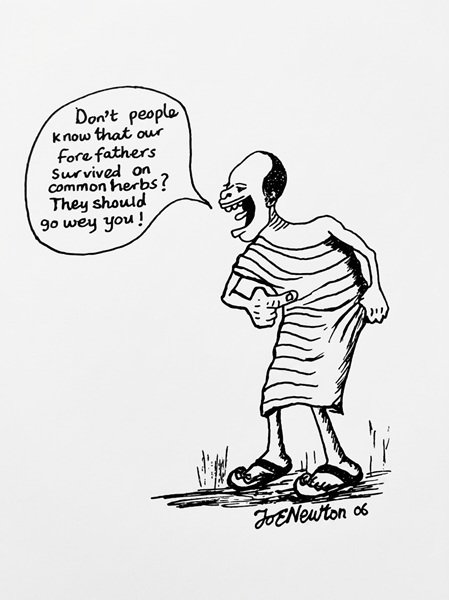
THE typical itinerant salesman in Sikaman is a herbalist. He is normally a slim macho with the capacity to perambulate the expanse of area covering the triangle of Accra-Tema-Ashiaman. In short, he can walk a total of 60 miles a day, marketing a product that cures every disease, including poverty. 
The door-to-door herbal pharmacist advertises his product by word of mouth. He has nothing to do with the Food and Drugs Board (FDB). After all, his concoctions do not feature on FM stations.
Those herbalists who cannot walk to propagate the herbal gospel, liaise with drivers of mass transportation and their mates. They are, therefore, given the chance to sell their products on Benz buses that ply the routes.
Normally, the herbalist starts his sales message with a prayer and Bible study. He asks the passengers to bow down their heads in supplication to God the father, the son, the Holy Spirit.
When a herbalist asks the passengers to close their eyes and bow their heads, Moslems on board naturally feel offended. They feel that the herbalist has no right to assume that every passenger is a Christian. They think such an assumption is an affront to Islam.
So a Moslem on board will raise the hand for a point of order. He’ll remind the herbalist that it would be in his own interest to mind his language.
“Be careful the way you address people in a public place. Not every person here is a Christian,” he’d state assertively.
Of course, the herbalist will promptly ignore him, but would all the same “watch” his tongue. Who knows whether or not the Moslem brother is inspired by Quoranic zeal to defend the tenets of Islam to the hilt?
When he starts saying, “Wallahi!” and “Inshallah!” it could be the beginning of proclaiming Islam as supreme, a point which must be driven home with talibanic precision.
So the herbalist must tread carefully lest he steps on fire.
The herbalist could even add a measure of mirth to it all, by announcing that Christians on board today have very interesting company on the journey, but that should not detract from the business of the day.
The Moslem brother will weigh the words carefully and offer a wry smile.
He must be careful the occasion does not degenerate into the use of semantics and proverbial oration to deride his conviction that public utterances must be mindful of religious sensibilities. He has made his point very clear and expects that it is taken in good faith in the interest of a peaceful journey.
The herbalist will now open the New Testament and preach salvation, stating clearly that salvation can come only through Jesus Christ and NOBODY else.
The Moslem brother will now start twitching his moustache. The visible and almost revolutionary reflexes of his upper lip can be an indication that sentiments have begun superseding reason, and the outcome could well be tragic now shift uneasily in his seat.
The time has come for him to also express his right to the religion of his fore-bears. He’ll put his hand into his pocket and rise to his feet. The time has indeed come!
This article was first published on Saturday, September 9, 2006
When the cause of a particular problem like sickness, disease, sudden illness, a social issue etc. are not known, it stands to reason that resolving it becomes a huge challenge.
Citizens would understand the government when public announcements are made to the effect that government is trying to find a solution to the issue, even though it is taking a while for it to be resolved because citizens are rational beings.
On the other hand, if the solution to a particular issue is known to everybody but the government for whatever reason, is dragging its feet in resolving it, citizens become frustrated and begin to lose trust in their leaders.
One such issue is the heavy traffic along a section of the Kasoa – Odokor road. A short stretch of bad road between the traffic light at the Weija Government Hospital and the entrance to the entrance of the overhead that leads to the N1, is the cause of the problem but nothing is being done about it, day after day, week after week, month after month. Thus is clearly unacceptable.
Another issue that requires urgent attention is the lack of pavements along a lot of streets in parts of the various Municipal Assemblies. Exercise is a prerequisite for long life and healthy living and for those of us who it has become a way of life, this issue of people putting up structures right to the edge of the drains beside the roads, are making life difficult for us.
We are compelled to walk along the roads, putting our lives at serious risk. Pedestrians should never be compelled to compete with vehicles on our streets and roads. Roads and streets are made for vehicles and pavements are made for pedestrians. That is the norm. Any attempt to normalise a situation where pedestrians are mingling with vehicles is insanity.
It is the road regulations that makes it so and therefore district or municipal assemblies are to take responsibility and ensure that spaces for pavements are not encroached upon. Citizens have rights that must be protected by their leaders and making pavements available to pedestrians, is one of them.
When we hear of teachers having sex with students, it appears it is something recent. It is not a new phenomenon. It has been there since Adam. Perhaps this issue is getting much attention due to the proliferation of social media. It was an open secret in times past when Teachers were in relationships with female students and some married them immediately after completion of school.
Some teachers were also known to be having unholy interactions with female pupils but due to the times that these acts occurred, human rights issues and the awareness around it, allowed such unscrupulous teachers to get away with their crimes.
Now we are in a different era and so a Headmaster is now in hot waters. He is alleged to have raped about 19 female students and as usual, some officials tried to cover it up and are also in hot waters and their actions or inactions in the matter are under investigation.
Why the man has been allowed to roam freely without being arrested is simply mind boggling. It appears that the law applies differently, depending on who you are. This issue came to public attention sometime in August this year, yet the police had not arrested or invited this man for question regarding the rape allegation.
It has come out that he is a Constituency Secretary of the ruling party and the question in the public domain is that, is it because he is a political figure that is why he is still walking around without questioning? I believe in the rule of law so let us hold our breadth and let the proper thing be done.
The police must however be seen to be active in this matter. God bless.
SKIP THE QUEUE, TAP THE NEWS
You can now read the Ghanaian Times and The Spectator newspapers from the comfort of your device via TimesNewsPlus.
Join our WhatsApp Channel: https://whatsapp.com/channel/0029VbBElzjInlqHhl1aTU27