Hot!
More stranded Ghanaians to be evacuated home-Foreign Ministry


More Ghanaians who have become stranded across the world due to COVID-19 border closures are expected to be evacuated in the coming weeks, the Ministry of Foreign Affairs and Regional Integration has indicated.
The Deputy Sector Minister, Charles Owiredu, who disclosed this at yesterday’s COVID-19 briefing in Accra, said the 230 compatriots who arrived from Kuwait on Saturday were the first cohort of the stranded people.
The others, he said would be evacuated in cohorts because to bring all of them at a go would be overwhelming, adding that the plan was not to bring all Ghanaians living abroad, back home but only those who needed to come.
“The government cannot make a decision saying all of these people should come in at the same time. It is going to be very chaotic if you look at the numbers. So the decision was taken that let’s start with those from Kuwait,” he said.
Mr Owiredu fell short of mentioning the number of people expected home but said the figure was rising because more people were registering with the country’s 63 missions abroad including US, UK, Holland, Germany and Ukraine.
According to him, one cohort of the stranded persons comprised persons who travelled outside the country on their own and were willing to pay for their flight home and the cost of quarantine.
Another category, he said were persons who attended conferences and other national assignments, students who were on government scholarships and completed schools and others who lacked finances to return home.
“We have a fluid situation, the numbers keep rising,” the deputy minister said adding that they would be evacuated in cohorts to reduce the pressure on the government as well as ensure their safety.
On the cost of evacuation, Mr Owiredu, explained that the government was not taking responsibility since majority of people who desired to be brought back home have agreed to finance the trip.
In the case of the first cohort of returnees, he said the government of Kuwait offered to bear the cost of their evacuation while Ghana, provided some food on their arrival as well as the cost of quarantine.
The Kuwait returnees were in quarantine while the COVID-19 medical team had started testing them even though they tested negative in Kuwait.
The deputy minister recounted that the decision to evacuate stranded compatriots followed distress calls following the closure of borders to contain the coronavirus pandemic.
He said President Nana Addo Dankwa Akufo-Addo, after a meeting with the sector ministry and ambassadors, directed that data should be collated on subsequent evacuation.
Ghana’s air, sea and land borders were closed on Sunday, March 22, 2020, following an order by President Akufo-Addo as part of efforts to stop the spread of COVID-19 in the country.
President Nana Addo Dankwa Akufo-Addo extended the closure, which did not apply to goods, to the end of May and is expected to either ease or extend it this weekend.
Within the past few weeks, scores of foreign nationals have been evacuated from the country by their native countries including UK, USA and South Africa as part of their respective COVID-19 measures.
BY JONATHAN DONKOR


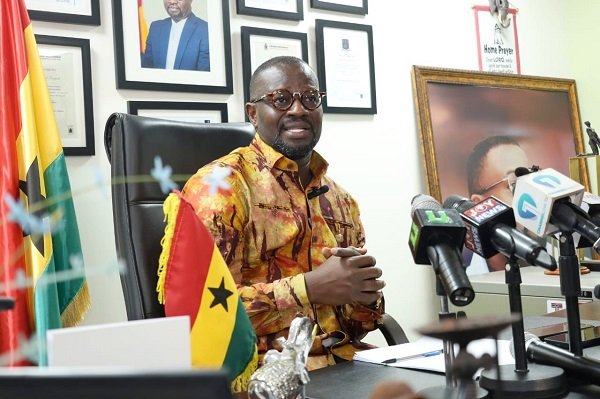
The Member of Parliament for Nsawam Adoagyiri, Frank Annoh Dompreh, has expressed concern over delays in the release of the District Assemblies Common Fund, warning that the situation is stalling development across the country.
On his facebook page, he described as a matter of urgent national importance, the Minority Chief Whip pointed to what he sees as a growing crisis of unpaid contractors, abandoned projects, and halted infrastructure works in many districts.
He noted that several communities are grappling with half completed schools, unfinished health facilities, abandoned markets, deteriorating roads, and stalled sanitation projects.
According to him, many contractors who have executed projects for district assemblies have not been paid, forcing some construction firms to demobilise from sites while workers lose their jobs.
He stressed that the District Assemblies Common Fund is not a discretionary allocation but a constitutional requirement under Article 252 of the 1992 Constitution, intended to support development at the local level.
In his view, years of delayed releases and accumulated arrears have weakened district development financing and disrupted projects meant to improve living conditions in communities.
He further argued that some payments made in recent years were largely the settlement of old debts rather than funding for new or ongoing projects, a situation he believes has affected contractor confidence and local economic activity.
He described the issue as more than a budgetary challenge, characterising it as a development emergency and a governance concern.
He therefore urged the appropriate authorities to pay outstanding DACF arrears, settle contractors who have completed their work, and ensure that transfers to districts are automatic and predictable.
He maintained that decentralisation can only succeed when district assemblies receive adequate and timely funding to carry out development projects.
He emphasised that stalled projects directly affect ordinary citizens, since they rely on such infrastructure for education, healthcare, transportation, sanitation, and economic activities.
He called for renewed attention to grassroots development, insisting that national progress should not be concentrated only in major cities but extended to all communities.
By: Jacob Aggrey

Richard Appiah, the footballer who killed two children and stored part of their bodies in a fridge at Abesim in the Bono Region in 2021 has been handed a lifetime sentence.
This was after a five member panel of judges at the Accra High Court returned a verdict of guilty against the convict.
Appiah, 32, also a draughtsman would spend the rest of his life in prison after he was convicted of murder.
More more more
BY MALIK SULLEMANA