Hot!
Mariupol fighters ‘successful in tying down Russian forces

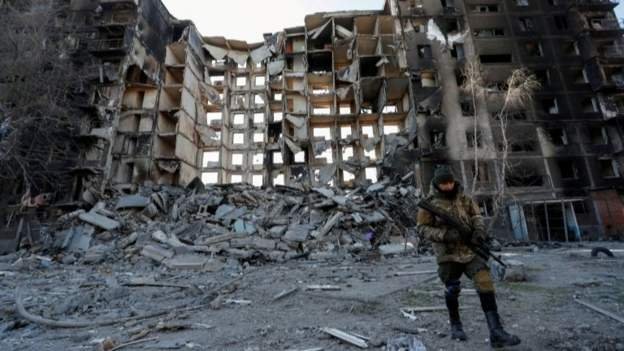
Ukrainian forces in Mariupol have successfully tied down thousands of Russian soldiers who otherwise would’ve been redeployed northwards for the main battle in Donbas, according to Professor Malcolm Chalmers, Deputy Director General of the Royal United Services Institute (Rusi).
“Defenders of Mariupol, having lasted so long, have made a significant contribution to the overall war effort – even if they eventually are overwhelmed”, he tells the BBC.
“Russian resources are not unlimited and they lost a lot of equipment and people in a failed campaign to take Kyiv,” Chalmers adds.
He says Putin’s maximum aim remains to replace the Ukrainian government with a regime to his liking – even the total absorption of Ukraine to Russia.
“The battle of Donbas is a case of sequencing – trying to achieve one thing at a time.”
He says if Russia is successful in its Donbas assault, “which is possible but not likely”, they would then move on to the south to attack Odesa and Kyiv.
“In retrospect, the Russian leadership will believe they made a strategic error trying to fight Ukraine on several fronts at the beginning of the war,” Chalmers says.
Fears Izyum will become next Bucha, with thousands trapped
The city of Izyum – known as the gateway to the Donbas region and the Black Sea – is experiencing fierce fighting as the Russians use it as a staging post to attack towns in the east.
Now, there are fears Izyum will become the next Bucha – where Russia is accused of war crimes against the civilian population, including executions and torture.
Izyum reportedly has the highest concentration of Russian troops in Ukraine.
The strategic city, located 70 miles south-east of Kharkiv, heads into the separatist-controlled east and fell completely to the Russians on 1 April.
While some civilian evacuations were carried out before Russian soldiers invaded, there are around 10,000 to 15,000 people still trapped according to officials.
Almost 80% of the city’s residential buildings have been destroyed and train lines have been cut, the city’s deputy mayor says.
People who have managed to flee Izyum told the BBC that it is on the edge of a humanitarian catastrophe.
For more than a month, civilians haven’t had access to humanitarian help, with “no electricity, heating or water”, head of the Izyum military administration, Stepan Maselsky, says.
Maselsky, who is in a Ukrainian-held area surrounding Izyum, says contact with civilians is being controlled by Russian forces, who won’t allow people to enter or leave the area.
“We have unconfirmed reports of deportations [of civilians] to Russia – people are not allowed to move around inside the city,” he says.
In maps: The latest across Ukraine
We’ve been focusing on Mariupol so far today – but let’s take a look at the broader picture across Ukraine.
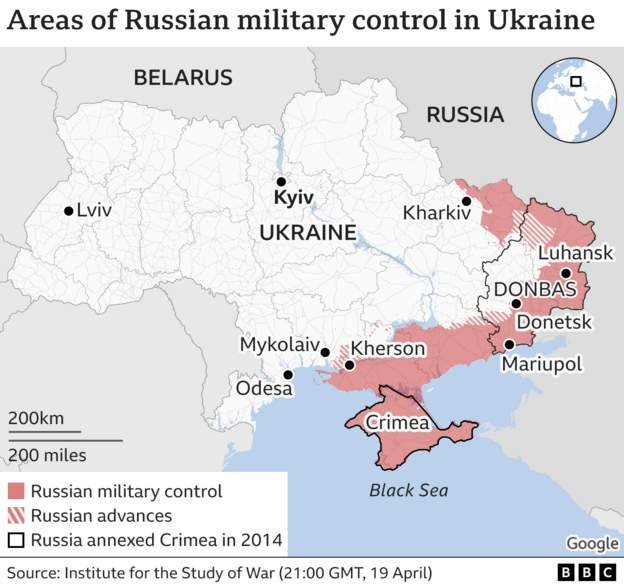
Russia’s military has seized most of Ukraine’s eastern border areas, and its forces have now fully withdrawn from around the capital Kyiv and northern Ukraine to Belarus and Russia.

Following the withdrawal, Russia refocused its efforts to launch a large-scale offensive in eastern Ukraine, intensifying fighting in the Donbas region.
Russia continues to build troops along its 300-mile eastern front, with satellite imagery showing a build-up of forces on Ukraine’s border and convoys of vehicles travelling towards the front line.
Track the war in maps here.
Russia claims to have hit 1,053 Ukrainian military facilities overnight
Russia’s Ministry of Defence claims its forces have hit 1,053 Ukrainian military facilities overnight.
In a Telegram update this morning, the defence ministry said it had destroyed 106 artillery firing positions and shot down six Ukrainian unmanned aerial vehicles.
It said its forces hit 73 military assets of Ukraine, among them:
- Four command posts
- 57 areas of Ukrainian manpower and military equipment
- Seven strong points and four ammunition depots
- Six tanks and nine armoured vehicles and
- One Msta-B howitzer battery weapon
It added that a high-precision missile strike killed up to 40 Ukrainian military personnel and destroyed seven military equipment units.
The Armed Forces of the Russian Federation said it continues “the special military operation in Ukraine”.
The BBC has not been able to independently verify these claims.
‘Still 100,000 people left in devastated Mariupol’

As we’ve been reporting, Ukraine hopes to evacuate 6,000 people from the besieged city of Mariupol via humanitarian corridors on Wednesday.
However, the mayor, who has left Mariupol, says that there are still about 100,000 people left in the city.
Vadym Boichenko also warned that the agreement with Russia was only preliminary. If it holds, it will be the first on creating safe corridors since 5 March.
That agreement collapsed, and many people have been trapped in Mariupol for weeks without running water, power or other supplies.
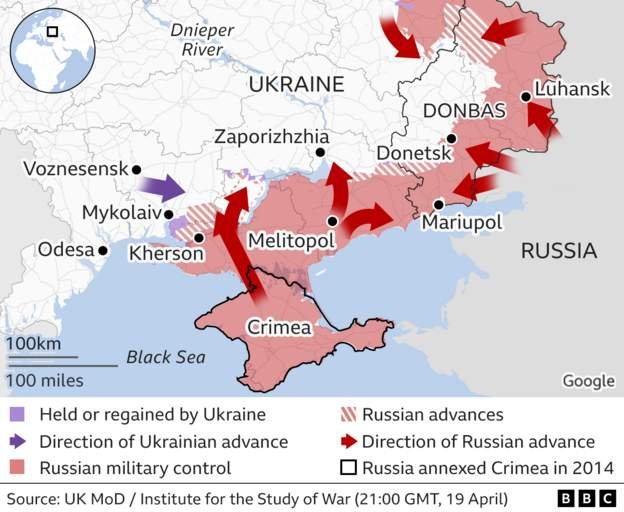
It’s a strategic target for Russia because it’s a south-eastern port for Ukraine. Russia claims to control most of it, with the last Ukrainian defenders holed-up in the vast steelworks.
What’s going on in Mariupol and why it matters
What’s happening
Russia has given Ukrainian forces in Mariupol a fresh ultimatum to lay down their weapons by 11:00 GMT on Wednesday. They’re holed up in a huge steelworks complex at the moment.
The port city is surrounded but still hasn’t fallen, and Ukraine’s foreign minister said Russia has decided to raze it to the ground.
Around 130,000 citizens have been blockaded in the besieged city for 50 days and are struggling to find food, water, and medicine, the city’s deputy mayor says.
Why Mariupol matters
- Securing land: Capturing Mariupol would leave Russia in control of a vast swathe of southern and eastern Ukraine
- Strangling the economy: It’s home to an important port, which in normal times is a key export hub for steel and coal
- Propaganda opportunity: Mariupol is home to a Ukrainian militia unit called the Azov Brigade, which contain far-right extremists. Although they form only the tiniest fraction of Ukraine’s fighting forces, it has been a useful propaganda tool for Moscow
- Morale boost: It would help the Kremlin to show its population – through state-controlled media – that Russia was achieving its aims
Get more detail from our security correspondent Frank Gardner here.
Source: BBC



Ghana Tourism Authority is leading Ghana’s participation at ITB Berlin, which opened in Berlin with a vibrant national pavilion highlighting Ghana’s rich cultural heritage, tourism destinations and investment opportunities.
March 5 has been designated as Ghana Day, a special platform to promote Ghana’s languages, cuisine, Kente, festivals and business prospects to the global tourism community. The stand has already drawn strong interest with traditional arts and crafts displays, immersive multimedia presentations and popular Ghanaian snacks.
Seven private-sector players are exhibiting alongside government officials as part of efforts to deepen trade partnerships, expand market access, and attract investment across the hospitality, heritage tourism, ecotourism, and creative arts sectors.
Ahead of the official opening, the Ghana delegation also engaged young Ghanaian investors in Germany in collaboration with V Afrika-Verein and the Ghana Embassy, strengthening diaspora investment linkages and highlighting opportunities within the tourism value chain.
Ghana’s coordinated presence at ITB Berlin 2026 reinforces its strategy to position the country as the Gateway to Africa and a competitive destination for leisure travel and global investment.

The Member of Parliament for Nsawam Adoagyiri, Frank Annoh Dompreh, has expressed concern over delays in the release of the District Assemblies Common Fund, warning that the situation is stalling development across the country.
On his facebook page, he described as a matter of urgent national importance, the Minority Chief Whip pointed to what he sees as a growing crisis of unpaid contractors, abandoned projects, and halted infrastructure works in many districts.
He noted that several communities are grappling with half completed schools, unfinished health facilities, abandoned markets, deteriorating roads, and stalled sanitation projects.
According to him, many contractors who have executed projects for district assemblies have not been paid, forcing some construction firms to demobilise from sites while workers lose their jobs.
He stressed that the District Assemblies Common Fund is not a discretionary allocation but a constitutional requirement under Article 252 of the 1992 Constitution, intended to support development at the local level.
In his view, years of delayed releases and accumulated arrears have weakened district development financing and disrupted projects meant to improve living conditions in communities.
He further argued that some payments made in recent years were largely the settlement of old debts rather than funding for new or ongoing projects, a situation he believes has affected contractor confidence and local economic activity.
He described the issue as more than a budgetary challenge, characterising it as a development emergency and a governance concern.
He therefore urged the appropriate authorities to pay outstanding DACF arrears, settle contractors who have completed their work, and ensure that transfers to districts are automatic and predictable.
He maintained that decentralisation can only succeed when district assemblies receive adequate and timely funding to carry out development projects.
He emphasised that stalled projects directly affect ordinary citizens, since they rely on such infrastructure for education, healthcare, transportation, sanitation, and economic activities.
He called for renewed attention to grassroots development, insisting that national progress should not be concentrated only in major cities but extended to all communities.
By: Jacob Aggrey