News
Low COVID-19 mortality in Africa has no correlation with hot climate – UG don

- /home/u249204778/domains/spectator.com.gh/public_html/wp-content/plugins/mvp-social-buttons/mvp-social-buttons.php on line 27
https://spectator.com.gh/wp-content/uploads/2023/06/Prof-Gordon-Awandare-2nd-left-being-congratulated-by-some-of-his-colleagues.jpg&description=Low COVID-19 mortality in Africa has no correlation with hot climate – UG don', 'pinterestShare', 'width=750,height=350'); return false;" title="Pin This Post">
- Share
- Tweet /home/u249204778/domains/spectator.com.gh/public_html/wp-content/plugins/mvp-social-buttons/mvp-social-buttons.php on line 72
https://spectator.com.gh/wp-content/uploads/2023/06/Prof-Gordon-Awandare-2nd-left-being-congratulated-by-some-of-his-colleagues.jpg&description=Low COVID-19 mortality in Africa has no correlation with hot climate – UG don', 'pinterestShare', 'width=750,height=350'); return false;" title="Pin This Post">
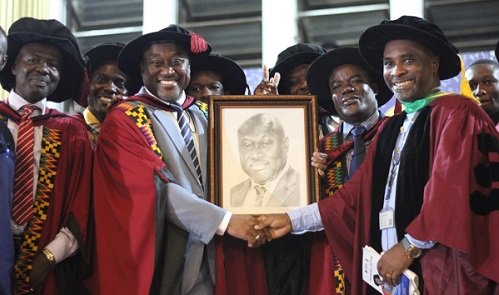
Prof Gordon Awandare (2nd left) being congratulated by some of his colleagues
The Pro-Vice Chancellor of the University of Ghana in-charge of Students and Academic Affairs, Prof Gordon Awandare, has said that the relatively low COVID-19 mortality recorded in Africa, has nothing to do with the hot climate in Africa, as some people suggested.
Making reference to a research conducted by his team, he observed that the rate of COVID-19 infections among Ghanaians was less, due to frequent exposure to malaria fight from childhood.
Professor Awandare was speaking during his inaugural lecture at the University of Ghana, last Thursday, on the topic: “How our Immune System Acquired Tolerance to Malaria and Helped us Survive COVID-19.”
According to him, the immune system of Ghanaians became tolerant to malaria parasites thereby “protecting them from the severity of the pandemic.”
He again stated that patients, who were infected with malaria parasites but showed no symptoms, had the capability of tolerating malaria parasites.
“Such people are asymptomatic patients and most of them live in malaria endemic areas thus their tolerance for the parasites intrigued my team and I,” he added.
He further noted that children and persons who hadn’t been exposed to malaria before were likely to have severe symptoms of malaria such as headache and little bit of fatigue.
This was also backed by a study he had undertaken in three key areas namely Kintampo, Navrongo and Accra on the differences in transmission rates within the country.
His study observed that despite having “lower parasite levels,” children in Accra were prone to higher fever than those at Kintampo who had huge parasite level.
Professor Awandare, who is also the Founding Director of the West Africa Centre for Cell Biology of Infectious Pathogens (WACCBIP), said that COVID-19 showed that African scientists were competent as their counterparts abroad, saying “this is because here at WACCBIP, we were able to sequence and test the virus as others did, thus understanding the virus.”
Professor Awandare stressed the need for the country to position itself towards developing vaccines locally instead of relying on foreign donors, and tasked Ghanaians to continue to support institutions like WACCBIP in order to train more scientists and build capacity.
Vice Chancellor of the University, Professor Nana Aba Appiah Amfo, also underscored that diverse significant roles played by several units of the university during the pandemic, contributed to understanding the pathogens, biology and disease mechanism to generate knowledge for the development of diagnostics, vaccines and drugs.
The inaugral lecture formed part of an exhibition of scholarly works by the renowned professor at the Balme Library, which had begun on Monday.
By Yunusah Essandoh


The Office of the Special Prosecutor (OSP) has taken note of public allegations of extortion and related conduct made against the Minority Leader of Parliament, Alexander Afenyo-Markin.
The allegations were made by the Chief Executive of the Ghana Gold Board (GoldBod), Sammy Gyamfi.
In a brief statement, the OSP said it has also received a joint petition submitted by two persons, as well as two separate petitions from other persons, in relation to the same allegations.
“Given the nature of the allegations, the OSP will assess the case and determine whether it falls within its statutory mandate and whether further investigative action is warranted,” the statement said.
The development comes amid a heated public feud between the Minority in Parliament and the leadership of GoldBod over the operations of the Domestic Gold Purchase Programme.
The Minority, led by Afenyo-Markin, has accused GoldBod and the Bank of Ghana of causing a loss of over $1.7 billion, citing the International Monetary Fund’s August 2026 report. The Minority has vowed to pursue the matter as Parliament has reconvened for an emergency sitting.
GoldBod, on the other hand, has rejected claims by some NPP MPs, including Tano South MP Dr Gideon Boako, that it owes the Bank of Ghana GH¢1 billion in overdrafts, describing the claim as “false and malicious.”
In the latest twist, GoldBod CEO Sammy Gyamfi has accused the Minority Leader of extortion and related conduct, an allegation that has triggered petitions to the OSP.
The OSP is mandated under Act 959 to investigate and prosecute specific cases of alleged or suspected corruption and corruption-related offences involving public officers and politically exposed persons.
By Edem Mensah-Tsotorme

General Secretary of the New Patriotic Party (NPP), Justin Kodua Frimpong, has filed his nomination to contest the position of General Secretary again as the party begins its rebuilding efforts ahead of the 2028 general elections.
He was accompanied by party stalwarts and supporters who were in high spirits, expressing confidence that he is the right person to hold the position.
Speaking after filing his nomination, Mr Kodua Frimpong assured the rank and file of the party that he would not disappoint them.
“I can assure you that the faith the rank and file of the party have had in me, I will never disappoint them,” he said.
He also pledged to run a clean campaign devoid of personal attacks.
“I can assure you that our internal campaign will be devoid of personal attacks,” he told his fellow contestants and the rank and file of the party as he seeks to retain his position.
His tenure has seen the party through the 2024 general elections, where the NPP lost power to the National Democratic Congress (NDC) after eight years in government.
The party is currently in a rebuilding phase, with internal elections scheduled to elect new national executives to lead its reorganization towards the 2028 polls.
The General Secretary position is considered one of the most influential in the party’s administrative structure, responsible for the day-to-day running of the party secretariat and implementation of party decisions.
By Edem Mensah-Tsotorme