
News
Low budget, teacher absenteeism, causes of poor performance in basic School.

- /home/u249204778/domains/spectator.com.gh/public_html/wp-content/plugins/mvp-social-buttons/mvp-social-buttons.php on line 27
https://spectator.com.gh/wp-content/uploads/2024/10/UNICEF-education-team-and-journalists-at-the-event-1000x600.jpg&description=Low budget, teacher absenteeism, causes of poor performance in basic School.', 'pinterestShare', 'width=750,height=350'); return false;" title="Pin This Post">
- Share
- Tweet /home/u249204778/domains/spectator.com.gh/public_html/wp-content/plugins/mvp-social-buttons/mvp-social-buttons.php on line 72
https://spectator.com.gh/wp-content/uploads/2024/10/UNICEF-education-team-and-journalists-at-the-event-1000x600.jpg&description=Low budget, teacher absenteeism, causes of poor performance in basic School.', 'pinterestShare', 'width=750,height=350'); return false;" title="Pin This Post">
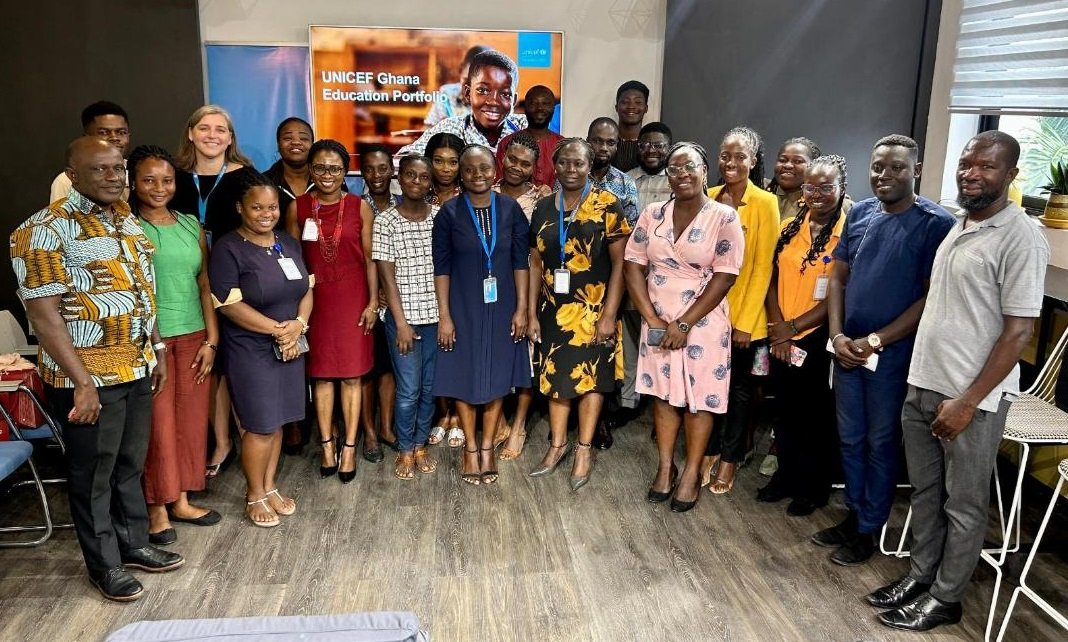
UNICEF education team and journalists at the event
The decline in budget allocation for Ghana’s basic education sector and high rate of teacher absenteeism have been identified as some of the major causes for the drop in performance of school children at that level of education.
According to a United Nations International Children’s Emergency Fund (UNICEF) statistics, a significant decline in basic school allocation has been recorded in recent years, explaining that in 2019, 39 per cent of the education budget was allocated to basic education, but that figure dropped to 19.6 per cent in 2024.
This came to light last week Thursday at the third UNICEF Media Café addressed by the Chief of the UNICEF Education team, Ms Christin McConnell.
According to her, about 98 per cent of the current budget allocated to basic education is spent on salaries, leaving little room for resources such as infrastructure, learning materials, and teacher training which she said had directly impacted the quality of education received by children.
Also, she stated that about 11 per cent of teachers are absent from school on any given day across all the levels, contributing to the non-effective learning for almost six years.
Despite these challenges, Ms McConnell noted that there had been significant progress in early childhood education with over 120,000 kindergarten children receiving basic learning materials and health screening as part of an initiative dubbed, ‘My First Day at School.’
She further stated that UNICEF’s differentiated learning programme which aims at providing remedial education to struggling students has also been instrumental in improving quality and early childhood education.
An Education Officer at UNICEF Ghana, Ms Rhoda Enchill speaking on access and inclusion in education disclosed that an estimated 40,000 children with disabilities in Ghana had never attended school.
According to her, the figure underscores the ongoing challenges faced by children with special needs in accessing education, despite government efforts to make school more inclusive.
She mentioned that 1.2 million children aged between four and 17 were still out of school across Ghana, adding that the figure included 623,000 primary school-aged children who are not enrolled.
Ms Enchill said despite the progress made in access to education, foundational learning levels remain low explaining that children were still struggling to read at the grade levels.
She indicated that results from the 2022 National Standard Test (NCT) revealed that only five out of 10 children in grade four could read.
And as part of efforts to standardise and promote inclusivity and sign language in the country, Ghana has developed a harmonised sign language dictionary for deaf teachers and learners.
A sign language dictionary is a resource that provides definitions, illustrations, or video demonstrations of signs used in a specific sign language.
The dictionary, she stated, will serve as a reference for both deaf and hearing individuals to learn and understand the meanings and hand gestures associated with words, phrases, or concepts in sign language.
By Jemima Esinam Kuatsinu







Minister for Education Haruna Iddrisu has questioned why Ghana continues to import toothpicks despite having the resources to produce them locally.
Speaking in Parliament, Mr. Iddrisu, who previously served as Minister for Trade and Industry, said he feels ashamed that the country still depends on imports for such a basic product.
“I have been Minister for Trade and Industry before and I carry the shame. How come that in Ghana we cannot produce toothpicks and we have to import them?” he asked.
According to him, Ghana has enough resources to support local businesses to manufacture products such as toothpicks instead of relying on imports. He said the country should encourage private sector investment in manufacturing to create jobs and reduce dependence on foreign goods.
Mr. Iddrisu alleged that some people who received government support under private sector initiatives failed to use the funds for their intended purpose.
“If you want, Honorable Kojo, because you… I can’t go there. There are people who took money in the name of the private sector and said they were going to farm. That money never went to their farms. You know that,” he told Parliament.
On job creation, the Education Minister said he agreed with the views expressed by a colleague on the need to create more employment opportunities. However, he argued that the One District, One Factory (1D1F) programme did not provide the solution to Ghana’s employment challenges.
Mr. Iddrisu made the remarks during parliamentary proceedings while contributing to discussions on job creation and the country’s industrial development.
By: Jacob Aggrey

New Patriotic Party (NPP) communications officer, Dennis Miracles Aboagye, has dismissed reports linking him to an alleged GH¢55 million case, insisting that no such issue was raised during his detention by the Economic and Organised Crime Office (EOCO).
In a Facebook post after his release from EOCO custody, Mr Aboagye stated that at no point during his detention was he questioned about any GH¢55 million.
“For the records: There was no discussion of any GH¢55 million with me by EOCO. None,” he wrote.
According to him, he was detained for four days, a day after announcing his intention to contest for the position of National Communications Director of the New Patriotic Party.
Mr Aboagye alleged that false narratives were circulated about his arrest but expressed confidence that the truth would eventually prevail.
He thanked NPP supporters who demonstrated and called for his release, saying news of the protests reached him while he was in detention and encouraged him.
Mr Aboagye indicated that the support shown by party faithful strengthened his resolve and reaffirmed his commitment to serve the NPP.
He maintained that his detention had not discouraged him from pursuing his political ambition.
“If the intention was to break me, it has failed. If the intention was to scare me, it has failed spectacularly,” he stated.
Mr Aboagye expressed appreciation to his legal team, the leadership of the NPP and all supporters who stood by him throughout his detention.
He reiterated his determination to lead the party’s Communications Directorate, declaring that he remained “ready to win” and committed to what he described as the party’s mission to “command the narrative.”
By: Jacob Aggrey


