News
Italy mourns and asks who will succeed Berlusconi

- /home/u249204778/domains/spectator.com.gh/public_html/wp-content/plugins/mvp-social-buttons/mvp-social-buttons.php on line 27
https://spectator.com.gh/wp-content/uploads/2023/06/6d67e8b0-83ba-4758-a8ca-fe14434e54fd.jpeg&description=Italy mourns and asks who will succeed Berlusconi', 'pinterestShare', 'width=750,height=350'); return false;" title="Pin This Post">
- Share
- Tweet /home/u249204778/domains/spectator.com.gh/public_html/wp-content/plugins/mvp-social-buttons/mvp-social-buttons.php on line 72
https://spectator.com.gh/wp-content/uploads/2023/06/6d67e8b0-83ba-4758-a8ca-fe14434e54fd.jpeg&description=Italy mourns and asks who will succeed Berlusconi', 'pinterestShare', 'width=750,height=350'); return false;" title="Pin This Post">
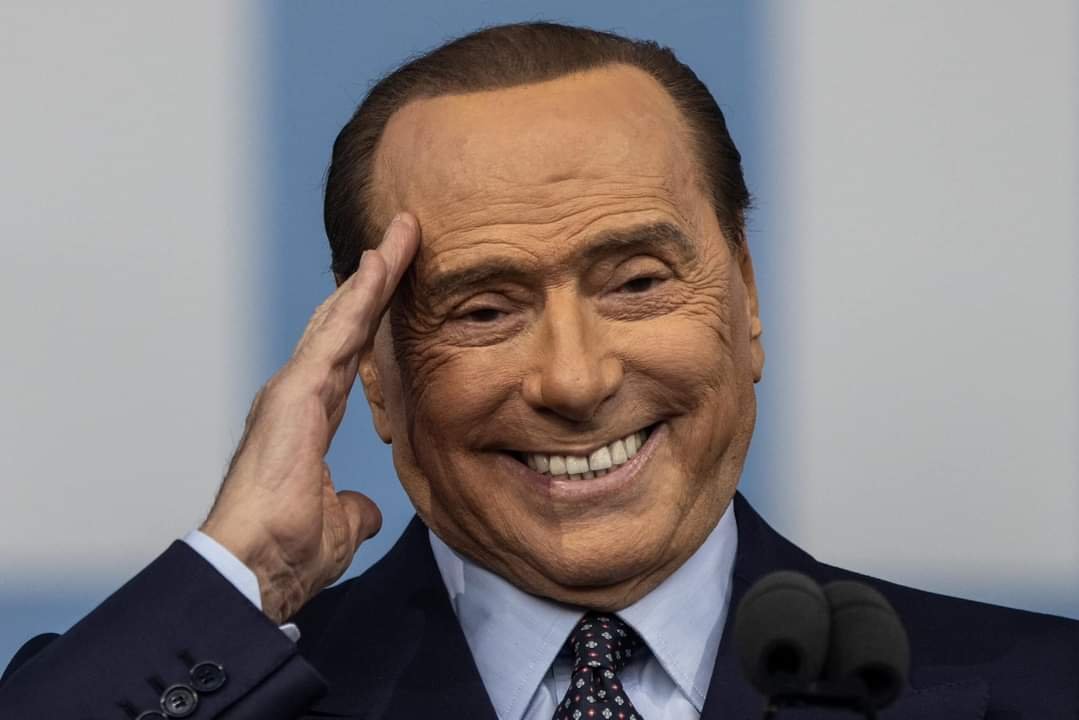
Italy is marking the death of ex-Prime Minister Silvio Berlusconi with a spectacle befitting the grand soap opera of his life.
The one-time cruise singer who led Italy with no prior political experience built a media empire and had a string of wives and girlfriends.
The Archbishop of Milan will lead Berlusconi’s state funeral in the city’s grand cathedral on Wednesday.
Italy is holding a day of national mourning.
All Italian and European flags on public buildings have been lowered to half-mast.
This kind of tribute is unprecedented for a former prime minister. A state funeral is a privilege usually reserved for popes, war heroes and serving ministers.
Milan is a city deeply associated with Silvio Berlusconi – this is where he was born and where he started his career, selling vacuum cleaners.
Maxi-screens have been set up in the main square, which is expected to fill up with thousands of people who will come to say a final farewell.
Behind the scenes, a true succession story is also playing out.
During his lifetime, Berlusconi amassed a vast empire that spanned media, real estate, finance, cinema and sport – as well as a powerful political party that is part of Italy’s current government.
He was one of Italy’s richest men. According to Forbes, his business assets are worth about €6bn (£5.15bn).
But he never publicly indicated who should lead his business empire after his death and there are also big questions over the future of the Forza Italia party he created.
Berlusconi has two children from his first marriage and three from his second. All of them have stakes in Fininvest, his holding company.
The future of his business interests will likely depend on how he has chosen to distribute the 61% stake he had in Fininvest.
Will there be equal shares for all, or more for the two eldest children, Marina and Pier Silvio, who have held management roles in the empire since the early 1990s?
Other valuable assets are undoubtedly Berlusconi’s numerous luxurious villas. They could be tricky to pass on to his offspring in an equal way.
His Villa San Martino in Arcore, north-east of Milan, covers 3,500 sq m and dates back to the 18th Century. He also has homes at Lake Maggiore, in Rome, Cannes, the Caribbean and elsewhere.
The jewel in Berlusconi’s crown of properties is Villa Certosa, a mansion in Sardinia that he bought in the 1970s.
He hosted world leaders there, from Vladimir Putin to George W. Bush. It has 126 rooms and looks like a theme park – including a fake volcano that erupts lava. Its value is estimated at €259m.
People close to the family have described Berlusconi as “the glue” who kept his children united.
There has been no dispute so far over who takes over the empire – that is expected to fall to his oldest child Marina, 56, considered closest of the five to her father.
The big question is whether that family unity can be maintained now that Berlusconi has gone, and what impact that might have on the future of his business empire.
His death could prove disastrous for the future of his political party. Can Forza Italia survive without its charismatic creator – or could it fall apart in a matter of months?
He was the ultimate populist leader, and unsurprisingly, the party he created was entirely shaped around his persona.
His right-hand man, foreign minister Antonio Tajani, has categorically denied its future is at risk: “It’s unthinkable that the party would disappear.”
But Forza Italia’s share of the vote had already slipped to 8% in last September’s general election.
Many Italians who backed the party did so because they were Berlusconi loyalists and it will be tricky to appoint a successor they will warm to.
In reality, party members will probably look to the Berlusconi family to make a decision.
Will the two eldest, Marina and Pier Silvio, want to keep investing in their father’s political creation, or will they turn off the financial tap and cut their losses?
Without their financial support, Forza Italia has no chance of surviving. Berlusconi heavily funded his party – reportedly injecting it with nearly €100m.
There is some speculation that Marina could succeed him as leader, but for now this remains a rumour. She is seen as more of a behind-the-scenes operator.
Another unknown is Berlusconi’s partner Marta Fascina, who is 53 years his junior. She’s an MP in his party and has said several times that “her passion is politics and she grew up with the myth of Silvio Berlusconi”.
Berlusconi’s eldest daughter reportedly blocked his plan to marry her last year. So there is a cloud over Ms Fascina’s future role in her late partner’s party.
One thing is certain: if Forza Italia does fracture, it would be a big problem for the other members of Prime Minister Giorgia Meloni’s coalition government.
Political instability looms after Wednesday’s day of national mourning.
In a country so well-known for regular political crises, a government collapse triggered by the disintegration of one of the coalition partners does not seem such an unlikely scenario.
Until now, Berlusconi’s children have avoided the limelight. But his death might force them to emerge from the shadows to take the reins of his empire.
Berlusconi had health problem for years so it is likely he and his children had thought all of this through.
They might opt for an easy transition heralded by their eldest sister Marina, rather than get into a succession battle which could go wrong.
Source:BBC

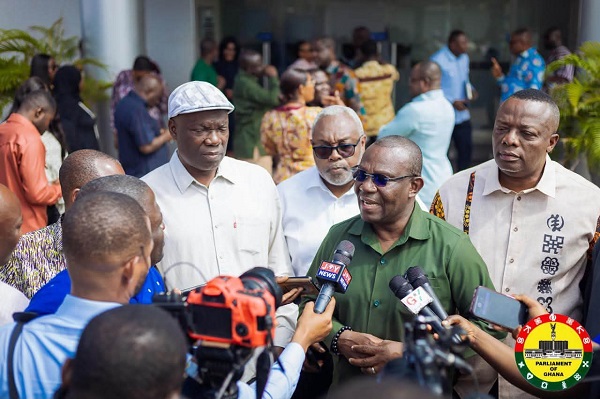
The Parliamentary Select Committee on Energy has appealed to the Ministry of Finance to release GH¢5.6 million to the Petroleum Commission to enable it to establish and operate a world-class data centre.
According to the Committee, access to the funds will strengthen the Commission’s capacity to manage critical upstream petroleum data and improve its operations.
Speaking during the appeal, Chairman of the Committee, Emmanuel Kwasi Bedzrah, said the move was crucial to efforts to revitalise Ghana’s upstream petroleum industry and increase oil production.
He noted that although investment and hydrocarbon production had declined in recent years, Parliament’s approval of an extension of the petroleum agreement to 2030 had attracted additional funding and contributed to an increase in production from about 80,000 to 120,000 barrels per day.
Meanwhile, concerns have been raised over repeated budget allocations for oil exploration in the Voltaian Basin.
Mr. Bedzrah stressed that funds approved for exploration must produce tangible results, adding that the Committee would require clear evidence of progress before supporting future budget allocations for the programme.
The appeal was made during a working visit to the Petroleum Commission as part of the Committee’s oversight activities to assess its operations and management procedures.
During the engagement, the Chief Executive Officer of the Petroleum Commission, Emeafa Hardcastle, took the Committee through the Commission’s working procedures and mandate, which includes regulating, managing and coordinating upstream petroleum activities.
She disclosed that since assuming office in 2025, government had pursued measures to reverse the decline in crude oil production, sustain output and reposition Ghana as an attractive destination for investment in Africa’s increasingly competitive petroleum sector.
In addition, she said government had secured fresh commitments of about US$35 billion to help revitalise the sector.
As part of the oversight exercise, the Committee is expected to conclude its monitoring visit with engagements at the National Petroleum Authority (NPA) and the Ghana Oil Company Limited (GOIL).
By Edem Mensah-Tsotorme
News
“No civilisation deserves to be annihilated” – Mahama calls for dialogue on global conflicts at UNGA 81

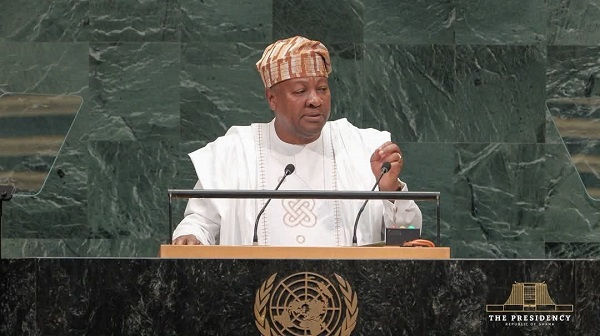
President John Dramani Mahama has called for solidarity and dialogue in resolving global conflicts, insisting that no civilisation deserves to be wiped out.
“No human civilisation deserves to be annihilated, certainly not a member state of the United Nations,” President Mahama stated in his address at the 81st United Nations General Assembly in New York.
He called for solidarity with nations facing terrorism, especially the Alliance of Sahel States (AES), and for a uniform approach to conflicts in Europe, the Middle East and Africa.
On the Middle East, the President called for a return to negotiations, saying “The current Middle East crisis is having a deleterious effect on the world economy.”
“I believe that dialogue can resolve even the most intractable of problems,” he added.
By Edem Mensah-Tsotorme