News
Invest in family planning to boost demographic dividends-NPC Boss


The Executive Director of the National Population Council (NPC), Dr. Leticia Adelaide Appiah has stressed on the need for Ghana to invest heavily in family planning which would help in turning the wheels towards economic development.
She was optimistic that, the demographic window of opportunity was opening for Ghana and therefore the citizens needed to become braver, stronger and bolder champions of population and development now than ever.
The Executive Director gave this address, during the launch of a documentary in Accra andfunded by USAID, which was designed to educate the public on the need for prioritizing family as a goal to demographic dividend.
Demographic dividend was explained by Dr. Appiah as the accelerated economic growth that a country could experience as a result of changes in population structure.
The NPC boss indicated that, sustained decline in fertility and mortality in countries produce changes in the population age structure with an accompanying increase in the working age population in relation to dependents.
She expressed optimism that, through sustained high-level of advocacy and sensitization, there would be an impact of reaping the demographic dividend.
That, she reiterated, would become a national priority among policy makers, political and traditional leaders which would bring about an increased commitment to invest in quality human capital.
“Though Ghana has experienced an appreciable decline in fertility since the 1980’s from 6.4 per cent in 1988 to 4.2 per cent in 2014 and corresponding dependency ratio, there is still room for further decline by focusing on reducing avoidable high-risk pregnancies”, she stated.
Dr. Appiah referred to the maternal health survey in 2017 which said that, the survival of infants and children depended in part on the demographic and biological characteristics of their mothers.
Shereccounted that, mortality and morbidity risk of mother and infant were higher if the mother was below 18 years, and birth intervals were less than two years and also women older than 35 to 40 years at first birth.
Delivering a keynote address at the launch, Dr. KodjoEssiem Mensah-Abrampa, Director-General of The National Development Planning Commission (NDPC) said maternal mortality rate has been dropping since 2007 from 451 per 100,000 live births to 310 per 100,000 live births in 2017.
He said, Ghana’s census data showed that, the proportion of population under 15 years old had fallen steadily from 46.9 per cent to 38.3 per cent in 2010.
According to him, the window of opportunity for harnessing a demographic dividend was said to open when country’s dependency ratio declined below 60 dependents per 100 working-age adults.
Dr. Mensah-Abrampa indicated that, with thecurrent dependency ratio of 76 dependents per 100 working-age, there was no doubt that, Ghana has a window of opportunity to harness a demographic dividend.
The NDPC boss said that, since 2013, Ghana had consciously embarked on interventions to harness the demographic dividend by making strategic investments in key sectors including education, health, economy, nutrition and governance.
By Alfred NiiArdayAnkrah



A 30-year-old man has been sentenced to 25 years imprisonment with hard labour by the Bekwai Circuit Court for his role in a 2022 robbery at a mining site at Manso Akwasiso in the Ashanti South Region.
The convict, Dominic Ofori, also known as Fanta, was arrested on 16th February 2026 after years on the run. He pleaded guilty before the Bekwai Circuit Court to robbery contrary to Section 149 of the Criminal Offences Act, 1960 Act 29, and was accordingly sentenced to 25 years imprisonment with hard labour.
On March 20, 2022, the Manso Adubia District Police received intelligence that a group of armed men from Manso Abodom were planning to attack a mining site at Manso Akwasiso to rob the owner of gold concentrate. Acting on the information, police mounted a coordinated operation and laid an ambush at the site.
At about 5:30 pm the same day, four-armed men arrived at the site, fired indiscriminately, and robbed the miners of their gold concentrate. The police team on surveillance intervened, resulting in an exchange of gunfire.
Three of the suspects, Abu Abubakar, Musah Latif, and Gideon Takyi, sustained gunshot wounds and were pronounced dead on arrival at St Martins Catholic Hospital at Agroyesum. Dominic Ofori escaped at the time but was later arrested and put before the court.
The Ashanti South Regional Police Command has assured the public of its continued commitment to combating violent crimes and bringing offenders to justice.
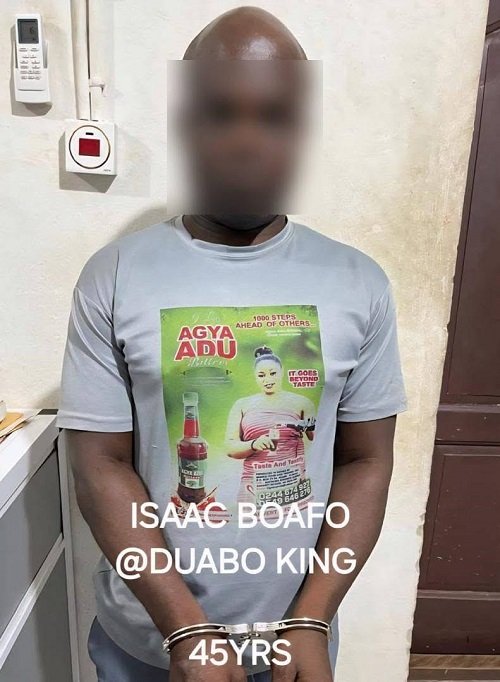
The Ashanti Regional Police Command has arrested 45-year-old Isaac Boafo, also known as “Duabo King,” for allegedly publishing false news intended to cause fear and panic.
Police said the arrest follows a viral TikTok video in which Boafo claimed that four officers at the Central Police Station in Kumasi engaged in inappropriate conduct with commercial sex workers during night patrols in Asafo.
Officers from the Police Intelligence Directorate (Ashanti Region) apprehended Boafo after receiving intelligence about the video.
During questioning, he admitted to creating the video to attract views and engagement online, and acknowledged that he could not prove the allegations.
Boafo also admitted making comments about the President of the Republic for content purposes and could not defend those statements.
He has been formally charged and is in detention as investigations continue.
The Ashanti Regional Police have warned the public against publishing or sharing false information on social media, noting that such acts can cause fear, panic, and damage reputations.
They said anyone found engaging in similar conduct will face legal action.
By: Jacob Aggrey