News
Increase LEAP stipends—Advocate of the Aged Welfare pleads


The government has been urged to increase stipends given to beneficiaries of the Livelihood Empowerment Against Poverty (LEAP) especially the aged, in the wake of the COVID-19 pandemic.
This, in the view of Advocates of the Aged Welfare, a Non-Governmental Organisation (NGO), would go a long way to aid the elderly to meet their daily needs especially during these trying times.
According to the Executive Director of the NGO, Richard Ofori, the support received by the aged had declined because their dependents were grappling with the economic impact of COVID-19, including job losses.
In an interview with the Ghanaian Times yesterday, he said; “The socio-economic effect of the COVID-19 will eventually reduce the number of aged to death if nothing is immediately done to mitigate the impact.”
He was speaking on the backdrop of World Elder Abuse Awareness Day which is being marked today across the world on the theme “The impact of COVID-19 on violence, abuse and neglect of elderly persons.”
The United Nations (UN) General Assembly has designated June 15 to focus global attention on the problem of physical, emotional, and financial abuse of elders and seek support to make their lives more comfortable.
The LEAP stipends, introduced in 2008, is given to the extremely poor including aged who are 65 years and above without any form of support, severely disabled without productive capacity and orphaned and vulnerable children.
As of last year, a household of a beneficiary was paid GH¢64 every two months, households of two, three and four beneficiaries were paid GH¢74, 83 and GH¢106, respectively every two months.
This, according Mr Ofori, was not sufficient in the prevailing times.
On abuse, he said the WHO estimated that one out of the six people aged 60 and above suffered abuse, adding that a survey conducted by his NGO in 2009 showed that seven out of 10 aged people in Ghana suffered same fate including neglect.
He said the abuse was still ongoing with many aged tagged as witches and wizards, a situation which, was affecting the elderly people emotionally and thus urged the public to report incidences of aged abuse to the police.
Mr Ofori appealed to the government to dedicate some health facilities as specialist hospitals for the aged because most of them were afraid to go for their routine check-ups due to the fear of contracting the virus.
Source: Ghanaian Times



A 30-year-old man has been sentenced to 25 years imprisonment with hard labour by the Bekwai Circuit Court for his role in a 2022 robbery at a mining site at Manso Akwasiso in the Ashanti South Region.
The convict, Dominic Ofori, also known as Fanta, was arrested on 16th February 2026 after years on the run. He pleaded guilty before the Bekwai Circuit Court to robbery contrary to Section 149 of the Criminal Offences Act, 1960 Act 29, and was accordingly sentenced to 25 years imprisonment with hard labour.
On March 20, 2022, the Manso Adubia District Police received intelligence that a group of armed men from Manso Abodom were planning to attack a mining site at Manso Akwasiso to rob the owner of gold concentrate. Acting on the information, police mounted a coordinated operation and laid an ambush at the site.
At about 5:30 pm the same day, four-armed men arrived at the site, fired indiscriminately, and robbed the miners of their gold concentrate. The police team on surveillance intervened, resulting in an exchange of gunfire.
Three of the suspects, Abu Abubakar, Musah Latif, and Gideon Takyi, sustained gunshot wounds and were pronounced dead on arrival at St Martins Catholic Hospital at Agroyesum. Dominic Ofori escaped at the time but was later arrested and put before the court.
The Ashanti South Regional Police Command has assured the public of its continued commitment to combating violent crimes and bringing offenders to justice.
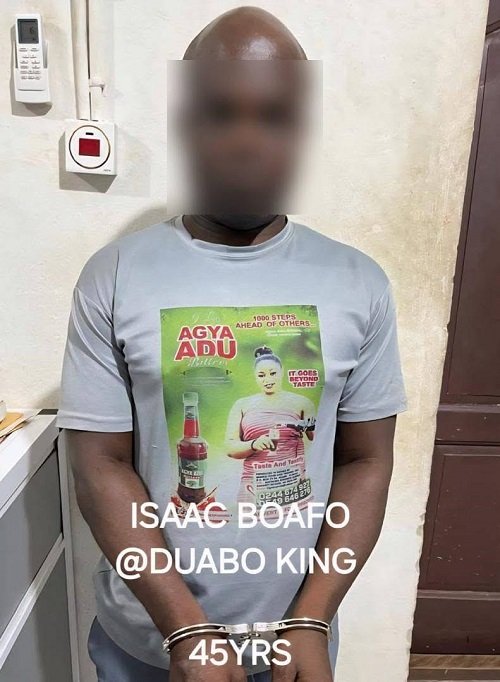
The Ashanti Regional Police Command has arrested 45-year-old Isaac Boafo, also known as “Duabo King,” for allegedly publishing false news intended to cause fear and panic.
Police said the arrest follows a viral TikTok video in which Boafo claimed that four officers at the Central Police Station in Kumasi engaged in inappropriate conduct with commercial sex workers during night patrols in Asafo.
Officers from the Police Intelligence Directorate (Ashanti Region) apprehended Boafo after receiving intelligence about the video.
During questioning, he admitted to creating the video to attract views and engagement online, and acknowledged that he could not prove the allegations.
Boafo also admitted making comments about the President of the Republic for content purposes and could not defend those statements.
He has been formally charged and is in detention as investigations continue.
The Ashanti Regional Police have warned the public against publishing or sharing false information on social media, noting that such acts can cause fear, panic, and damage reputations.
They said anyone found engaging in similar conduct will face legal action.
By: Jacob Aggrey