News
Implications of easing restrictions on public gathering

The expectations of some Ghanaians were met last Sunday evening when the President, Nana Addo Dankwa Akufo-Addo announced the easing of restrictions on public gathering in the country under the observance of strict health protocols amid the COVID-19 pandemic.
However, some have also expressed disappointment over the restrictions to the churches and mosques as they complain bitterly that limiting the gathering to 100 members won’t work for them.
While the leadership of most churches welcome the directive as a step in the right direction as it would enable members to fellowship with one another after over two months of being under lockdown, others are not so much enthused about the announcement. The leadership of those churches have, therefore, decided to continue to hold virtual services for their members.
It is obvious that, it would be quite difficult for the big churches to control the number of attendees, as social gathering is to be allowed under certain stringent conditions hence their decision to continue with their virtual services.
The President made it clear that those who flout the directives would be sanctioned and the leaders of such religious organisations would be held liable.
For those in the hospitality industry,the decision by the government to lift the ban on public gathering was an answer to their prayers because at least their businesses would bounce back to help them make some gains.
In the educational sector final-year students would heave a sigh of relief as they can now continue with their studies and refresh their memories before they write their final examinations after being home for some time now.
The lifting of the restrictions came with its own attendant directives that must be adhered to in order to combat the spread of the coronavirus (COVID-19) disease in the country. Currently, confirmed cases of the virus in Ghana have hit 8,548 with 3,132 recoveries and 38 deaths.
For religious gathering which took effect yesterday, June 5, 2020, the Chieftaincy and Religious Affairs Minister, Mr Samuel Kofi Dzamesi during a media briefing announced a set of advisories following the resumption of religious activities.
Among these advisories older persons and people of any age with underlying medical conditions such as diabetes, liver disease, and asthma are advised to stay away from attending such services.
Now that the lockdown on public gathering has been partially lifted, it implies that the citizenry would have to be very vigilant and go strictly by the comprehensive guidelines spelt out by the government as community infection is now on the ascendancy.
Any careless mistakes will have dire consequences on individual lives. Thankfully, children have been exempted from having children services since it would be difficult to control them and keep social distancing.
Now that the ban on social gathering has been lifted with the number of attendees increased from 25 to 100, it implies that more weddings, funerals, parties and other social functions would be organised putting more people at risk.
For some people, life must go on normal despite the coronavirus pandemic but the fact is we are not in normal times, therefore, there is the need to put in place more safety measures to save lives.
The government should provide the necessary items needed for final-year students to protect themselves. Although the government has announced that Day students in boarding schools will be made boarders, the Spectator proposes that transport arrangements should also be made for students who attend Day schools to facilitate their movement to and from school in these difficult times.
We express much concern over the fact that some citizenry are still careless and do not adhere to the World Health Organisation (WHO) protocols and health directives provided by the government and the Ghana Health Service (GHS) for their own safety. It behoves on all to be responsible and vigilant as the virus is no respecter of persons.



A 30-year-old man has been sentenced to 25 years imprisonment with hard labour by the Bekwai Circuit Court for his role in a 2022 robbery at a mining site at Manso Akwasiso in the Ashanti South Region.
The convict, Dominic Ofori, also known as Fanta, was arrested on 16th February 2026 after years on the run. He pleaded guilty before the Bekwai Circuit Court to robbery contrary to Section 149 of the Criminal Offences Act, 1960 Act 29, and was accordingly sentenced to 25 years imprisonment with hard labour.
On March 20, 2022, the Manso Adubia District Police received intelligence that a group of armed men from Manso Abodom were planning to attack a mining site at Manso Akwasiso to rob the owner of gold concentrate. Acting on the information, police mounted a coordinated operation and laid an ambush at the site.
At about 5:30 pm the same day, four-armed men arrived at the site, fired indiscriminately, and robbed the miners of their gold concentrate. The police team on surveillance intervened, resulting in an exchange of gunfire.
Three of the suspects, Abu Abubakar, Musah Latif, and Gideon Takyi, sustained gunshot wounds and were pronounced dead on arrival at St Martins Catholic Hospital at Agroyesum. Dominic Ofori escaped at the time but was later arrested and put before the court.
The Ashanti South Regional Police Command has assured the public of its continued commitment to combating violent crimes and bringing offenders to justice.
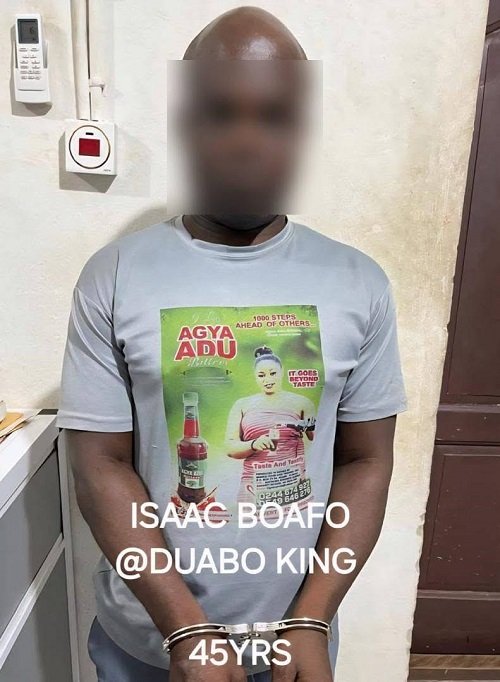
The Ashanti Regional Police Command has arrested 45-year-old Isaac Boafo, also known as “Duabo King,” for allegedly publishing false news intended to cause fear and panic.
Police said the arrest follows a viral TikTok video in which Boafo claimed that four officers at the Central Police Station in Kumasi engaged in inappropriate conduct with commercial sex workers during night patrols in Asafo.
Officers from the Police Intelligence Directorate (Ashanti Region) apprehended Boafo after receiving intelligence about the video.
During questioning, he admitted to creating the video to attract views and engagement online, and acknowledged that he could not prove the allegations.
Boafo also admitted making comments about the President of the Republic for content purposes and could not defend those statements.
He has been formally charged and is in detention as investigations continue.
The Ashanti Regional Police have warned the public against publishing or sharing false information on social media, noting that such acts can cause fear, panic, and damage reputations.
They said anyone found engaging in similar conduct will face legal action.
By: Jacob Aggrey