News
Honouring a legend: Tourism minister hails Agya Koo Nimo’s legacy


In a heartfelt tribute to one of Ghana’s musical treasures, the Minister for Tourism, Culture and Creative Arts, Madam Abla Dzifa Gomashie, has lauded high-life maestro, Agya Koo Nimo, by highlighting his immense contribution to the country’s cultural heritage and national development.
The 94-year-old virtuoso, born Daniel Amponsah, is famed for pioneering the ‘Palm Wine’ music genre—a soulful blend of indigenous storytelling, melodic guitar rhythms, and age-old wisdom.
For over five decades, he has remained a cultural torchbearer, captivating audiences with both music and message.
During an official visit to the New Adwase residence of the legendary musician in Kumasi, Madam Gomashie, flanked by her Deputy, Mr Yussif Issaka Jajah, and the Ashanti Regional Minister, Dr Frank Amoakohene, presented a hamper and also made a cash donation to the nonagenarian.
She conveyed the gratitude of President John Dramani Mahama and the Ghanaian people for the maestro’s trailblasing role in shaping the nation’s music industry.
“Agya Koo Nimo didn’t just create music—he crafted identity, instilled pride, and charted a path for generations to follow,” the Minister stated.
A former lecturer at KNUST and founder of the iconic ‘Adadam Agofomma’ troupe, Agya Koo Nimo has been a fixture at university events and traditional ceremonies alike.
Despite retirement, he remains the lifeblood of the cultural group, continuing to inspire with humility and grace.
Dr Amoakohene reaffirmed the government’s ongoing efforts to spotlight creative industry pioneers, revealing that over 25 actors have already been acknowledged in the Ashanti region alone. The visit to Agya Koo Nimo marked a new phase of this outreach to musicians.
Gracious and visibly moved, the music legend expressed his appreciation to President Mahama and called for the establishment of a Creative Arts Museum to preserve and honour the works of Ghanaian musicians.
He also paid tribute to his 74-year-old wife, Madam Comfort Manu, and the members of his troupe for their enduring support.
The Minister’s delegation later toured the KNUST Department of Indigenous Arts and Technology, where she interacted with staff and students, and viewed an exhibition showcasing creative pieces made from local materials.
With this act of recognition, Ghana once again affirms that those who shaped its cultural soul will not be forgotten.
From Kingsley E. Hope







Minister for Local Government, Chieftaincy and Religious Affairs, Ahmed Ibrahim, has revealed that in the whole of 2024, only GHS 362 million was released to MMDAs in Common Fund.
Contrary to this, In 2025 alone GHS 5 billion was released to the MMDAs with the following breakdown as follows.
The Minister made this revelation when he took his turn at the Government Accountability Series held today.
In breakdown, the minister nonted that 1st Quarter – 790,372,058.40 was released for 2025.
He added that for the 2nd Quarter, 1,464,983,309.60 was released.
3rd Quarter saw the release of 1,188,921,640.80 and
1,592,706,391.20 for 4th Quarter.
The Minister added tha each of the MMDAs were required to undertake the following; at least 2-CHPS compounds, 3 Classroom blocks, 10 Boreholes, and Completion of legacy projects.
Additionally, 25% of the Common Fund was allocated for the Construction of 24-Hour Economy Model Markets.
Ahmed Ibrahim noted that as a result of the timely and unprecedented release of Funds, a total of 494 CHPS compounds, 761 Classroom Blocks, 4,029 Boreholes, and 2,755 Legacy projects are currently at various stages of completion.
Also, he added that 261 24-Hour Economy Model Markets have all been awarded on contracts and construction has begun on many of them.
By Edem Mensah-Tsotorme
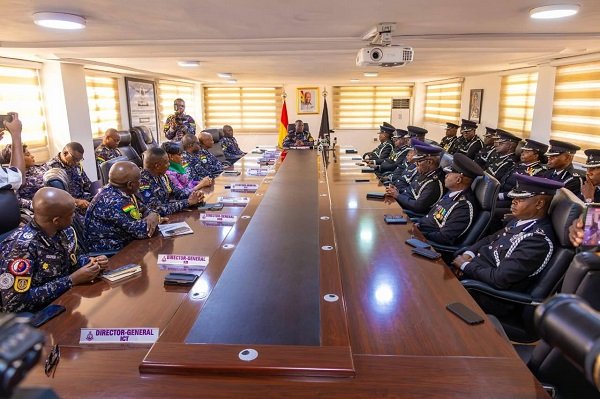
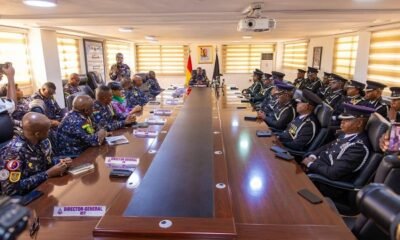
The Inspector-General of Police (IGP), Mr. Christian Tetteh Yohuno, together with members of the Police Management Board (POMAB), on April 17, 2026, decorated nineteen (19) senior officers who have been promoted to their next ranks based on the recommendations of the Police Council and approval of the President, John Dramani Mahama.
The ceremony, held at the National Police Headquarters in Accra, forms part of efforts to recognise merit, dedication, and long-standing service within the Ghana Police Service, while strengthening leadership across key operational and administrative levels.
The officers promoted from Deputy Commissioner of Police (DCOP) to Commissioner of Police (COP) are Dr. Luke Asue-In-Yeng Zakpaa, Mr. Frederick Agyei, Mr. Duuti Tuaruka, Mr. Arthur Osei-Akoto, Mr. Darko Offei Lomotey, Mr. Eric Ken Winful, Mr. Barnabas Nambont Nasumong, and Mr. Desmond Owusu Boampong.
The IGP and members of POMAB congratulated the officers and urged them to uphold the highest standards of professionalism and integrity in the discharge of their duties.