Hot!
Government creating enabling environment for businesses to thrive – Trade Minister


The Minister for Trade, Agribusiness and Industry, Elizabeth Ofosu-Adjare, says government has created an enabling environment for businesses and exporters to grow and thrive.
She made the remarks during a working visit to Kasapreko PLC, where she interacted with management and staff of the company.
According to the Minister, Ghana’s macroeconomic indicators have improved significantly, making it easier for businesses to plan and operate.
“When I became Minister, industry players were worried about the exchange rate and how it affected pricing and working capital. Today, that is no longer the case. The economy has done well, and the cedi has appreciated,” she said.
Ofosu-Adjare noted that government’s economic recovery efforts under President John Dramani Mahama have stabilised the business environment, a development she said is already reflecting positively in the operations of local industries.
She explained that her ministry has adopted a deliberate approach of engaging exporters regularly to understand their challenges and address them promptly.
One of such issues, she said, was the time frame for the repatriation of export proceeds, which has since been resolved to help businesses improve cash flow.
The Minister expressed excitement about Kasapreko’s expansion plans, stressing that government is not only focused on attracting foreign direct investment but also committed to supporting Ghanaian-owned businesses.
“My presence here shows that I am interested in local businesses expanding and taking their rightful place in the industry,” she said.
She added that local entrepreneurs invest in Ghana, live in the country, and contribute directly to national development, and therefore deserve strong government support.
Ofosu-Adjare assured Kasapreko PLC of government’s continued support to ensure its growth and sustainability.
She revealed that she would engage the Ghana Water Company to address water supply challenges facing the company.
Management of Kasapreko PLC welcomed the Minister’s visit and commended government for policies that have helped stabilise the economy and improve business confidence.
By: Jacob Aggrey

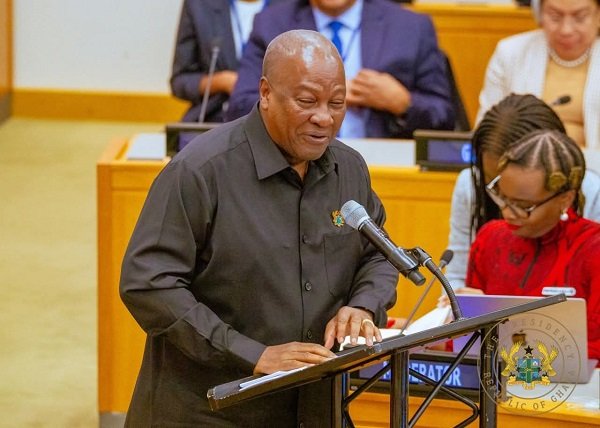
Photos from the High-Level Event on Reparatory Justice for the trafficking of enslaved Africans and the racialised chattel enslavement of African people, convened at the United Nations Headquarters, New York.
Delivering a powerful address, President John Dramani Mahama underscored the moral urgency of confronting historical injustices and advancing a global commitment to reparatory justice.
“The entire transatlantic slave trade was designed to deny African people their humanity,” the President stated.
Highlighting the significance of ongoing international efforts, he added:“This resolution allows us, as a global community, to collectively bear witness to the plight of the 18 million men, women, and children whose homes, communities, names, families, hopes, dreams, futures, and lives were stolen from them over the course of four centuries.”
In reaffirming the enduring truth of justice, President Mahama noted:
“Just because everybody is doing something doesn’t make it right. Slavery is wrong now, and it was wrong then. For as long as Africans have been trafficked and enslaved, there have been abolitionists who have spoken up against it.”
He further called for a deeper reflection on identity and dignity:
“We must also remember to reclaim our own humanity… when we absorb too much of the language of violence and erasure, our minds become enslaved.”

A member of the New Patriotic Party (NPP), Beatrice Siaw, has expressed mixed views about Ghana’s current leadership, saying she admires President John Dramani Mahama but is not fully satisfied with how the country is being governed.
Speaking in an interview on Metro TV on Tuesday, she said although she belongs to the NPP, she finds it difficult to criticise the President personally.
“I admire President Mahama, so it’s hard to speak against him. But I do love my party. I am impressed with the President, not necessarily impressed with how things are going” she said.
She acknowledged that the NDC has made efforts in managing the economy and improving some key indicators. She noted that the party appears determined to prove critics wrong after previously being voted out of office.
“They are trying to do a lot of things that Ghanaians thought they couldn’t do when they were in power,” she said.
However, she was quick to add that these efforts may not necessarily translate into electoral success in the next election cycle.
When asked whether the NDC’s performance could pose a strong challenge in 2028, she said she does not believe so, although she admitted there have been some improvements in certain areas.
“In some aspects, yes,” she said when asked if she had been impressed by the government’s performance.
By: Jacob Aggrey