Features
Ghana needs radical constitutional reforms …as we seek economic support from the IMF

Times are, indeed, very hard and Ghana our beloved country is not what it used to be in the past. The country is now more than a hell, with things beginning to fall apart and if we do not take care, very soon, the centre will not hold, with apology to Chinua Achebe’s Things Fall Apart novel. As of now, it is the fervent prayer of every Ghanaian citizen that our hope in the International Monetary Fund’s (IMF) economic bailout, will yield a positive result within the shortest possible time, so as to lift this country out of the economic mess it finds itself.
GMA SECRETARY’S ASSERTION
As the current General Secretary of the Ghana Medical Association (GMA), Dr. Titus Kofi Beyuo, once pointed out in a television programme recently, “The state of Ghana now, is like a patient at the Intensive Care Unit (ICU) of any health facility with all the supporting breathing instruments on him or her while gasping for breath. As soon as these health supports are removed, it means that is the end of the patient Ghana”. That is exactly the situation in which Ghana finds itself in at the moment, as it battles for breath of survival.
Indeed, without mincing words, Ghana is in a state of coma and unless something extra-ordinary and urgently is done to revive the shattered and downward trend of the economy, the possibility of this country becoming doomed, cannot be ruled out. The leaders have been overwhelmed with the challenges the country is facing hence taking an advantage of the IMF bailout which does not come easily but with certain harsh conditions. Currently, the country is in a difficult situation, saddled with high cost of living and severe hardships. Prices of goods and services are astronomically high, people have grounded their cars due to high cost of fuel, motorists, especially public transportation, are finding it difficult to break even, due to increase in spare parts and other lubricants. Landlords and prospective developers are complaining bitterly due to the high cost of building materials such as cement, iron rod, sand, stone, roofing sheet, floor tiles among others.
PLIGHT OF PUBLIC SECTOR WORKERS
Currently, public sector workers are facing severe difficulties as their take home pay cannot sustain them and their dependants. The high inflation rate coupled with the high cost of living, has eroded the monthly salaries of workers, thereby deepening their woes and making them impoverished. People’s health conditions are deteriorating faster than it used to be as they find it extremely difficult to access medical facilities due to underlying poverty and lack of funds. The situation we find ourselves in now, is just too bad and uncomfortable to say the least.
Even though President Akufo-Addo and for that matter the government, has admitted that we are in a terrible economic crisis, nevertheless, it keeps laying the blame at the doorstep of the COVID-19 pandemic which rocked the entire world in 2019, causing a lot of misery and havoc as well as the Russian-Ukraine war which affected the importation of certain goods and services from those two countries by nations which relied on them for survival. The government’s defence that the situation was a global challenge, has been debunked by economic think tanks in the country, arguing that it was a failure on the part of the government and its appointees to put proper structures in place to curtail the difficulties we find ourselves in at the moment. According to them, people placed in positions of authority have failed to manage the economy in the right perspectives.
CALLS FOR THE DISMISSAL OF FINANCE MINISTER
The recent call by both the Majority and Minority caucuses in Parliament to the President to sack the Finance Minister, Mr. Ken Ofori-Atta and the Minister of State in-charge of Finance, Dr. Charles Adu Boahen, who was recently dismissed by the President on grounds of corruption allegation against him, attests to the fact that, those put in charge of our economic management, are not performing to expectation, hence the economic downturn. If MPs from the ruling party, the NPP, are calling on the President for the removal of personalities who are managing the public purse, then there is a systematic failure in government which needs to be addressed. As we speak now, there is a censure motion pending against the substantive Minister Ken Ofori-Atta which will be debated in parliament by the full house.
ECONOMIC CHALLENGES
As of now, some of the economic challenges the country faces are unemployment, corruption, inconsistent economic policies, poor human capital development, poor health system, crime and terrorism. Our major problem is the rising debt which stands above 80 per cent of Gross Domestic Product (GDP) and is projected to reach 104 per cent by the end of 2022. The country has been thrust into debt distress as 70 per cent of its total revenue must go towards debt servicing. The GDP rate in Ghana is expected to reach 72 billion dollars by the end of 2022, according to Trading Economic global macro models and analyst expectations. However, some financial analysts have suggested that in order to revamp the economy, we need to support private sector growth in strategic export oriented sectors but not limited to agriculture and agricultural processing services to ensure greater export, garment and apparel production and light manufacturing.
SOLUTIONS TO THE ECONOMIC PROBLEMS
It is also suggested that to confront the graduate unemployment situation in the country, a youth programmed fund should be created to fund start-up businesses for the youth. Government should also encourage young people to pursue technical education. We need to promote transparency and access to information. We must create funding and strengthen agencies to prosecute corrupt cases. Children must be given access to quality education, while at the same time ensuring basic health care for all Ghanaians.
The large size of government has been a thorny issue which is posing a serious threat to the country’s advancement since it serves as a drain to our meagre financial and economic resources. For now, most Ghanaians are suggesting that, there should be a drastic reduction of ministers to a maximum of between 10 and 12, while at the same time merging some of the ministries to take up other duplicating and similar roles. Some people have also argued that, until the economy is put on a sound footing, the position of District Chief Executive, should be suspended, while we allow the respective regional ministers to take up their roles and functions in their respective jurisdictions to cut down cost and conserve resources. It is also being suggested that the current number of 275 MPs should be reduced to at least 200, and this means we have to review our Constitutional requirements.
ADDITIONAL ROLE FOR VEEP
A suggestion is made that in view of the financial background of the current Vice President who is the Head of the Economic Management Team, he should be given an additional responsibility as Minister responsible for Finance, with at least a competent deputy to manage the finance portfolio. The argument being put across is that, “your area of expertise that made you to gain the position in government must be put into practice”.
These are, indeed, fine and pragmatic suggestions from a section of Ghanaians which must be seriously considered at this time of the country’s history when it is confronted with a lot of challenges and, therefore, needs various and varied solutions and interventions to our problems, as we try to access the IMF facility to put our economy in good shape. All we need at this critical period, is a referendum that will encourage Ghanaians to pool ideas, irrespective of party affiliations to hit the ground running. Ghana is at a crossroads and we need all hands on deck to resuscitate our ailing economy once and for all. Once the government has admitted that, we are in economic crisis, this is the time to call on Ghanaians to support government’s efforts in revamping the ailing economy.
TRIBUTE TO DR. KWESI BOTCHWEY
This article will not be complete without paying a special tribute to the Prof. Kwesi Botchwey of blessed memory, a former long serving Finance Minister in Ghana and who until his death, was so passionate about the turn of events in Ghana and had been speaking a lot about the country’s economic downturn and professing tangible solutions for its recovery. He would be sorely missed by Ghanaians for his rich ideas on the economy. May his soul rest in perfect peace.
Contact email/WhatsApp of Author:
0277753946/0248933366
By Charles Neequaye


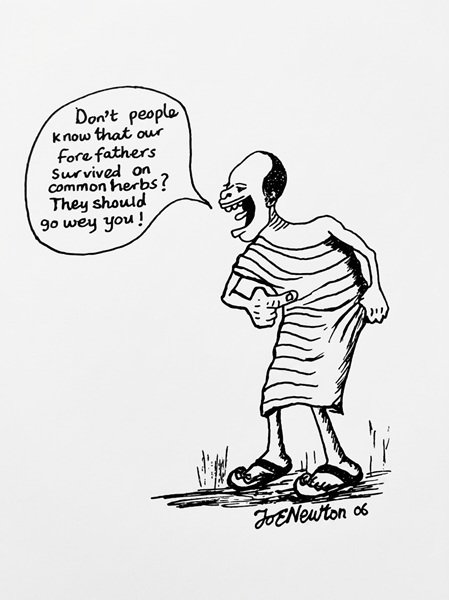
THE typical itinerant salesman in Sikaman is a herbalist. He is normally a slim macho with the capacity to perambulate the expanse of area covering the triangle of Accra-Tema-Ashiaman. In short, he can walk a total of 60 miles a day, marketing a product that cures every disease, including poverty. 
The door-to-door herbal pharmacist advertises his product by word of mouth. He has nothing to do with the Food and Drugs Board (FDB). After all, his concoctions do not feature on FM stations.
Those herbalists who cannot walk to propagate the herbal gospel, liaise with drivers of mass transportation and their mates. They are, therefore, given the chance to sell their products on Benz buses that ply the routes.
Normally, the herbalist starts his sales message with a prayer and Bible study. He asks the passengers to bow down their heads in supplication to God the father, the son, the Holy Spirit.
When a herbalist asks the passengers to close their eyes and bow their heads, Moslems on board naturally feel offended. They feel that the herbalist has no right to assume that every passenger is a Christian. They think such an assumption is an affront to Islam.
So a Moslem on board will raise the hand for a point of order. He’ll remind the herbalist that it would be in his own interest to mind his language.
“Be careful the way you address people in a public place. Not every person here is a Christian,” he’d state assertively.
Of course, the herbalist will promptly ignore him, but would all the same “watch” his tongue. Who knows whether or not the Moslem brother is inspired by Quoranic zeal to defend the tenets of Islam to the hilt?
When he starts saying, “Wallahi!” and “Inshallah!” it could be the beginning of proclaiming Islam as supreme, a point which must be driven home with talibanic precision.
So the herbalist must tread carefully lest he steps on fire.
The herbalist could even add a measure of mirth to it all, by announcing that Christians on board today have very interesting company on the journey, but that should not detract from the business of the day.
The Moslem brother will weigh the words carefully and offer a wry smile.
He must be careful the occasion does not degenerate into the use of semantics and proverbial oration to deride his conviction that public utterances must be mindful of religious sensibilities. He has made his point very clear and expects that it is taken in good faith in the interest of a peaceful journey.
The herbalist will now open the New Testament and preach salvation, stating clearly that salvation can come only through Jesus Christ and NOBODY else.
The Moslem brother will now start twitching his moustache. The visible and almost revolutionary reflexes of his upper lip can be an indication that sentiments have begun superseding reason, and the outcome could well be tragic now shift uneasily in his seat.
The time has come for him to also express his right to the religion of his fore-bears. He’ll put his hand into his pocket and rise to his feet. The time has indeed come!
This article was first published on Saturday, September 9, 2006
When the cause of a particular problem like sickness, disease, sudden illness, a social issue etc. are not known, it stands to reason that resolving it becomes a huge challenge.
Citizens would understand the government when public announcements are made to the effect that government is trying to find a solution to the issue, even though it is taking a while for it to be resolved because citizens are rational beings.
On the other hand, if the solution to a particular issue is known to everybody but the government for whatever reason, is dragging its feet in resolving it, citizens become frustrated and begin to lose trust in their leaders.
One such issue is the heavy traffic along a section of the Kasoa – Odokor road. A short stretch of bad road between the traffic light at the Weija Government Hospital and the entrance to the entrance of the overhead that leads to the N1, is the cause of the problem but nothing is being done about it, day after day, week after week, month after month. Thus is clearly unacceptable.
Another issue that requires urgent attention is the lack of pavements along a lot of streets in parts of the various Municipal Assemblies. Exercise is a prerequisite for long life and healthy living and for those of us who it has become a way of life, this issue of people putting up structures right to the edge of the drains beside the roads, are making life difficult for us.
We are compelled to walk along the roads, putting our lives at serious risk. Pedestrians should never be compelled to compete with vehicles on our streets and roads. Roads and streets are made for vehicles and pavements are made for pedestrians. That is the norm. Any attempt to normalise a situation where pedestrians are mingling with vehicles is insanity.
It is the road regulations that makes it so and therefore district or municipal assemblies are to take responsibility and ensure that spaces for pavements are not encroached upon. Citizens have rights that must be protected by their leaders and making pavements available to pedestrians, is one of them.
When we hear of teachers having sex with students, it appears it is something recent. It is not a new phenomenon. It has been there since Adam. Perhaps this issue is getting much attention due to the proliferation of social media. It was an open secret in times past when Teachers were in relationships with female students and some married them immediately after completion of school.
Some teachers were also known to be having unholy interactions with female pupils but due to the times that these acts occurred, human rights issues and the awareness around it, allowed such unscrupulous teachers to get away with their crimes.
Now we are in a different era and so a Headmaster is now in hot waters. He is alleged to have raped about 19 female students and as usual, some officials tried to cover it up and are also in hot waters and their actions or inactions in the matter are under investigation.
Why the man has been allowed to roam freely without being arrested is simply mind boggling. It appears that the law applies differently, depending on who you are. This issue came to public attention sometime in August this year, yet the police had not arrested or invited this man for question regarding the rape allegation.
It has come out that he is a Constituency Secretary of the ruling party and the question in the public domain is that, is it because he is a political figure that is why he is still walking around without questioning? I believe in the rule of law so let us hold our breadth and let the proper thing be done.
The police must however be seen to be active in this matter. God bless.
SKIP THE QUEUE, TAP THE NEWS
You can now read the Ghanaian Times and The Spectator newspapers from the comfort of your device via TimesNewsPlus.
Join our WhatsApp Channel: https://whatsapp.com/channel/0029VbBElzjInlqHhl1aTU27