Features
Qatar 2022, the West and Africa


The FIFA Mundial has got off in the oil-rich nation of Qatar and our own Black Stars are among the elites of world football to showcase what stuff they are made of.
I have a gut feeling that Ghana’s national team will spring a surprise this time round. As ambassadors of this country, it is my expectation that our boys will lift high the flag of Ghana at the tournament.
My concern today is not about the game itself but about how some Western media platforms have treated the host country in their respective narratives since Qatar won the bid to host the tournament as long as 12 years ago.
Western media practitioners are largely ignorant about the rest of the world. In their commentaries, they falsely posit that the Gulf state only started playing football just a couple of years ago. The truth is that Qatar started playing football in the late 1940s.
The West has a jaundiced perception of all Islamic countries and this is mirrored in their media reportage. The sufferings these countries have gone through to reach where they are, are completely lost on the Western media.
They harp on abuse of human rights and dictatorial tendencies, intolerance of dissent and lack of freedoms. Some even suggested, and campaigned, that the tournament be moved elsewhere because of a so-called ill-treatment of migrant workers in Qatar.
I have no reason to defend Qatar and its treatment of migrant workers. But my search revealed that this is not a state policy. Rather, there are rogue employment agencies that recruit workers under situations akin to enslavement. Some of these agencies are only out to make money out of people desirous of eking a living to support their families back in their respective countries. These agencies have collaborators in the job seekers’ countries.
When these rogue agencies get mentioned to the media by aggrieved and affected migrants, the Qatari Government is blamed. Of course, it makes sense because the government has the duty of ensuring that its labour laws are respected by both employers, agents and employees. However, many agencies operate outside of the laws till someone dies in the line of work and the media raises a flag.
A young friend of mine lives and works in Qatar. Though he is desirous of migrating to the West, he tells me he is well treated as an expat, but also agrees that many blacks are treated badly by their employers. The racist slur, he says, is as rampant in the Gulf as it is in many Western countries.
People work in deplorable conditions in Europe and the Americas. Racism and racial abuse are daily occurrences in these countries but their media projects them as safe havens. You should listen to tomato pickers in Iberia telling their tales.
America and Europe will like to impose whatever catches their fancy on the rest of the world. If you don’t dance to their music, either you are a dictatorship or a pariah state. Or dictating to the rest of the world is not dictatorship?
These Western countries expect you to conform to their way of doing things when you are on their territory. The adage of, “When you go to Rome, do as Romans do,” applies here. However, they expect their citizens to not live by the dictates of countries they visit. This is hypocrisy.
When journalist Jamal Kashoggi was brutally murdered and his body chopped and put in acid on the orders of then Saudi Crown Prince Muhammad bin Salman, then candidate Joe Biden (now US President) swore not to let the Crown Prince off the hook. Today, Joe Biden has granted MBS (the then Crown Prince) immunity from prosecution because he has been appointed Prime Minister of the Saudi Kingdom.
When America under Bush and Britain under Blair killed Saddam Hussein, did they know he was the president of Iraq? When America under Obama and France under Sarkozy got Gaddafi murdered, did they know he was the president of Libya? When it’s for political and economic expediency, the West will throw integrity out the window.
Qatar is an Islamic nation with strict religious edicts. If you want to visit, you are expected to live by the tenets of their belief and way of life. Western media is trumpeting their fancy LGBTQ+ idea as a freedom the authorities in Qatar must subscribe to. Are we there to play and enjoy football or we are there on an orgy of sexual gratification the way it suits our fancy?
As the football tournament progresses, the Western media is looking for cases of arrest of visitors for acts that offend the sensibilities of the Qatari people and will present these as a confirmation of their jaundiced perception of the host country. The success of the organisation of the Mundial will mean nothing to them.
The rest of the world cannot, and should not, be measured by Western standards. The stance of Iran and some radical groups in the Middle East, in my opinion, is a reaction to Western imperialism.
Now, something was posted on my family platform on Qatar ’22. I reproduce it here:
“The FIFA scandal documentary on Netflix is a must watch for every Nigerian vis-a-vis African.
There are huge lessons to take home for the black race regarding his penchant to put personal greed ahead of community good and development.
“Qatar basically won the hosting rights for the world cup by buying up a majority of the members in the 22-man committee which voted in the decision to award the 2022 world cup hosting rights to the gulf nation.
“Michel Platini in return for his vote forced the Qataris to enter into an arms deal with France worth billions of dollars, plus buy their aircraft, and a football club in France (Yeah, that’s how they came about PSG).
“The Brazilians traded their vote for a gas deal which saw the setting up of a fully functional mega gas plant in the Amazon nation.
“The Africans among them asked for 1.5 MILLION DOLLARS wired straight to their personal accounts.
Like bro, you came to the table where nation-changing deals were being made and all you cared for was your personal account balance? Not the millions of lives that could be changed forever? You didn’t ask for your country’s share of those far reaching deals of epic national proportions worth in the regions of several hundred millions of dollars. Instead you went for a self serving interest thereby denying your people the luxury of a better life?
“That Netflix documentary summed up the mentality of the African man in its entirety. If you are wondering why it’s the richest yet poorest continent, look no further.”
True, look no further. But look at this scenario: Imagine I was one of those who voted. Then I asked for the Qatari to invest in the triangular rail line from Takoradi to Kumasi, down to Accra through Koforidua and Asuoyaa. That money lands on the desk of our government . Will the project see the light of day?
It is the behaviour of the thieves Africans elect our leaders that breeds mistrust, thus pushing people to seek their own. Platini knows the French Government will be transparent in accounting to the people. How many of our leaders account to their citizens? I believe I would also give my personal bank account to save our leaders the headache of feasting on the money. I also have family and friends, don’t I?
I can bet my last pesewa that only one African nation’s delegate will deliver to their country if there was such a deal. And that is Rwanda. Rwanda has proved that it is a country that should be taken seriously. Let us enjoy Qatar 2022.
Writer’s email address:
akofa45@yahoo.com
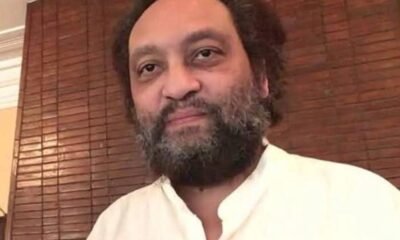
By Dr. Akofa K. Segbefia

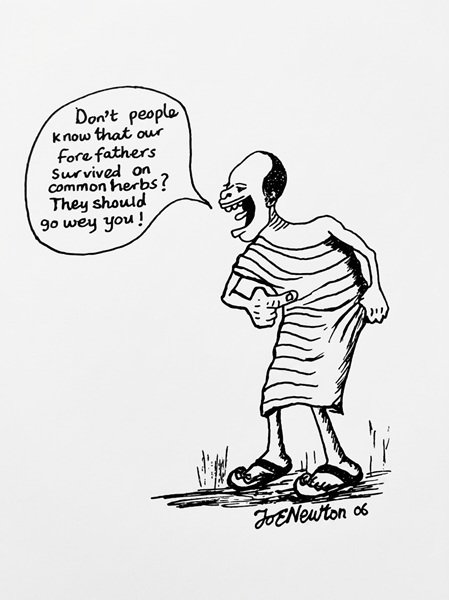
THE typical itinerant salesman in Sikaman is a herbalist. He is normally a slim macho with the capacity to perambulate the expanse of area covering the triangle of Accra-Tema-Ashiaman. In short, he can walk a total of 60 miles a day, marketing a product that cures every disease, including poverty. 
The door-to-door herbal pharmacist advertises his product by word of mouth. He has nothing to do with the Food and Drugs Board (FDB). After all, his concoctions do not feature on FM stations.
Those herbalists who cannot walk to propagate the herbal gospel, liaise with drivers of mass transportation and their mates. They are, therefore, given the chance to sell their products on Benz buses that ply the routes.
Normally, the herbalist starts his sales message with a prayer and Bible study. He asks the passengers to bow down their heads in supplication to God the father, the son, the Holy Spirit.
When a herbalist asks the passengers to close their eyes and bow their heads, Moslems on board naturally feel offended. They feel that the herbalist has no right to assume that every passenger is a Christian. They think such an assumption is an affront to Islam.
So a Moslem on board will raise the hand for a point of order. He’ll remind the herbalist that it would be in his own interest to mind his language.
“Be careful the way you address people in a public place. Not every person here is a Christian,” he’d state assertively.
Of course, the herbalist will promptly ignore him, but would all the same “watch” his tongue. Who knows whether or not the Moslem brother is inspired by Quoranic zeal to defend the tenets of Islam to the hilt?
When he starts saying, “Wallahi!” and “Inshallah!” it could be the beginning of proclaiming Islam as supreme, a point which must be driven home with talibanic precision.
So the herbalist must tread carefully lest he steps on fire.
The herbalist could even add a measure of mirth to it all, by announcing that Christians on board today have very interesting company on the journey, but that should not detract from the business of the day.
The Moslem brother will weigh the words carefully and offer a wry smile.
He must be careful the occasion does not degenerate into the use of semantics and proverbial oration to deride his conviction that public utterances must be mindful of religious sensibilities. He has made his point very clear and expects that it is taken in good faith in the interest of a peaceful journey.
The herbalist will now open the New Testament and preach salvation, stating clearly that salvation can come only through Jesus Christ and NOBODY else.
The Moslem brother will now start twitching his moustache. The visible and almost revolutionary reflexes of his upper lip can be an indication that sentiments have begun superseding reason, and the outcome could well be tragic now shift uneasily in his seat.
The time has come for him to also express his right to the religion of his fore-bears. He’ll put his hand into his pocket and rise to his feet. The time has indeed come!
This article was first published on Saturday, September 9, 2006
When the cause of a particular problem like sickness, disease, sudden illness, a social issue etc. are not known, it stands to reason that resolving it becomes a huge challenge.
Citizens would understand the government when public announcements are made to the effect that government is trying to find a solution to the issue, even though it is taking a while for it to be resolved because citizens are rational beings.
On the other hand, if the solution to a particular issue is known to everybody but the government for whatever reason, is dragging its feet in resolving it, citizens become frustrated and begin to lose trust in their leaders.
One such issue is the heavy traffic along a section of the Kasoa – Odokor road. A short stretch of bad road between the traffic light at the Weija Government Hospital and the entrance to the entrance of the overhead that leads to the N1, is the cause of the problem but nothing is being done about it, day after day, week after week, month after month. Thus is clearly unacceptable.
Another issue that requires urgent attention is the lack of pavements along a lot of streets in parts of the various Municipal Assemblies. Exercise is a prerequisite for long life and healthy living and for those of us who it has become a way of life, this issue of people putting up structures right to the edge of the drains beside the roads, are making life difficult for us.
We are compelled to walk along the roads, putting our lives at serious risk. Pedestrians should never be compelled to compete with vehicles on our streets and roads. Roads and streets are made for vehicles and pavements are made for pedestrians. That is the norm. Any attempt to normalise a situation where pedestrians are mingling with vehicles is insanity.
It is the road regulations that makes it so and therefore district or municipal assemblies are to take responsibility and ensure that spaces for pavements are not encroached upon. Citizens have rights that must be protected by their leaders and making pavements available to pedestrians, is one of them.
When we hear of teachers having sex with students, it appears it is something recent. It is not a new phenomenon. It has been there since Adam. Perhaps this issue is getting much attention due to the proliferation of social media. It was an open secret in times past when Teachers were in relationships with female students and some married them immediately after completion of school.
Some teachers were also known to be having unholy interactions with female pupils but due to the times that these acts occurred, human rights issues and the awareness around it, allowed such unscrupulous teachers to get away with their crimes.
Now we are in a different era and so a Headmaster is now in hot waters. He is alleged to have raped about 19 female students and as usual, some officials tried to cover it up and are also in hot waters and their actions or inactions in the matter are under investigation.
Why the man has been allowed to roam freely without being arrested is simply mind boggling. It appears that the law applies differently, depending on who you are. This issue came to public attention sometime in August this year, yet the police had not arrested or invited this man for question regarding the rape allegation.
It has come out that he is a Constituency Secretary of the ruling party and the question in the public domain is that, is it because he is a political figure that is why he is still walking around without questioning? I believe in the rule of law so let us hold our breadth and let the proper thing be done.
The police must however be seen to be active in this matter. God bless.
SKIP THE QUEUE, TAP THE NEWS
You can now read the Ghanaian Times and The Spectator newspapers from the comfort of your device via TimesNewsPlus.
Join our WhatsApp Channel: https://whatsapp.com/channel/0029VbBElzjInlqHhl1aTU27