News
Ghana loses GH₵100m port revenue – Minority

Ghana lost GH₵100 million at the ports in three days due to errors in the switch from port management system GCNET to UNIPASS.
Isaac Adongo, the Member of Parliament for Bolgatanga Central and Minority Spokesperson on Finance who made the claim at a press briefing in Accra yesterday said the anomaly occurred from April 28 to 30 this year.
He said the revenue loss had continued till June causing huge financial loss to the country.
“In Tema, no single end-to-end transaction has gone through since 1st June This is how the system will operate even after the backlog of Wes Blue/GCNET transactions are cleared at excessive revenue loss to the state,” he said.
He said, “No entry has been processed at the Elubo border for one week. All revenue for the state for one week completely lost and entries are not going through at KIA and declarants are compelled to make payments against clearance to be corrected later.”
Mr Adongo alleged that “out of 750 clearing agents on the Wes Blue/GCNET system, only 450 are able to access the dysfunctional ICUMS with no end product. About 300 agents can’t access this bogus system”.
According to Minority Spokesperson following all protocols for a transition and conducting “a pilot would have cleared the way for a seamless transition from an end to end digital system to an end to end digital system”.
He said there was no need to replace the tried and tested GCNET and West Blue adding that the integration proved successful, resulting in government revenues consistently rising (except in 2019 when government reduced benchmark values at the ports) to the admiration of all governments.
The data he said showed that customs revenue generated through the system rose from GH₵7.5 billion in 2015 to about GH₵13.2 billion in 2018. This represented an accumulated growth in customs revenues between 2015 and 2018 of about 76 percent.
“Unsurprisingly, the system the two companies have put together has not had any system breaches since its inception. Indeed, the system’s robustness in the midst of expanded port operations has been remarkable as evidenced through the increased revenues delivered year-in-year-out,” he said.
In spite of these outstanding performances, he said GCNET and West Blue whose contracts were due to expire at the end of 2023 and 2020, respectively, were paid a combined fee of 0.54% of Free on Board (FOB) taking into consideration government’s 35% shares in GCNET.
“Now, after these years of sustained innovations, deliberate investments and visible improvements in the gains, the country is readying itself to throw away its best trade facilitation service providers for a company that neither has a track record nor a concrete, a defined, a professed or a self-procured system to work with,” he said.
Mr Adongo said the emergence of manual releases and clearing of cargo, manual warehousing of cargo, manual releases of export or transhipment cargo and engendering human interference in the clearing system was an attempt to abuse the port system.


The New Patriotic Party (NPP) says it has successfully conducted constituency executive elections in 245 out of its 276 constituencies across the country.
The party’s General Secretary, Justin Kodua Frimpong, said the exercise recorded an 88.7 per cent success rate and was conducted peacefully in the constituencies where voting took place.
In an update posted on his Facebook page, he said elections in 23 constituencies were put on hold because of various disputes.
He added that four constituencies Ningo Prampram, Atwima Mponua, Obuasi West and Trobu could not hold their elections due to last minute challenges.
According to him, the party’s National Steering Committee will also review election activities in Afigya Sekyere East, Adansi Asokwa, Bantama and Asante Akyem Central.
Mr Frimpong said the National Secretariat is committed to resolving all outstanding issues to ensure the successful completion of the constituency executive elections.
He expressed appreciation to members of the party for their support and discipline throughout the exercise.
“We extend our sincere appreciation to all Patriots for their commitment, discipline, and support, which contributed to the successful conduct of these elections,” he stated.
By: Jacob Aggrey
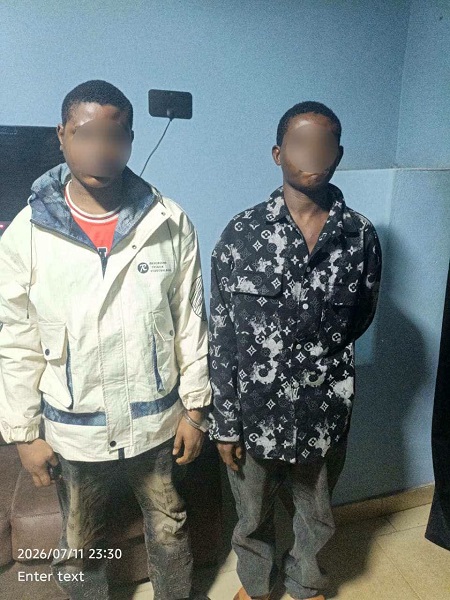
The Northern Regional Police Command has arrested two Nigerian nationals in connection with the murder of a 36-year-old Nigerian man at Sanzirigu in Tamale.
The suspects, identified as Daniel Victor Eze and David Oko Ewa, were arrested on Saturday, July 11, shortly after the body of Nkemujika Uzorchuku Eze was found in his bedroom.
According to the Police, preliminary investigations showed that the deceased lived in a three-bedroom apartment with his wife, Peace Uzorchuku, the two suspects and another Nigerian national, Godwin Nwafor.
The Police said officers began investigations after receiving a report that the deceased had been found lying in a pool of blood in his room.
A team that visited the scene found that he had suffered a deep cut to the forehead and had a towel stuffed into his mouth. The room had also been ransacked.
The Police said a wooden pestle believed to have been used in the attack, together with other items, was recovered from the scene for forensic examination.
The body was taken to the Tamale Teaching Hospital, where a medical officer confirmed him dead before it was deposited at the hospital mortuary for preservation and an autopsy.
According to the Police, intelligence-led operations led to the arrest of the two suspects at Tatale on the same day while they were allegedly attempting to escape into the Republic of Togo.
They were later handed over to the Tamale District Criminal Investigations Department to assist with investigations.
The Police said the suspects allegedly admitted during interrogation that they had conspired to kill the deceased because he had been withholding money they claimed was obtained through internet fraud.
A search conducted after their arrest led to the recovery of several items suspected to have been stolen from the deceased’s room, including mobile phones, laptop computers, a tablet, jewellery, clothing, wristwatches, personal documents and other valuables. The Police said the items have been kept as exhibits to support the investigations.
The suspects remain in Police custody and are expected to appear before court on Monday, July 13, to facilitate the ongoing investigations.
The Northern Regional Police Command said it remains committed to bringing everyone involved in the crime to justice and urged the public to provide credible information to help fight crime.
By: Jacob Aggrey