News
GASIP honours 59 farmers in UER

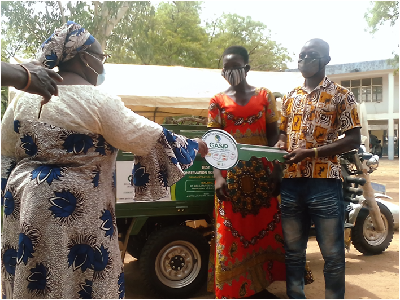
The Upper East Regional Director of Agriculture, Mr Francis Ennor, has assured farmers in the region that the Ministry of Food and Agriculture will not withdraw its interventions to them in this farming season as a result of the coronavirus (COVID-19).
The Regional Director allayed the fears of the farmers at an award ceremony organised by the Ghana Agricultural Sector Investment Programme (GASIP) and his outfit in Bolgatanga on Monday to honour some farmers in the region for adopting Agriculture Conservation Practices.
In all, GASIP rewarded 329 farmers in the seven programme beneficiary regions with tricycle motors and personal protection gears for farm activities, including Wellington boots, nose masks, long sleeves and trousers, eye goggles and knapsack sprayers.
For the Upper East Region, 59 farmers drawn from the Kalbeo, Yebongo, Sumbrungu, Katanga, Yikine, and Yorogo communities were part of the awardees.
Mr Ennor told the farmers the region had started receiving its package of the farming subsidy under the Planting for Food and Jobs (PFJ).
He told the farmers that arrangements were being made by the Regional and District Directorates of Agriculture to ensure that the farmers got their share of the government’s fertiliser and seeds subsidies on time.
Mr Ennor said any lapses to support farmers to undertake farming activities this farming season would have the tendency of affecting food security in this period of COVID-19.
He indicated that plans were far advanced to deploy information technologies in the form of mobile applications and radio programmes on good farming practices to complement the work of agriculture extension agents to educate the farmers on good agriculture practices to ensure food security.
Mr Ennor impressed upon the farmers to adopt climate smart agriculture technologies such as the use of climate-resilient seeds, applying the right quantity of fertilizer at the right time, appropriate land preparation devoid of slash and burn, to enable them harvest good yields.
The Climate Change Adaptation Manager of GASIP, Dr.Edmund Akoto-Danso, who addressed the ceremony on behalf of the GASIP National Programme Coordinator, Mr Klutse Kudomor, said the ceremony, being organised separately in seven regions, marked the beginning of the 2020 farming season.
He said the five-year GASIP, which is being implemented by the Ministry of Food and Agriculture with support from the International Fund for Agricultural Development (IFAD), would this farming season provide support in the form of climate-resilient seeds and other inputs to 1,500 smallholder farmers in 12 districts to cultivate a maximum of two acres each, using various climate-smart agriculture technologies and techniques.
The Municipal Chief Executive (MCE) of Bolgatanga, Mr Joseph Amiyure, said formerly farmers in the region used to plant early April, but now it often travels to June and entreated the farmers to take the issues of climate change very seriously.
FROM SAMUEL AKAPULE, BOLGATANGA



Search and rescue operations are ongoing following a structural collapse at the Experimental D/A School in Accra Newtown.


The Ghana National Fire Service (GNFS) confirmed that emergency teams were deployed to the scene to assist victims who may be trapped under the debris.
In an update, the service indicated that personnel from the Ghana Police Service, the National Ambulance Service and the National Disaster Management Organisation (NADMO) are workin7g together to manage the situation and rescue affected persons.
It noted that the area has been cordoned off by the police to prevent members of the public from entering the scene and interfering with the operation.
According to the GNFS, the coordinated effort is aimed at ensuring that all trapped victims are safely rescued as quickly as possible.
The service advised residents and the general public to stay away from the area to allow emergency teams to carry out their work without obstruction.
The service added that further updates will be provided as the situation develops.
By: Jacob Aggrey

The New Times Corporation (NTC), publishers of The Ghanaian Times and The Spectator, on Wednesday held a staff get-together to commemorate the Ghana Month celebration.
The event was also to strengthen teamwork and bonding. It was attended by management members and staff from various departments.
The staff were engaged in activities such as apple eating, musical chairs competition, pick and act, and other interesting games.
Speaking at the gathering, the Chairperson of the Corporation’s Interim Management Committee (IMC), Dr (Mrs) Charity Binka, emphasised the importance of unity and collaboration in achieving organisational goals. She urged the staff to put aside their differences, work together, and also create a positive working environment.
In a welcome address, the Editor of The Spectator, Mrs Georgina Naa-Maku Quaitoo, urged the staff to have fun as “we climax the Ghana Month celebration with this get-together.”


The Acting Editor of The Ghanaian Times, Mr David Adadevoh, commended the staff for coming out in their numbers to join in the celebration and called for unity to transform the fortunes of the Corporation.
By Linda Abrefi Wadie
Join our WhatsApp Channel now!
https://whatsapp.com/channel/0029VbBElzjInlqHhl1aTU27


 News4 days ago
Agona West NDC demands unqualified apology from Paul Adom-Otchere over alleged misleading editorial
- News1 week ago
Eid not only moment of celebration but call to sustain values of discipline – President Mahama
- Profile2 days ago
Aziz Adimah raising the bar in International Hockey officiating