News
Fact sheet about agric equipment and machines in Ghana

It is interesting to note that:
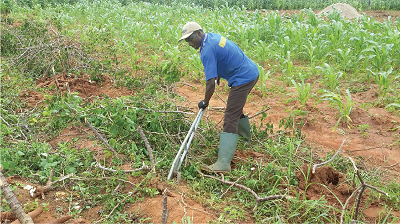
- Improved manual cassava harvester was released in 2017. Harvesting, one of the serious bottlenecks in the cassava production value chain, has received little attention in terms of mechanization. Earlier attempts at mechanising cassava harvesting have been challenged mainly by inappropriate method of planting, field topography and scale of cultivation.
Developing and adopting simple but efficient energy-saving manual harvesting tools and equipment is a sure way forward in overcoming these challenges in cassava harvesting. The cassava harvesting tool was constructed with the idea of reducing drudgery due to waist bending associated with existing manual harvesting tools which usually leads to waist pains and other bodily weaknesses.
The equipment is suitable for all cassava growing ecologies in Ghana. The improved hand-held tool can harvest cassava twice as fast with half the effort required when using existing manual harvesting options. Farmers have increased their production area and yield by 15-25 per cent after being introduced to the harvester.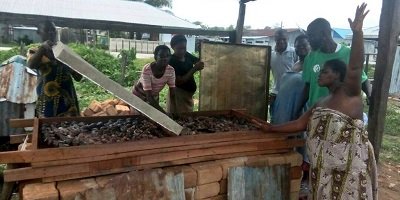
• Ahotor oven for fish smokers in Delta State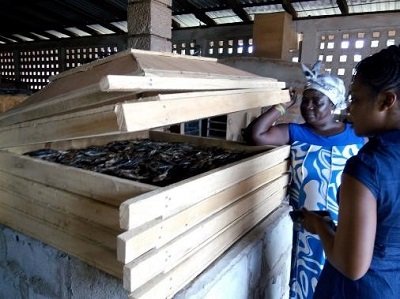
- Recirculating aquaculture technology was released in 2015. Simple raised tanks that can be set in the backyard with minimal skill requirement. This technology is an aquaculture system composed of a raised tank structure (rectangular, circular or ellipsoid) made of either a cement block or wooden frame and lined with a canvas material to make. It is applicable to all cassava growing parts of the country. It can be done in homes.
- New oven for smoking fish (AFSMO-150)/ Ahotor stove was released in 2007. A brick oven which reduces tar deposition on smoked fish with increased fish smoking capacity. Ahotor stove is applicable in all fishing communities in Ghana. It is less laborious to operate, has higher smoking capacity, it is more economical to use because it consumes less fuel, and it deposits less tar on the fish and, therefore, produces better quality smoked fish.
- Improved Chorkor smoker (AFSMO) was released in 2005. This technology is to help to reduce Poly-aromatic Hydrocarbons (PAHs) in smoked fish and reduce the drudgery involved in the other means of smoking fish. The use of fuel wood is reduced. Chorkor smoker is applicable in all fishing communities in Ghana. It reduces PAH in smoked fish which makes it healthy.
- Flash Dryer– drying of root crops cakes, was released in 2004. A typical flash-drying process consists of a modified pneumatic conveyor in which the wet solids are introduced. They go through a chute where they are transported in a high velocity hot air stream. Particles fall under high velocity and pressure through a cyclone (in some instances 2, 4 or 6 cyclones). Thermal contact time between the conveying air and the solids is usually very short and, therefore, flash dryers are most suitable for removal of external moisture.
It is applicable in all parts of the country. Compared to solar drying (two days for drying) and cabinet drying (12-15hrs), the flash dryer dries one ton of cassava (for example) in 1hr 30mins. Flash dryer dries in a flash. Flash Dryer is fast, and temperature build-up after an hour is enough to keep on drying without fuel. It can utilise either LPG or diesel in operating. Capacity is between 250- 500kg/hr output 7. It requires little oversight after temperature build-up
Source: Manual of Agricultural Technologies developed by
CSIR, MAG and MoFA
Page: 133-136


The Diaspora Affairs Office at the Office of the President has hosted a delegation of African diaspora women who are in Ghana ahead of a planned Presidential Conferment of Citizenship ceremony.
The Director of Diaspora Affairs, Kofi Okyere Darko, explained in a Facebook post that the visit was a gesture of appreciation by the delegation to the Government of Ghana for its continued efforts to reconnect Africans in the diaspora with their ancestral homeland.
He indicated that the ceremony, scheduled for next Monday, will officially grant Ghanaian citizenship to members of the delegation as part of the country’s broader engagement with the African diaspora.
The delegation was led by Erica Bennett, Founder of the Diaspora Africa Forum.
According to Mr Okyere Darko, her years of advocacy have played an important role in strengthening ties between Africa and people of African descent living abroad.
He noted that the group’s journey towards citizenship represents not only a legal process but also a cultural and spiritual return to their roots.
Also present at the meeting was Natalie Jackson, an attorney who is also expected to receive Ghanaian citizenship during the ceremony. She works closely with renowned civil rights lawyer Ben Crump.
Mr Okyere Darko emphasised that Ghana remains committed to strengthening relationships with the African diaspora and promoting unity, identity, and shared heritage among people of African descent worldwide.
By: Jacob Aggrey

Ghana has signed a debt restructuring agreement with the Kingdom of Belgium as part of efforts to restore the country’s economic stability after the financial crisis that hit the nation in 2022 and 2023.
The Minister of Finance, Cassiel Ato Forson, today disclosed that he signed the agreement on behalf of the Government of Ghana.
He explained that Ghana experienced a very difficult period during the crisis, which forced the government at the time to declare a debt default.
However, he indicated that the country is now recovering and witnessing a significant economic turnaround.
According to him, stronger systems are also being put in place to ensure that Ghana does not return to such a situation again.
Dr Forson noted that the agreement with Belgium is the eighth deal Ghana has concluded with countries under the Official Creditor Committee as part of its external debt restructuring programme.
He expressed appreciation to the Government of Belgium for its support and partnership with Ghana during the process.
The Finance Minister thanked Carole van Eyll, Ambassador of Belgium to Ghana, for her role in strengthening relations between the two countries.
The agreement forms part of Ghana’s broader effort to restructure its external debts and stabilise the economy following the crisis.
By: Jacob Aggrey

 News1 week ago
Finance Minister outlines new gold policies to boost reserves and curb smuggling
- News1 week ago
Sam George launches the 2026 Meteorological Awareness Month; presents the 2026 seasonal forecast for southern Ghana
- Hot!1 week ago
Breaking: Footballer who killed two children in Abesim handed lifetime sentence