News
Dr. Zaato questions Frimpong Boateng over claim NPP is fake

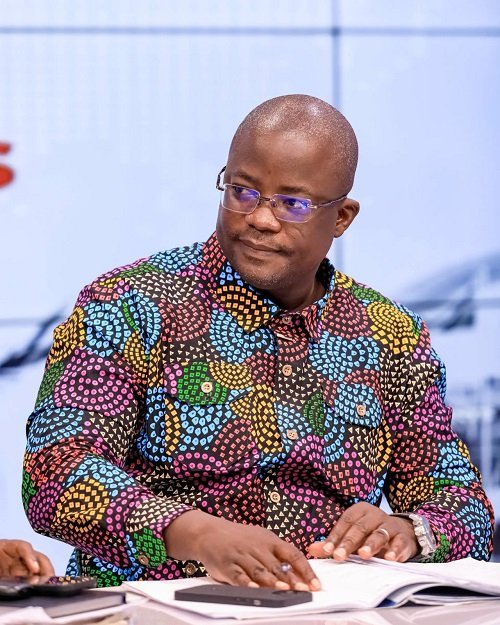
Policy analyst and senior lecturer at the University of Ghana, Dr Joshua Zaato, has questioned former Minister of Environment, Science, Technology and Innovation, Professor Kwabena Frimpong Boateng, over his description of the New Patriotic Party NPP as fake.
Dr Zaato raised concerns about when Professor Frimpong Boateng formed the view that the party was fake and why he has remained a member if he truly believes that.
Speaking during a political discussion a TV3 , Dr Zaato drew a clear line between Professor Frimpong Boateng as a respected cardiologist and scientist, and Professor Frimpong Boateng as a politician.
He praised the former health professional for his global reputation and role in establishing the National Cardiothoracic Centre, stressing that he had no standing to question him in that capacity.
However, he argued that as a politician, Professor Frimpong Boateng is open to public scrutiny like any other political actor.
Dr Zaato questioned whether the NPP was fake in 2016 and 2017 when Professor Frimpong Boateng served as a cabinet minister and benefited from being in government.
He also asked whether the party became fake after the 2020 elections when Professor Frimpong Boateng left government, and why he remained in the party from 2020 to 2024 if he believed it had lost its authenticity.
According to Dr Zaato, staying in a party one describes as fake raises concerns about principle and consistency.
He further challenged Professor Frimpong Boateng to clearly define what he meant by describing the party as fake or different, arguing that such words are loaded and require explanation.
Dr Zaato noted that political parties naturally evolve over time, adding that the NPP of 1992 is not the same as the NPP of 2025.
He traced the leadership of the party from Professor Albert Adu Boahen, through former President J A Kufuor, to President Nana Addo Dankwa Akufo Addo, pointing out that changes in leadership do not automatically make a party fake.
He argued that the current difference in the party is linked to Vice President Dr Mahamudu Bawumia’s leadership, noting that he is a Northerner, a Muslim, and not a traditional founding member of the party.
Dr Zaato questioned whether the party only became fake now that a different kind of leader is emerging, and challenged Professor Frimpong Boateng to state this clearly if that was his position.
He stressed that the NPP still exists as an organisation, with its constitution, offices, and symbol intact, and therefore asked what exactly Professor Frimpong Boateng considered not real.
Dr Zaato underscored that without clear definitions, claims that the party is fake remain unclear and open to interpretation.
By: Jacob Aggrey










A 30-year-old man has been sentenced to 25 years imprisonment with hard labour by the Bekwai Circuit Court for his role in a 2022 robbery at a mining site at Manso Akwasiso in the Ashanti South Region.
The convict, Dominic Ofori, also known as Fanta, was arrested on 16th February 2026 after years on the run. He pleaded guilty before the Bekwai Circuit Court to robbery contrary to Section 149 of the Criminal Offences Act, 1960 Act 29, and was accordingly sentenced to 25 years imprisonment with hard labour.
On March 20, 2022, the Manso Adubia District Police received intelligence that a group of armed men from Manso Abodom were planning to attack a mining site at Manso Akwasiso to rob the owner of gold concentrate. Acting on the information, police mounted a coordinated operation and laid an ambush at the site.
At about 5:30 pm the same day, four-armed men arrived at the site, fired indiscriminately, and robbed the miners of their gold concentrate. The police team on surveillance intervened, resulting in an exchange of gunfire.
Three of the suspects, Abu Abubakar, Musah Latif, and Gideon Takyi, sustained gunshot wounds and were pronounced dead on arrival at St Martins Catholic Hospital at Agroyesum. Dominic Ofori escaped at the time but was later arrested and put before the court.
The Ashanti South Regional Police Command has assured the public of its continued commitment to combating violent crimes and bringing offenders to justice.
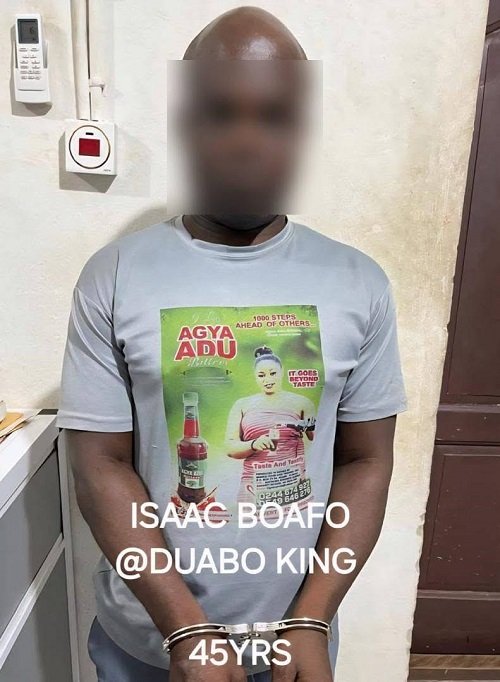
The Ashanti Regional Police Command has arrested 45-year-old Isaac Boafo, also known as “Duabo King,” for allegedly publishing false news intended to cause fear and panic.
Police said the arrest follows a viral TikTok video in which Boafo claimed that four officers at the Central Police Station in Kumasi engaged in inappropriate conduct with commercial sex workers during night patrols in Asafo.
Officers from the Police Intelligence Directorate (Ashanti Region) apprehended Boafo after receiving intelligence about the video.
During questioning, he admitted to creating the video to attract views and engagement online, and acknowledged that he could not prove the allegations.
Boafo also admitted making comments about the President of the Republic for content purposes and could not defend those statements.
He has been formally charged and is in detention as investigations continue.
The Ashanti Regional Police have warned the public against publishing or sharing false information on social media, noting that such acts can cause fear, panic, and damage reputations.
They said anyone found engaging in similar conduct will face legal action.
By: Jacob Aggrey