Features
Cry of the poor

The poor constitute the dregs of the society
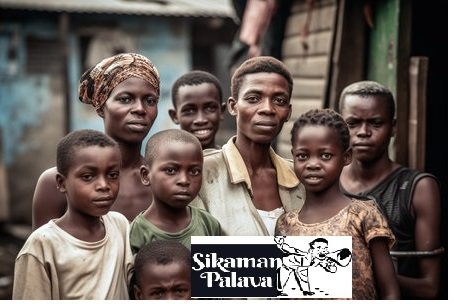
Everywhere, the poor constitute the dregs of the society. They are the have-nots and the down-trodden who always feel economically dizzy, politically sleepy, socially tired and are religiously confused. Their worth is never recognised in society and everyone forgets that without the poor, society can never be complete.
Some people believe that the poor will never go to heaven. So very unfortunate since the majority of Africans are congenitally poor.
My former classmate, Kwame Korkorti, for instance entertains the conviction that the eventual destination of the poor is hell. I have always protested the senselessness of this notion, but Korkorti advances arguments to back his point.
According to him, a poor man is a sinful person by virtue of his empty pocket. Because he has no money, he may think about making ends meet through stealing, which is against the Bible; he does not give alms to the poor, and because he is perpetually broke, he is always temperamental and will slap you if you rob him the wrong way.
According to Korkorti, St. Peter, who is at the gates of Heaven, does not admit such people. He cites an example that immediately a poor man approaches the gates of Heaven, he would be turned away because he would be smelling heavily of akpeteshie, to which Peter will refer him: “Thou shall not drink local gin, especially bitters…”
In contrast, says Korkorti, a rich man does not pilfer, he gives alms, is cheerful and will always forgive a fault. And when he gets to the gates of Heaven, he will not smell of mahogany-bitters or raw akpeteshie. He will scent of either Mathews Wine, Jackson’s Special Cocktail, Irish Cream or at least Guinness. Peter will be too willing to get him registered on the list of qualified entrants.
It is quite unfortunate for Korkorti to perceive the poor vis-a-vis the rich, in such a disparaging manner, but I do not blame him since the very nature of society makes him think that way. Who haven’t always thought that a poor person is a wicked person? And most people regard the rich as next to God just because they can cause food and drink to flow by just issuing a simple command.
In any situation, the have-nots are always in a disadvantaged position. When a boy whose father is a poor farmer completes sixth form and applies for an overseas scholarship advertised in the papers, his chances of clinching the award is virtually nil when a boy who has a rich father also applies. Even the manner of interviewing the two candidates can be highly disparate, not forgetting the circumstances under which each of them attends the interview.
Indeed, on the morn of the interview, the poor lad arrives at the appointed time after having taken Koko and Koose. The previous night, he had taken Kokonte and light-soup. Now, he feels quite drowsy, albeit confident. The rich man’s son had oats and milk against bread and cheese. He washes these down with Vitamin C laden orange-juice and appears at the interview bright and exuberant.
His father, who is in the same golf club as two of the panel members, has also done his homework satisfactorily. The questions that would be thrown at his ward will not be too difficult. Even if they are difficult, the boy must not be seen to be failing.
Eventually, the scholarship award is presented on a silver platter. The poor farmer’s son goes back home disenchanted. He had not been born with a silver spoon in his mouth. Moreover, he does not look like a scholarship holder, because he appears anaemic.
Dear reader, imagine that at a big social function in the capital of Sikaman the Master of Ceremonies describes the chairman for the occasion as follows: “Ladies and gentlemen, lend me your ears. This is Mark Antony speaking… The chairman for this ocсаsion is a man we all know. Presently, he is unemployed, sorry redeployed…
“Our honourable chairman is a product of Kordiabe Junction Secondary Boarding where he obtained a school certificate in 1969, lest I forget, with distinction. However, he could not proceed to sixth form because his poor father, a cocoyam farmer could not afford to buy his school uniform any longer. As for his school fees don’t talk about it. It is a taboo!”
At this stage, invited guests will start wondering whether the MC had not forgotten the life-history of the honourable chairman, or is he mistaking him for another person? The MC must, however, complete his job.
“Ladies and gentlemen, distinguished guests, since our honourable chairman could not afford the school fees, he decided to get employed. He worked with a private company as a junior clerk where he marked time for ten years before he was promoted to the post of a clerk. As a clerk, he marked time again till the company went bankrupt. That was when he was forcibly redeployed against his wish.
“Currently, he is unemployed and finds difficulty in procuring one square meal a day. Ladies and gentlemen, permit me to introduce to you, the chairman for this wonderful occasion, Mr Kofi Owuo alias Death By Poverty.”
If Kofi Owuo was indeed present and stood up in a faded Jumper and khaki shorts with a pair of worn out charlie woté (one red and one green), and a lousy moustache, and smiles rather broadly, what would you as an invited guest do? Will you applaud, or would you start glancing at the programme to see how soon the vote of thanks will be delivered so that Kofi Owuo could be left to his woes and poverty?
The chairman of any big function today is chosen by special criteria. He must have a car which is in good condition, especially with a good starter, with which he’d drive to the function. He must be able to afford a decent suit, preferably a three-piece; or a bright traditional wear of Kente or Adinkra.
He must be able to smile like a rich man, talk like a rich man, laugh like a rich man, and sneeze like a rich man. He must have had academic exposure in renowned universities in countries abroad including Australia, Canada, war-torn Liberia, crisis-filled Kuwait, US and Surinam. Such is society. He must be the chairman of the Board of Directors of one company or another.
Even in his family, the poor man is not respected, be a father, a grandfather or an uncle. During an extended family meeting his opinions are not sought. If he tries to make even a sensible point, his age-mate who is relatively rich will remark: “My friend if you’ve drunk akpeteshle, go and sleep. We want people of sound mind who can talk sense. Look at how your eyes are red. Too much akpetsshie!” The appropriate thing the cousin should have said is, “We want people who have money to offer their views.”
Of course who doesn’t respect and tolerate a rich person and scorns a poor man. Even rich ugly men are considered very handsome. You dare not think he is ugly, because society’s eye does not perceive the world in such simple terms.
But the poor are also human. They may be luck-less, born into poverty and hopeless in life. However, they serve society in numerous ways. They clean our gutters, sweep our offices, cart foodstuffs, tend our gardens and watch our homes.
It is for this reason that Teddy Alor of Tema, Site 21, says that if everyone were to be rich, there would be no society. Social stratification is indispensable to the continued perpetuation of every society since every member of a society plays a distinctive role and performs functions.
We may not carry our poor folks shoulder high. But let us give them the due respect and help them out of their miseries.
This article was first published on Saturday, August 18, 1990




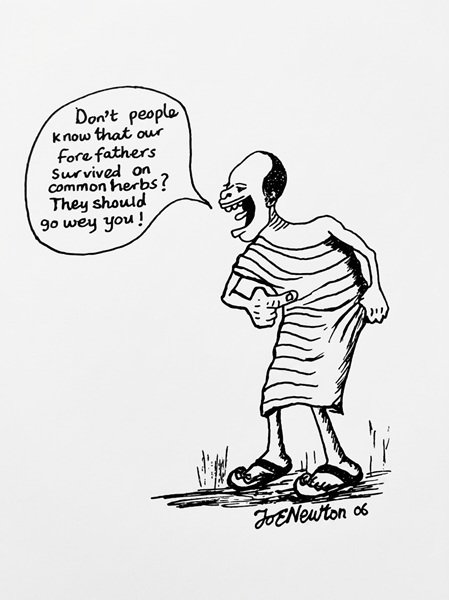
THE typical itinerant salesman in Sikaman is a herbalist. He is normally a slim macho with the capacity to perambulate the expanse of area covering the triangle of Accra-Tema-Ashiaman. In short, he can walk a total of 60 miles a day, marketing a product that cures every disease, including poverty. 
The door-to-door herbal pharmacist advertises his product by word of mouth. He has nothing to do with the Food and Drugs Board (FDB). After all, his concoctions do not feature on FM stations.
Those herbalists who cannot walk to propagate the herbal gospel, liaise with drivers of mass transportation and their mates. They are, therefore, given the chance to sell their products on Benz buses that ply the routes.
Normally, the herbalist starts his sales message with a prayer and Bible study. He asks the passengers to bow down their heads in supplication to God the father, the son, the Holy Spirit.
When a herbalist asks the passengers to close their eyes and bow their heads, Moslems on board naturally feel offended. They feel that the herbalist has no right to assume that every passenger is a Christian. They think such an assumption is an affront to Islam.
So a Moslem on board will raise the hand for a point of order. He’ll remind the herbalist that it would be in his own interest to mind his language.
“Be careful the way you address people in a public place. Not every person here is a Christian,” he’d state assertively.
Of course, the herbalist will promptly ignore him, but would all the same “watch” his tongue. Who knows whether or not the Moslem brother is inspired by Quoranic zeal to defend the tenets of Islam to the hilt?
When he starts saying, “Wallahi!” and “Inshallah!” it could be the beginning of proclaiming Islam as supreme, a point which must be driven home with talibanic precision.
So the herbalist must tread carefully lest he steps on fire.
The herbalist could even add a measure of mirth to it all, by announcing that Christians on board today have very interesting company on the journey, but that should not detract from the business of the day.
The Moslem brother will weigh the words carefully and offer a wry smile.
He must be careful the occasion does not degenerate into the use of semantics and proverbial oration to deride his conviction that public utterances must be mindful of religious sensibilities. He has made his point very clear and expects that it is taken in good faith in the interest of a peaceful journey.
The herbalist will now open the New Testament and preach salvation, stating clearly that salvation can come only through Jesus Christ and NOBODY else.
The Moslem brother will now start twitching his moustache. The visible and almost revolutionary reflexes of his upper lip can be an indication that sentiments have begun superseding reason, and the outcome could well be tragic now shift uneasily in his seat.
The time has come for him to also express his right to the religion of his fore-bears. He’ll put his hand into his pocket and rise to his feet. The time has indeed come!
This article was first published on Saturday, September 9, 2006
When the cause of a particular problem like sickness, disease, sudden illness, a social issue etc. are not known, it stands to reason that resolving it becomes a huge challenge.
Citizens would understand the government when public announcements are made to the effect that government is trying to find a solution to the issue, even though it is taking a while for it to be resolved because citizens are rational beings.
On the other hand, if the solution to a particular issue is known to everybody but the government for whatever reason, is dragging its feet in resolving it, citizens become frustrated and begin to lose trust in their leaders.
One such issue is the heavy traffic along a section of the Kasoa – Odokor road. A short stretch of bad road between the traffic light at the Weija Government Hospital and the entrance to the entrance of the overhead that leads to the N1, is the cause of the problem but nothing is being done about it, day after day, week after week, month after month. Thus is clearly unacceptable.
Another issue that requires urgent attention is the lack of pavements along a lot of streets in parts of the various Municipal Assemblies. Exercise is a prerequisite for long life and healthy living and for those of us who it has become a way of life, this issue of people putting up structures right to the edge of the drains beside the roads, are making life difficult for us.
We are compelled to walk along the roads, putting our lives at serious risk. Pedestrians should never be compelled to compete with vehicles on our streets and roads. Roads and streets are made for vehicles and pavements are made for pedestrians. That is the norm. Any attempt to normalise a situation where pedestrians are mingling with vehicles is insanity.
It is the road regulations that makes it so and therefore district or municipal assemblies are to take responsibility and ensure that spaces for pavements are not encroached upon. Citizens have rights that must be protected by their leaders and making pavements available to pedestrians, is one of them.
When we hear of teachers having sex with students, it appears it is something recent. It is not a new phenomenon. It has been there since Adam. Perhaps this issue is getting much attention due to the proliferation of social media. It was an open secret in times past when Teachers were in relationships with female students and some married them immediately after completion of school.
Some teachers were also known to be having unholy interactions with female pupils but due to the times that these acts occurred, human rights issues and the awareness around it, allowed such unscrupulous teachers to get away with their crimes.
Now we are in a different era and so a Headmaster is now in hot waters. He is alleged to have raped about 19 female students and as usual, some officials tried to cover it up and are also in hot waters and their actions or inactions in the matter are under investigation.
Why the man has been allowed to roam freely without being arrested is simply mind boggling. It appears that the law applies differently, depending on who you are. This issue came to public attention sometime in August this year, yet the police had not arrested or invited this man for question regarding the rape allegation.
It has come out that he is a Constituency Secretary of the ruling party and the question in the public domain is that, is it because he is a political figure that is why he is still walking around without questioning? I believe in the rule of law so let us hold our breadth and let the proper thing be done.
The police must however be seen to be active in this matter. God bless.
SKIP THE QUEUE, TAP THE NEWS
You can now read the Ghanaian Times and The Spectator newspapers from the comfort of your device via TimesNewsPlus.
Join our WhatsApp Channel: https://whatsapp.com/channel/0029VbBElzjInlqHhl1aTU27