News
Be our best all time to make it a habit


Perhaps most of us give way at times to actions, attitudes and utterances which we well know are below our best. But whenever we depart from being at our best, we must remember that there are at least two things for which we are constantly accountable: One is the effect our attitudes and actions have on us, and the other is the effect our attitudes and actions have on others.
Especially should we be mindful of the effect of our actions and utterances on young and impressionable people. By the time we have become adults, we ourselves may have acquired a solid set of standards from which we may feel that there is not much danger of departing very far, and to which even if we do depart, it may seem rather easy to return—and we may think that occasional small lapses and laxities won’t matter too much.
But while these occasions or periods of letting down may for us be only passing departures, the impressions we implant in others may be permanent. Many a man who has said and done things that didn’t seem to him to change his own well-settled standards and basic beliefs has found that the example of his words and his ways has changed his children and may have led them to permanent departures.
Of course, we may presume privileges which we suppose belong to our years: We may presume that it is all right for us who are older to say and to do things that those who are younger, shouldn’t say and do. But even supposing that we ourselves could, on occasion, stray somewhat (but not too far, we think) from our standards and principles, or from our most acceptable selves, without seeming to hurt ourselves very much, even if it didn’t hurt us (which is doubtful), still we must be mindful of the effects of what we do and say on others, because other people are influenced as much by us when we are at our worst as they are when we are at our best.For this reason, if for no other, it is important to be at our best.
“Rip Van Winkle, in Jefferson’s Play, excuses himself for every fresh dereliction by saying, ‘I won’t count this time!’ Well, he may not count it; and a kind heaven may not count it, but it is being counted nonetheless. Down among his nerve cells and fibres, the molecules are counting it, registering and scoring it up to be used against him when the next temptation comes. Nothing we ever do is in strict scientific literalness wiped out.” These are the words of the celebrated psychologist and philosopher, William James. And he adds: “Could the young but realise how soon they will become … walking bundles of habits, they would give more heed to their conduct …. We are spinning our own fates, good or evil . Every smallest stroke of virtue or of vice leaves its never so little sear … We are … imitators and copiers of our past selves.” (William James, The Law of Habits)
But our habits, good or bad, weren’t always habits. What we now do habitually we once did first, and then again and then again. And since we become “slaves to our own past performance,” we had better be particular about the first performance, because almost anything done once could become a habit, and obviously the reason we have bad habits is because we did the first time what shouldn’t have been done at all. This may seem to offer little comfort to those who already have habits they want to be rid of.
Fortunately, however, bad habits aren’t hopeless. But it takes more effort to get out of a rut than it does to get in and sometimes the only way to get out is to get out all at once. And sometimes the best way to leave bad habits behind is simply to leave them behind without lingering or looking back. The break has to come sometime. Sometime has to be the last time. And it isn’t likely to be any easier later, because habits, like ruts, dig more deeply with time even though at first we may think of them as trifles as something we can start or stop or take or leave whenever we want to.
An ancient philosopher had something to say on this subject. He once rebuked a person for engaging in a gambling game. And when the person protested that lie had only played for a “trifle,” Plato replied: “The habit is not a trifle.” No potentially potent thing is a “trifle.” And the best time to break a bad habit is before the first time. The next best time is NOW: before the next time.
By Samuel Enos Eghan



A 30-year-old man has been sentenced to 25 years imprisonment with hard labour by the Bekwai Circuit Court for his role in a 2022 robbery at a mining site at Manso Akwasiso in the Ashanti South Region.
The convict, Dominic Ofori, also known as Fanta, was arrested on 16th February 2026 after years on the run. He pleaded guilty before the Bekwai Circuit Court to robbery contrary to Section 149 of the Criminal Offences Act, 1960 Act 29, and was accordingly sentenced to 25 years imprisonment with hard labour.
On March 20, 2022, the Manso Adubia District Police received intelligence that a group of armed men from Manso Abodom were planning to attack a mining site at Manso Akwasiso to rob the owner of gold concentrate. Acting on the information, police mounted a coordinated operation and laid an ambush at the site.
At about 5:30 pm the same day, four-armed men arrived at the site, fired indiscriminately, and robbed the miners of their gold concentrate. The police team on surveillance intervened, resulting in an exchange of gunfire.
Three of the suspects, Abu Abubakar, Musah Latif, and Gideon Takyi, sustained gunshot wounds and were pronounced dead on arrival at St Martins Catholic Hospital at Agroyesum. Dominic Ofori escaped at the time but was later arrested and put before the court.
The Ashanti South Regional Police Command has assured the public of its continued commitment to combating violent crimes and bringing offenders to justice.
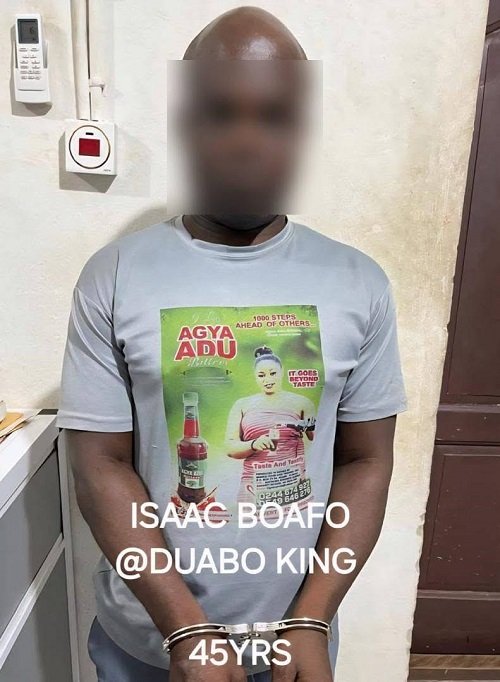
The Ashanti Regional Police Command has arrested 45-year-old Isaac Boafo, also known as “Duabo King,” for allegedly publishing false news intended to cause fear and panic.
Police said the arrest follows a viral TikTok video in which Boafo claimed that four officers at the Central Police Station in Kumasi engaged in inappropriate conduct with commercial sex workers during night patrols in Asafo.
Officers from the Police Intelligence Directorate (Ashanti Region) apprehended Boafo after receiving intelligence about the video.
During questioning, he admitted to creating the video to attract views and engagement online, and acknowledged that he could not prove the allegations.
Boafo also admitted making comments about the President of the Republic for content purposes and could not defend those statements.
He has been formally charged and is in detention as investigations continue.
The Ashanti Regional Police have warned the public against publishing or sharing false information on social media, noting that such acts can cause fear, panic, and damage reputations.
They said anyone found engaging in similar conduct will face legal action.
By: Jacob Aggrey