Entertainment
Christmas movie production reaches new record


- /home/u249204778/domains/spectator.com.gh/public_html/wp-content/plugins/mvp-social-buttons/mvp-social-buttons.php on line 27
https://spectator.com.gh/wp-content/uploads/2021/12/122005355_dsc04671_3.jpg&description=Christmas movie production reaches new record', 'pinterestShare', 'width=750,height=350'); return false;" title="Pin This Post">
- Share
- Tweet /home/u249204778/domains/spectator.com.gh/public_html/wp-content/plugins/mvp-social-buttons/mvp-social-buttons.php on line 72
https://spectator.com.gh/wp-content/uploads/2021/12/122005355_dsc04671_3.jpg&description=Christmas movie production reaches new record', 'pinterestShare', 'width=750,height=350'); return false;" title="Pin This Post">
Settling down in front of feel-good festive movies has become a modern Christmas tradition – and has driven the production of seasonal films to record-breaking levels this year.
More than 200 new feature films and TV movies with the word Christmas in the title are listed on the Internet Movie Database (IMDB) for release in 2021.
That number has doubled since 2016 and is four times more than in 2011.
Channels and streamers have discovered festive films are big ratings winners.
Christmas movies have been popular for decades, and classics like Home Alone, Love Actually and It’s A Wonderful Life will be widely watched again in the coming weeks.
But the boom in a new breed of festive films can be traced back to the Hallmark US cable channel’s decision to launch a special season of TV movies in 2009.
Its first Countdown To Christmas featured four original productions and delivered record audiences.
This year, its countdown started even earlier, on 22 October, and includes a record 42 original holiday films.
Boyfriends Of Christmas Past is one of Hallmark’s 42 original festive films this year
“They bet really big on Christmas and everyone else seemed to notice the ratings,” says Brandon Gray, co-host of the Deck the Hallmark podcast and one of the authors of a new book called I’ll Be Home for Christmas Movies.
Rival channel Lifetime was among those to take notice and has made 35 of its own Christmas crowd-pleasers this year, also its highest number yet.
Streaming platforms are tapping into the seasonal demand too, with Netflix offering a dozen original films starring big names like John Cleese, Kelsey Grammar and Brooke Shields.
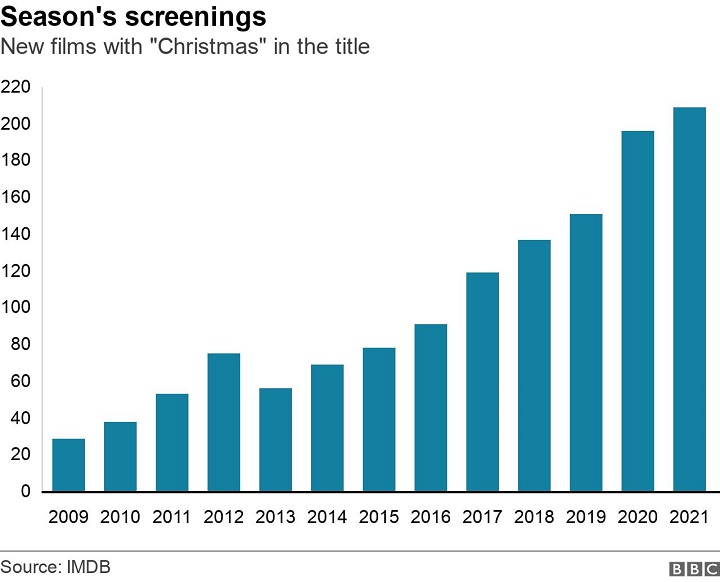
The IMDB numbers only include movies with “Christmas” in the title, meaning the true number of festive films is even higher.
This season’s big cinema releases include Silent Night, starring Keira Knightley, and Aml Ameen’s Boxing Day, which also stars Little Mix’s Leigh-Anne Pinnock.
When it comes to made-for-TV movies, many are relatively low-budget and use a feel-good formula to tell stories of romance and family – and are cosy and comforting enough to cancel out being corny and cheesy.
“It’s this magical season when the storyline that’s on the screen doesn’t matter as long as there’s a bunch of Christmas trees in the background and it’s snowing,” says Gray.
“For viewers, it’s just a way to escape and to feel for at least two hours this little bit of peace in the midst of the craziness of the holiday season and the craziness of the world in which we have lived in the last couple years.”
Successful formula
Hallmark built its festive empire on films that look and feel the same, Gray says.
“They have the same aesthetic because they figured out what works: ‘If we keep everything basically uniform – not too funny, not too sad – people will go from one movie to the next.’
“So you have the two people that fall in love and there’s some sort of misunderstanding with about 30 minutes to go and then they’ll figure it out, and they’ll kiss.
“And you do it over and over again, and as long as it looks uniform and feels uniform, people will watch one after the other.”
This year is the best crop of films so far, Gray says – partly because channels like Hallmark are beginning to experiment with that formula.
“Especially this year, I feel the change, where they’re putting more emphasis on different types of stories,” he says. “They’re working hard with inclusion and making sure that the stories that are being told match what you’re seeing on the screen.
“So it’s no longer them just putting a person of colour on screen in a white world, but they’re actually telling stories that feel authentic to who you’re watching on screen.”
In the UK, some of those TV movies have been playing on the Great! Movies Christmas channel since 23 September, and on Channel 5 in the daytimes since early November.
Source: graphic.com.gh



Ghanaian rapper Medikal has advised musicians to focus on building financial security rather than relying mainly on awards, shows and public recognition.
According to him, the difficult situations some senior musicians face after years in the industry should serve as a lesson to younger artistes.
Medikal made the comments on TikTok while sharing his thoughts on an interview involving veteran Ghanaian musician DJ Barosky, whom he claimed is currently homeless in the United Kingdom.
He expressed surprise at the situation, noting that he grew up listening to and admiring some of the senior musicians who influenced his generation.
“Bro, right now, social media, I know if you tell which one be real or what be fake,” Medikal stated, questioning the reality of what people see online.
He argued that musicians should make money and put proper financial plans in place while they are active in the industry.
“If you be artist for this country, you for make money, collect money, put certain things in place,” he said.
Medikal stressed that awards and performances were important but should not replace financial planning.
He encouraged artistes to be careful with their relationships and to understand that the entertainment industry is largely driven by money.
According to him, even friendships can change when a person’s financial circumstances change.
He therefore urged musicians not to become discouraged by financial losses but to remain focused on creating wealth.
“Make money. If you lose money, still collect money,” he advised.
Medikal said the experiences of older artistes should encourage current musicians to take their finances seriously and prepare for life beyond their peak years in the entertainment industry.
By: Jacob Aggrey
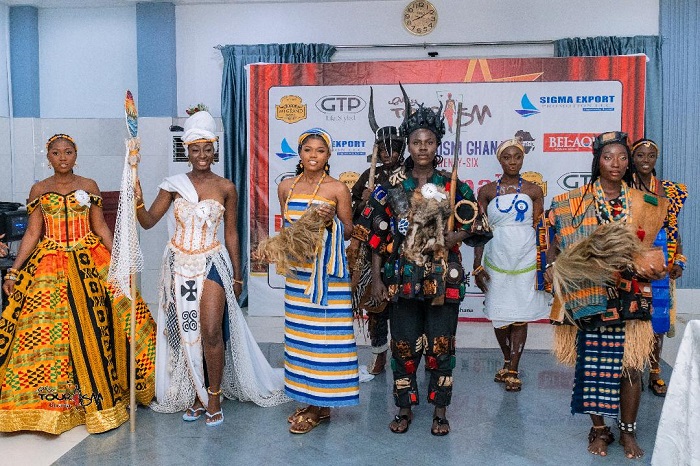
It was a night of colour, culture and creativity as Miss Tourism Ghana successfully held its Regional Costume & Talent Night in Accra.
The event drew fashion lovers, culture enthusiasts, and proud supporters who came out to witness Ghana’s beauty queens represent their regions on one grand stage.
From the moment guests stepped in, the atmosphere was electric, ushering,
Okra, Zabe, Gina, Akpe, Sela, Afia,Asher and Ajua into the auditorium to mesmerize patrons.
The blistering night, commenced with a breathtaking regional costumes rocked by contestants that told stories of Ghana’s traditions from, african print, kente, smock, batakari, beads and other indigenous fabrics.
Each outfit with beautiful local accessories to match was paired with confidence, poise, and pride.
The night then shifted gears into the talent segment. The audience was treated to powerful performances traditional dance, spoken word, fashion, singing, and drama all centered on promoting Ghana’s tourism and heritage.
The judges were stunned with the various displays and passed favorable commentaries encouraging the contestants to keep giving their all.
Patrons left with unforgettable moments, and the contestants delivered to their expectations.
Organisers of Miss Tourism Ghana congratulated all the amazing participants who took part and urged them to forged ahead strongly before the grand final.
They also, encouraged families and friends to keep their favourite in the competition through their campaigns and votes.
The search for Ghana’s next tourism ambassador is officially on, and the competition is getting tighter with each stage.
Beyond the glamour, Miss Tourism Ghana continues to use the platform to market Ghana’s tourist sites, culture and hospitality to the world.
The Regional Costume & Talent Night served as both entertainment and education, reminding Ghanaians of the beauty in our diversity.
By Edem Mensah-Tsotorme