News
Drivers can record police during traffic stops under new road traffic rules – CUTS International

- /home/u249204778/domains/spectator.com.gh/public_html/wp-content/plugins/mvp-social-buttons/mvp-social-buttons.php on line 27
https://spectator.com.gh/wp-content/uploads/2026/08/WhatsApp-Image-2026-08-17-at-14.26.49.jpeg&description=Drivers can record police during traffic stops under new road traffic rules – CUTS International', 'pinterestShare', 'width=750,height=350'); return false;" title="Pin This Post">
- Share
- Tweet /home/u249204778/domains/spectator.com.gh/public_html/wp-content/plugins/mvp-social-buttons/mvp-social-buttons.php on line 72
https://spectator.com.gh/wp-content/uploads/2026/08/WhatsApp-Image-2026-08-17-at-14.26.49.jpeg&description=Drivers can record police during traffic stops under new road traffic rules – CUTS International', 'pinterestShare', 'width=750,height=350'); return false;" title="Pin This Post">
Drivers can use their mobile phones to record their interactions with police officers during traffic stops, and such recordings may be admitted as evidence in court under the new road traffic rules.
Director of the West Africa Regional Centre of CUTS International, Appiah Kusi Adomako, explained that the measure would help protect both motorists and police officers by providing a record of what happens during traffic stops.
He was speaking to Sam Lardy Anyenini on Joy News about the new road traffic rules.
Mr Adomako noted that some drivers who are stopped for offences such as overspeeding or jumping red lights often negotiate with police officers at the roadside, making it difficult for the state to properly document the offences.
He explained that the new system would help authorities collect data on traffic offences and identify drivers who repeatedly break the law.
According to him, a driver who repeatedly commits the same offence could eventually reach the threshold for sanctions, including the revocation or suspension of their driving licence and possible mandatory training.
He said the system would also help the police make better use of their resources.
Mr Adomako explained that under the automated system, police officers would not always have to take motorists to the police station after a traffic offence.
He noted that when an officer leaves a particular location to escort a driver to the police station, there could be no officer available to manage traffic at that location.
The use of technology, he added, would help reduce the need for such physical processes while providing authorities with evidence of traffic violations.
He further pointed out that the rules allow motorists to record their interactions with police officers during traffic stops using their phones.
“If a police officer stops you and you are recording the interaction with your phone, that can be admitted in court as evidence,” he explained.
Mr Adomako urged motorists to remain calm and inform officers that they are within their rights to record the interaction if an officer objects.
He noted that in some countries, police officers use body cameras to record such interactions and expressed hope that Ghana could adopt similar measures in the future.
He commended the Ghana Police Service for what he described as progress under the new Inspector General of Police, while stressing that more work remained to be done.
By: Jacob Aggrey








Majority Leader of Parliament, James Agalga, has expressed gratitude to Ghanaians for the confidence reposed in him following his elevation to the position.
Mr Agalga thanked Ghanaians who had sent him congratulatory messages and expressed appreciation to President John Dramani Mahama, the leadership of the National Democratic Congress (NDC), members of the Majority Caucus and the people of Builsa North.
In a statement posted on his socials, he also extended his gratitude to Ghanaians across the country for their support and confidence.
He pledged to work with other stakeholders to advance the government’s Reset Agenda and support the passage of legislation that would improve the lives of Ghanaians.
“We remain committed to working together to drive the government’s RESET Agenda and to champion legislation that delivers real benefits to every Ghanaian,” he said.
Mr Agalga called for continued cooperation as he begins his new role as Majority Leader.
By: Jacob Aggrey
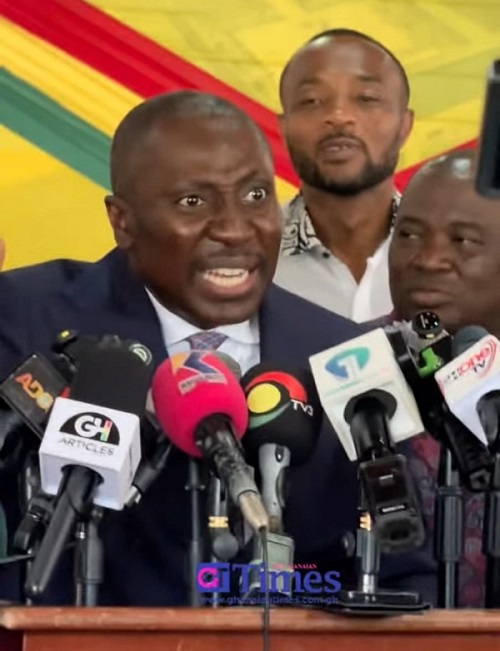
Minority Leader in Parliament, Alexander Afenyo-Markin, has maintained that the Minority’s concerns over the reported GH¢22 billion loss linked to the Ghana Gold Board (GoldBod) are not politically motivated.
He made the remarks at a press conference in Parliament on Tuesday, August 18, 2026, where he defended the Minority’s position on the financial implications of GoldBod’s domestic gold purchasing operations.
Mr Afenyo-Markin stated that the Minority was raising the concerns because Ghanaians deserved clear information about how public funds were used in the gold purchasing programme.
He explained that the figures being cited by the Minority were contained in the International Monetary Fund’s (IMF) report on Ghana and were therefore not figures manufactured by the opposition.
According to him, the IMF identified losses of about US$1.7 billion, equivalent to approximately GH¢22 billion, from the domestic gold purchasing programme in 2025.
He said the IMF attributed the losses to service and assay fees, discounts on gold sold to off-takers and exchange-rate differences between the rates used to purchase gold and the reference rate used by the Bank of Ghana for accounting purposes.
Mr Afenyo-Markin argued that the losses should be subjected to public scrutiny because GoldBod played a central role in buying, aggregating, assaying and exporting the gold, while the Bank of Ghana provided the financing.
He questioned why GoldBod should receive fees from the transactions while the associated losses were reflected on the books of the Bank of Ghana.
The Minority Leader stressed that the location of a loss in an institution’s accounts did not change its economic impact on the country.
He therefore called for answers on the prices paid for gold, how the prices were determined, the selection of off-takers, discounts applied to gold sales and the fees earned by GoldBod.
Mr Afenyo-Markin questioned the risk-sharing arrangement between GoldBod and the Bank of Ghana, arguing that the institution carrying out the commercial activity should not be able to benefit from transaction fees while another institution bears most of the financial risk.
He said the Minority was not seeking to trade insults with GoldBod officials but was focused on holding institutions accountable for the management of public resources.
He urged the government and GoldBod to address the concerns raised by the IMF and provide Ghanaians with clear explanations about the reported losses.
Mr Afenyo-Markin maintained that the Minority would continue to scrutinise the programme because the financial consequences ultimately affected Ghanaian taxpayers.
By: Jacob Aggrey